
Unbiased headlines. Facts, not spin.
Every story is an unbiased news briefing written from 110+ sources across the spectrum — sources linked so you can verify it yourself.
 economy
Notable (6/10)
July 10, 2026 at 12:04 AM
economy
Notable (6/10)
July 10, 2026 at 12:04 AM
NOAA Puts 81% Odds on a 'Very Strong' El Niño Through Early 2027, Goldman Sachs Warns Crop Markets Are Highly Vulnerable
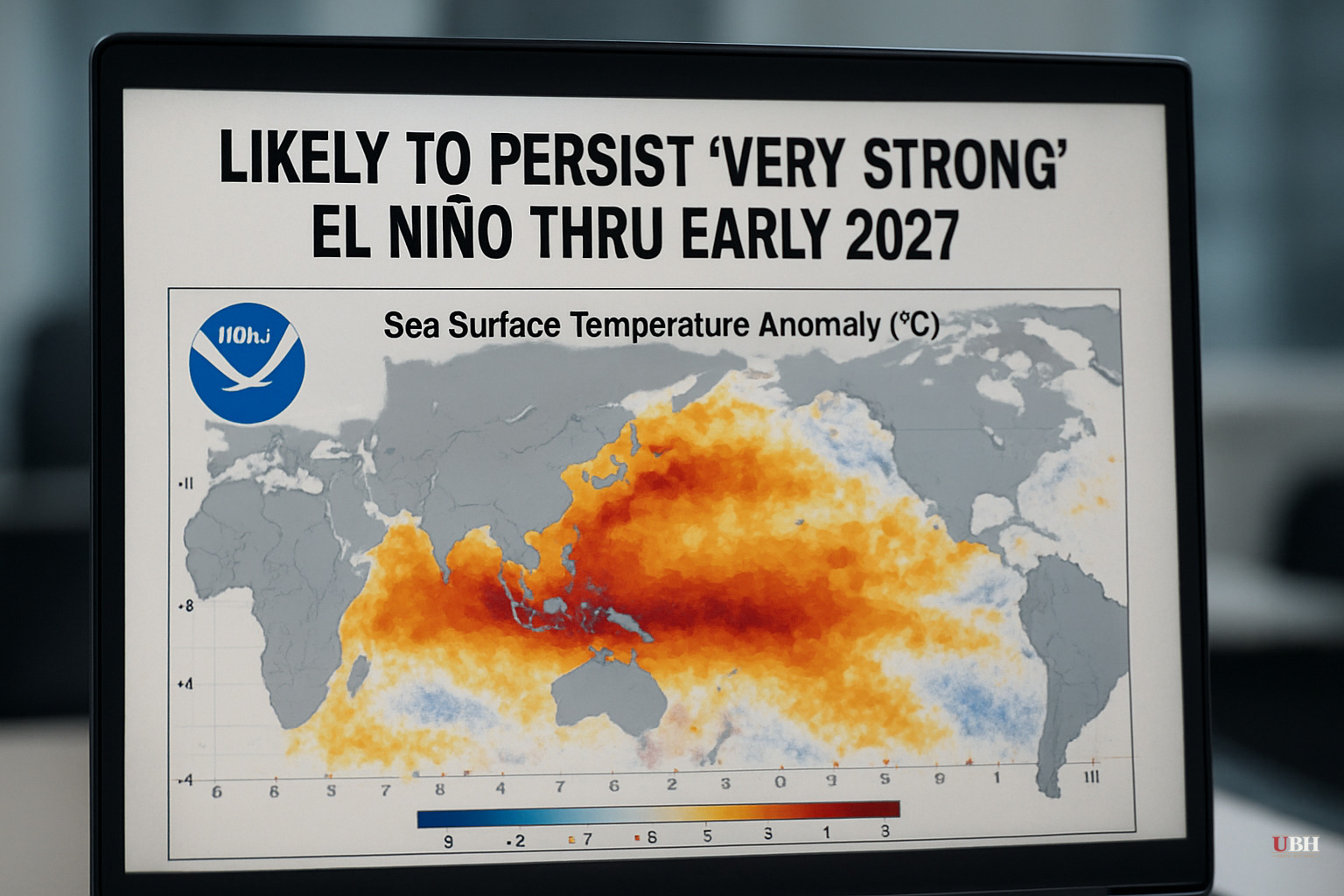
A weather system with the potential to reshape global food markets for the next nine months has drawn warnings from both U.S. government climate forecasters and Wall Street commodities analysts.
What NOAA Is Saying
The U.S. Climate Prediction Center, a unit of NOAA's National Weather Service and the body that issues official U.S. government climate outlooks, has placed an 81% probability on the current El Niño becoming "very strong" and ranking among the largest events recorded since 1950, according to its most recent report.
Sea-surface temperatures in the central and eastern equatorial Pacific are already running at least 1°C above normal. Some patches of the Pacific measured 2.7°C above normal last week, according to the CPC. The Southern Oscillation Index, a pressure-pattern measure tied to El Niño intensity, is now at levels not seen since 2005.
The CPC's own language: El Niño "will strengthen through the end of the year, with a 97% chance it will last through early spring 2027."
The agency was careful to note that strong events don't produce identical effects everywhere. "Even the strongest El Niño events do not lead to typical impacts everywhere, but stronger events can more significantly tilt the odds in favor of expected outcomes," the CPC wrote. The probabilities shift, not the certainty.
The Agricultural Chokepoint Problem
Goldman Sachs commodities research analyst Lina Thomas quantified the exposure. Her warning is geographic, not just meteorological.
Across key crops — soybeans, corn, rice, sugar, and palm oil — the top three exporting countries account for 60% to 90% of global trade. That level of concentration means a single bad growing season in a handful of countries can move global supply. Thomas described agricultural markets as "highly vulnerable to localized weather, geopolitical, or policy shocks."
El Niño typically brings more adverse weather to regions that are major exporters of staples such as rice, and crops used for biofuels such as sugar and palm oil. Thomas also flagged that because major agricultural exporters increasingly prioritize domestic food and energy security through export restrictions and biofuel mandates, even modest disruptions — or the fear of disruptions — can trigger policies that reduce exportable supply. In highly concentrated markets, the resulting loss of exportable supply can be much larger than the original production shock, amplifying price volatility.
Why This Compounds Existing Stress
Food supply chains were already under pressure before this forecast. Export restrictions, rising protectionism, and intermittent drought and flooding have been recurring features of agricultural markets. A very strong El Niño layered on top of those pre-existing vulnerabilities is a different risk profile than a moderate event arriving in a stable trade environment.
Thomas identified three near-term supply concerns that could trigger precautionary measures even if underlying disruptions prove limited: El Niño conditions already present, with a 63% probability of developing into a "super" El Niño; higher energy prices in 2026H1 potentially encouraging governments to increase biofuel mandates, diverting crops from export markets; and fertilizer markets remaining exposed to renewed disruptions in the Strait of Hormuz during the critical Q3 procurement season ahead of second-half planting.
The strongest counterargument is worth stating plainly. Meteorological forecasts at 9-12 month horizons carry significant uncertainty. The CPC itself acknowledges that regional impacts vary even during the largest events. Farmers, commodity traders, and governments have adapted to El Niño cycles repeatedly over decades. Modern agricultural logistics, buffer stocks, and futures markets exist precisely to absorb supply shocks. A 97% probability of persistence is not the same as a 97% probability of crop failure anywhere specific.
Dismissing the concentration data is harder. When three countries control up to 90% of a given crop's global exports, the math on systemic risk doesn't require a catastrophic outcome. Thomas warned explicitly that import-dependent countries may respond to disruptions by stockpiling and pursuing greater self-sufficiency, fragmenting trade, reducing market liquidity, and increasing price sensitivity to future shocks.
What to Watch
The CPC issues monthly updates. The next round of sea-surface temperature readings will either confirm the strengthening trajectory or moderate the forecast. Goldman Sachs's Thomas specifically flagged geopolitical and policy shocks as compounding risks alongside weather — meaning export bans, tariff escalations, or currency moves in major agricultural exporters could amplify whatever the climate delivers.
The unresolved question is whether a 75-year peak event actually materializes or whether the CPC's probability range leaves enough room for a moderate outcome. That answer won't be clear until Southern Hemisphere growing seasons begin and Pacific temperatures either continue climbing or plateau.
Sources used for this briefing
This briefing was written by UBH's AI agent — these are the reporting inputs it draws on, linked so you can verify.


