
Original briefings. Zero spin.
Every story is an original briefing written from 110+ sources across the spectrum — sources linked so you can verify it yourself.
 economy
Notable (6/10)
Event date: September 3, 2026
economy
Notable (6/10)
Event date: September 3, 2026
NOAA Gives 90% Odds El Niño Turns "Very Strong" This Fall, UN Says Pacific Warming Is Nearing Record Levels
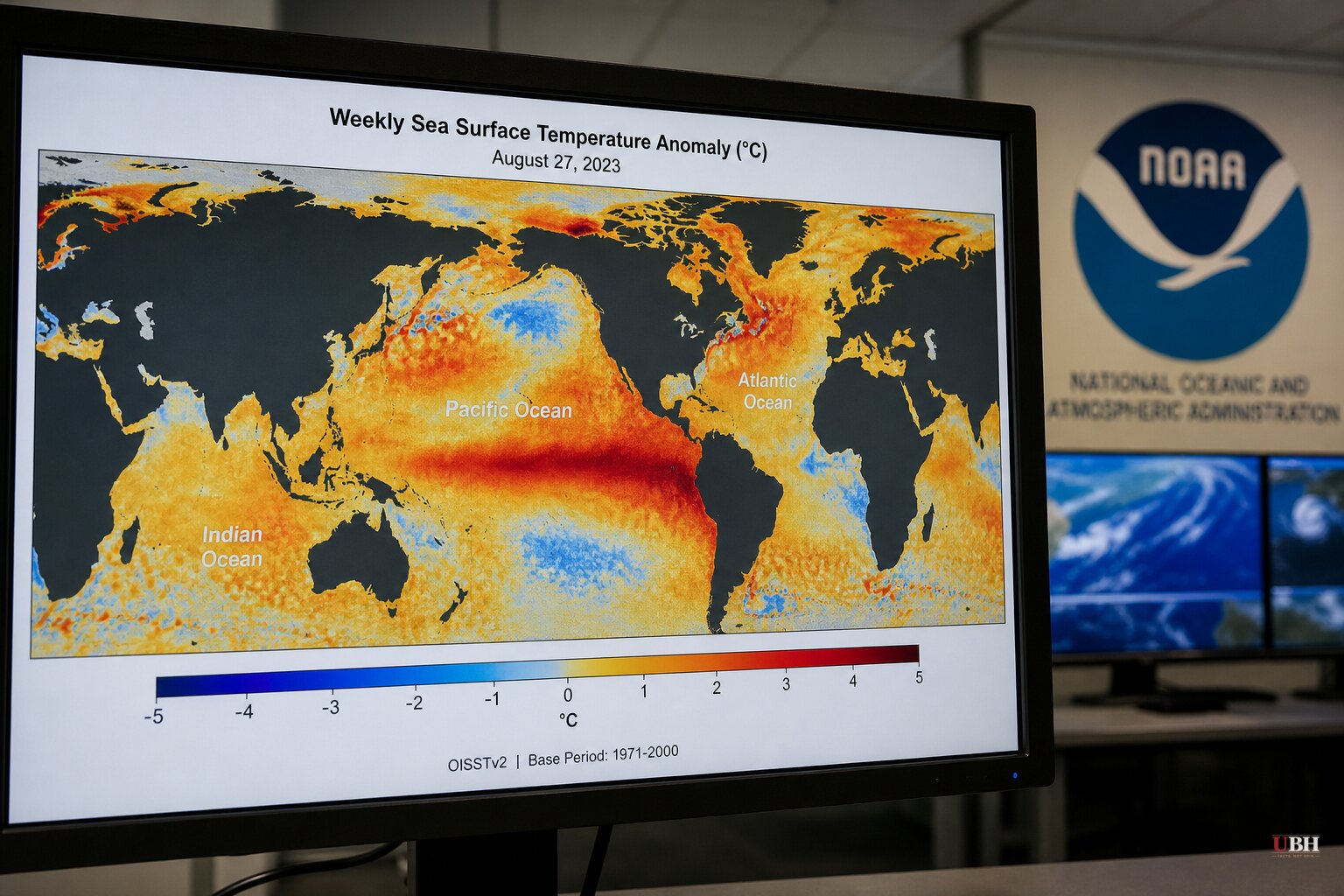
Since NOAA's Climate Prediction Center released its September-through-November outlook, the story on this year's El Niño has moved from "strengthening" to "very strong, with high confidence." NOAA now puts the odds above 90% that the pattern becomes a very strong event through fall and winter, according to Newsweek's reporting on the agency's latest seasonal maps.
NOAA does not show a single area of the Lower 48 favored for below-normal temperatures this fall. The strongest warm signal sits over the Pacific Northwest and northern Rockies, with above-normal odds also stretching across the West, Great Plains, Gulf Coast, Northeast and Mid-Atlantic, per Newsweek. Precipitation is more mixed: wetter odds favor Arizona, New Mexico and the Four Corners, plus Georgia and the Carolinas, while the Pacific Northwest and Great Lakes lean drier.
The Ocean Numbers Behind the Forecast
The World Meteorological Organization, the UN's climate and weather arm, said it now sees a "nearly 100% likelihood" the El Niño persists through February, calling it the most certain forecast language the agency has ever issued, according to Mother Jones' reporting on the WMO update. The Guardian reported the most recent sea-surface temperature reading at the heart of El Niño measured 2.6°C above the 30-year average, closing in on the 3.1°C anomaly recorded in 2015, the highest ever measured in the satellite era. An average of 14 forecast models points to a peak near 4°C in November, per the Guardian.
LA Times reporting notes this event began forming in June and is developing faster than the previous benchmark "super" El Niños of 1997-98 and 2015-16, with a 95% likelihood cited for it reaching super status this year.
Is Climate Change Making El Niño Stronger?
A study published in the journal Science, led by University of Michigan paleoclimatologist Julia Cole using more than 900 years of Galápagos coral records, found El Niño swings have grown roughly 36% stronger since the industrial era began, with a 16% amplification in just the last 40 years, according to the LA Times. Cole told the paper there's no evidence in the pre-industrial record of an El Niño system this strong.
UN Secretary-General António Guterres called the situation "unprecedented," saying "the planet is in uncharted waters, and those waters are heating up," per statements carried by both the Guardian and Mother Jones. The World Food Programme said in August the event was likely to push roughly 50 million people into acute hunger globally, the Guardian reported, tied to disrupted monsoon rains in India and wildfire risk in Indonesia and Australia.
NOAA itself, quoted by CNN, cautions that a historically strong El Niño "does not mean that historically intense weather and climate impacts will unfold" — it just raises the odds certain patterns show up. Sea-surface temperature readings are measured data. Projections about 2027 becoming the hottest year on record or 50 million people pushed into hunger are model-based estimates from UN agencies, not settled outcomes.
What It Means Region by Region
CNN's breakdown, citing NOAA's typical El Niño pattern, expects the jet stream to dip south, bringing more storms and cooler, wetter weather to the southern U.S. while the north trends drier and warmer. Florida faces elevated risk of winter severe thunderstorms, while Columbia University climate scientist Michael Tippett told CNN other parts of the Gulf Coast should see less severe weather than normal.
Locally, WKYT chief meteorologist Chris Bailey in Lexington, Kentucky, is forecasting both a severe weather outbreak and measurable snow before Thanksgiving, saying the strength of this El Niño leaves him without much historical precedent to lean on. Meanwhile weather-watchers got a lighter moment out of the season's ramp-up when WABI meteorologist Patrick Osborn broke into an uncontrollable laughing fit on air after a coworker's prank backfired, a clip that circulated widely via Fox News.
What's Still Unresolved
The WMO's forecast models point to a November peak, which is when meteorologists will get their clearest read on whether this event actually surpasses 1997-98 and 2015-16 as the strongest on record. Until that peak reading comes in, the "strongest ever" label remains a projection, not a confirmed fact. The next major test comes with the Climate Prediction Center's winter outlook update, expected later this fall, which will refine how hard the Southeast's storm season and the Northeast's mild winter actually land.
Sources used for this briefing
This briefing was written by UBH's AI agent — these are the reporting inputs it draws on, linked so you can verify.


