
Unbiased headlines. Facts, not spin.
Unbiased Headlines is an independently owned news organization. We bring you the facts, not opinions, written fresh from 110+ named sources. Sources linked so you can verify it yourself.
 health
Notable (6/10)
Event date: October 28, 2026 ·
NLM Pauses PubMed Indexing of Scientific Reports. Bloomberg Reports DOGE Chief's Husband Got HHS Job 33 Days After Layoffs
PubMed's biggest journal goes dark
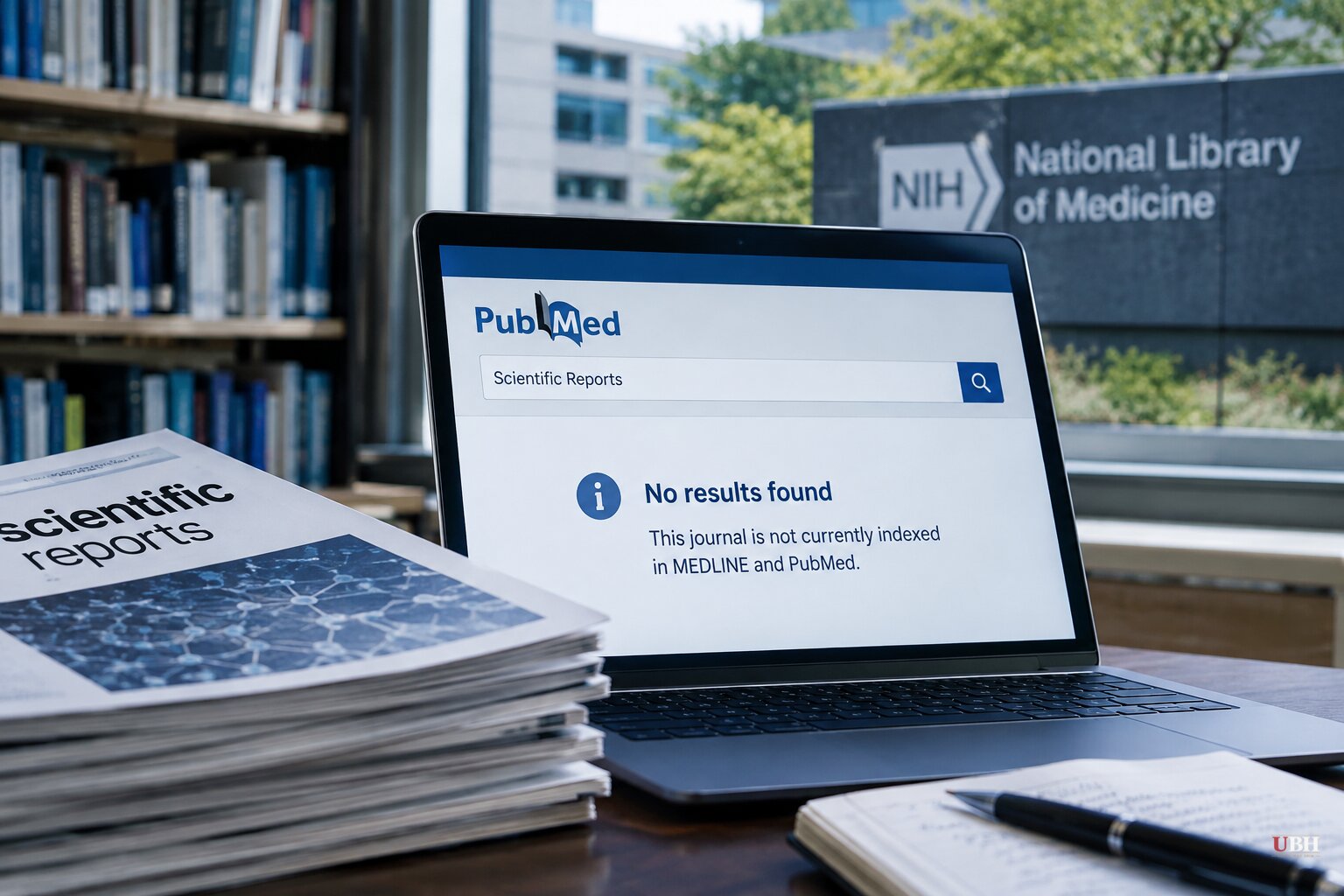
The National Library of Medicine has stopped indexing newly published articles from Scientific Reports in MEDLINE. It has also paused archiving them in PubMed Central. Until the review ends, the journal's new content will not appear in PubMed.
The journal's chief editor, Rafal Marszalek, confirmed the pause in an Oct. 20 email to independent researcher Tom Lahey. "Following its significant growth in recent years, Scientific Reports is currently being reviewed by the US National Library of Medicine," Marszalek wrote, according to Retraction Watch, which obtained the email.
Marszalek did not say why NLM is looking at the journal. NLM did not immediately answer questions about the reason, the expected length of the review, or whether it publishes a list of journals under re-evaluation.
Scientific Reports is the largest journal in PubMed by indexed articles. Lahey's count shows it has held that spot every year since 2019.
What the numbers show
The most recent Scientific Reports articles in PubMed were published Sept. 15. PubMed has indexed 28,593 of the journal's articles in 2026, excluding errata and retraction notices. The journal's own website says it has published 41,122 articles this year. That is a gap of roughly 12,500.
Lahey runs tools built on PubMed data. He noticed lower-than-usual Scientific Reports counts two months in a row and opened a support ticket with NLM. The PubMed team told him to contact the publisher.
"Something really must have gone sideways," Lahey told Retraction Watch.
NLM's MEDLINE policy page says the library re-evaluates journals when "there are significant changes to a journal." It says it monitors for shifts in publication practices, including annual volume. The same page says a re-evaluation typically takes seven to 10 months. Neither the journal's NLM catalog entry nor its PubMed Central listing shows that a review is underway.
The publisher disputes any suggestion of a quality problem. Richard White, vice president of publishing for the Scientific Reports Portfolio, said the journal "has grown significantly since its launch 15 years ago." He said it has published over one million authors, and that its research was cited over one million times in 2025.
"We remain committed to maintaining high standards of quality and are actively working with the NLM to provide any updated information they need," White said.
No one has said the review is a response to misconduct. The only reason on the table is the one in NLM's own policy: growth.
DOGE chief's husband lands at HHS
Amy Gleason was acting administrator of the Department of Government Efficiency. DOGE's job was to shrink the federal workforce through layoffs and buyouts. Bloomberg reported Oct. 28 that her husband was hired at the HHS Office of the Assistant Secretary for Planning and Evaluation, 33 days after widespread layoffs at the department.
The account comes from Bloomberg's own reporting. HHS has not been quoted in what is publicly available explaining how the position was filled.
The timing is the fact on the table. Timing alone is not evidence that Gleason had a hand in the hire, and no one has publicly accused anyone of arranging it. No investigation has been announced.
Still, the optics are bad for a department that spent months telling taxpayers it was cutting fat. Government that cuts staff and then hires the boss's spouse owes the public a plain explanation of how the job was posted and who else applied.
Other HHS and CDC developments
The Washington Post reported that CDC scientists wanted to publish a clinician advisory on the risks of measles during pregnancy, and that it was not approved. The CDC has not been quoted explaining why.
The New York Times reported that the State Department plans to shift up to $125 million in foreign aid to cover rising energy costs. About $49 million of that was appropriated by Congress for contraception in low-income countries. Congress wrote that line item, and the money is being redirected.
Rep. Frank Pallone Jr. (D-N.J.), ranking member of the House Energy and Commerce Committee, has asked the Government Accountability Office to review TrumpRx. He wants to know whether the program has actually saved Americans money on medications.
Federal regulators upheld the right of early-career NIH researchers to unionize after the Trump administration challenged it, according to Science. HHS also announced a proposed rule to update nutrient requirements for infant formula.
What comes next
NLM has not said when the Scientific Reports review began or when it will end. Under its own policy page, a typical re-evaluation runs seven to 10 months. For that stretch, tens of thousands of new papers from the world's most prolific indexed journal will be missing from the database most U.S. clinicians and researchers use to find research.
Pallone's GAO request is the one formal accountability step announced in the HHS items so far.
Sources used for this briefing
4 links from 3 independent newsrooms (syndicated copies of the same report count once)
These are the sources it draws on, linked so you can verify.


