
Unbiased headlines. Facts, not spin.
Unbiased Headlines is an independently owned news organization. We bring you the facts, not opinions, written fresh from 110+ named sources. Sources linked so you can verify it yourself.
 health
Notable (5/10)
UK Government AI Fund Co-Leads Eight-Figure Round for Cambridge Drug-Design Startup Potential Sciences
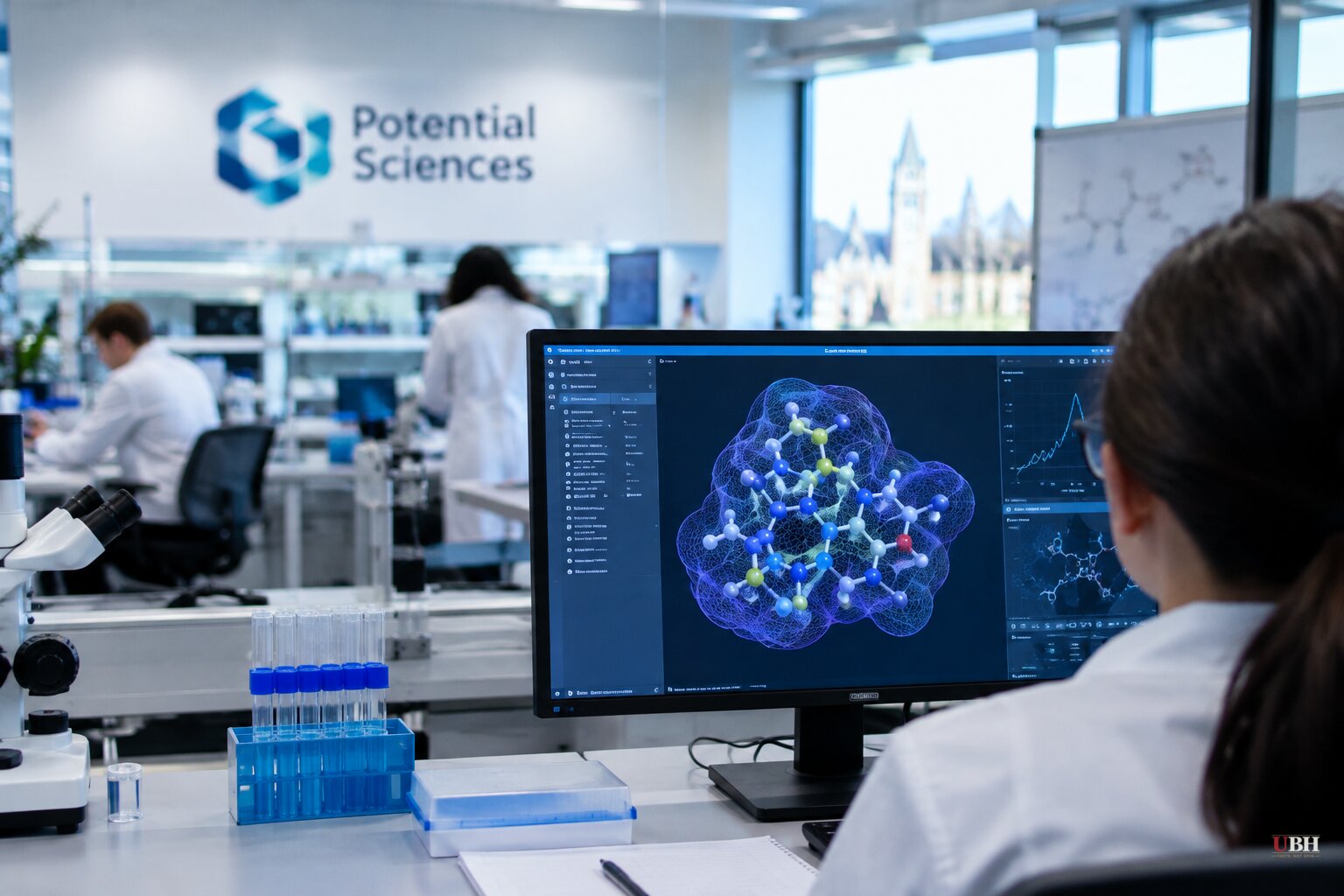
A Cambridge startup that wants to design drugs with physics instead of lab experiments came out of stealth today, Nov. 5, with a seed round co-led by the British government.
Potential Sciences announced an "eight-figure" raise, according to a UK government press release. The company's backers include SovAI, the government's AI venture fund, and Twin Path Ventures, which co-led the round. Blue Wire Capital, Lightfield Equity, Nauta Capital, Odyssey, Portfolio Ventures and Rule30 also invested.
Founder and CEO Hatem Helal declined to give the exact amount or the company's valuation. Neither the government nor the company has said how much SovAI put in.
What the company says it is building
Most AI drug-discovery models learn from past lab results. Helal says that well is running dry. Many AI drug labs train on a single public database of 3D atomic structures, the Protein Data Bank, which researchers have built up over decades of experiments. He told WIRED that dataset is too small to train advanced models.
Potential Sciences plans to generate its own data. It will use basic physics to simulate interactions between atoms, then small molecules, then amino acids and proteins. It will train AI prediction systems on the results.
"We want molecules that are never going to work in the clinic to fail fast," Helal told WIRED.
The company says it rebuilt quantum chemistry code to run on GPUs. "When your code is 100 times more efficient, a seed round buys what used to take a dedicated data centre," Helal said. The company and the government both claim the approach could make the AI calculations behind chemical design 100 times cheaper. That figure is the company's own projection.
Helal also says cheaper experimentation could make it economical to chase treatments for rare diseases that drug makers now skip.
The government's role
SovAI is part of a £500 million Sovereign AI program. The Department for Business, Innovation, Science and Trade describes it as the government's "big bet" on early-stage AI companies. Potential Sciences also gets access to the AI Research Resource, the UK's national supercomputing suite, which includes the Isambard-AI machine in Bristol.
AI Minister Kanishka Narayan said Britain is "uniquely well-placed" to use its expertise in data, fundamental science and computing to "unleash the next great wave of medical discovery." He said solving chemistry's "data bottleneck" could let researchers pursue diseases "currently deemed too rare or expensive to focus on."
The fund is public money. Taxpayers are now co-lead investors in a company that has not disclosed the size of that stake.
The scientific hurdle
The core question is whether the models can predict how tightly a drug candidate binds to a disease-related protein. WIRED reports that doing so as accurately as the company hopes would require a marked leap forward.
Peter Wolynes, a chemistry professor at Rice University, was measured. "I'm sure it will be an improvement," he told WIRED. He added that the field remains primitive: "the engineering is at the level of the Romans, not of the Renaissance, in terms of how protein engineering is done."
That is the gap between a simulation and a patient. A molecule can look right in software and still fail in human biology. Potential Sciences' pitch is that better physics will narrow that gap.
The company has big names in its corner for the general idea. Demis Hassabis, who won the Nobel Prize in Chemistry for his work at Google DeepMind, has said for years that AI will eventually produce major scientific breakthroughs. Startups like Potential Sciences are betting drug discovery will be among the first fields to change.
The team
The company is staffed by mathematicians, physicists and chemists trained at Caltech, Cambridge University and CERN. Some have built science-focused AI systems at Graphcore, Recursion and Dayhoff Labs, according to the company.
Potential Sciences is about a year old. It has announced no drug candidates, partners or clinical programs. What it has is a funding round, a government supercomputer allocation and a claim about computational efficiency.
The next test is whether the company can show its simulation-trained models predict real protein binding. Helal has not said when it will publish results.
Sources used for this briefing
7 links from 5 independent newsrooms (syndicated copies of the same report count once)
These are the sources it draws on, linked so you can verify.


