
Unbiased headlines. Facts, not spin.
Unbiased Headlines is an independently owned news organization. We bring you the facts, not opinions, written fresh from 110+ named sources. Sources linked so you can verify it yourself.
 tech
Notable (6/10)
Event date: October 16, 2026 ·
Ninth Circuit Reverses Class Certification in Tesla Full Self-Driving Advertising Suit
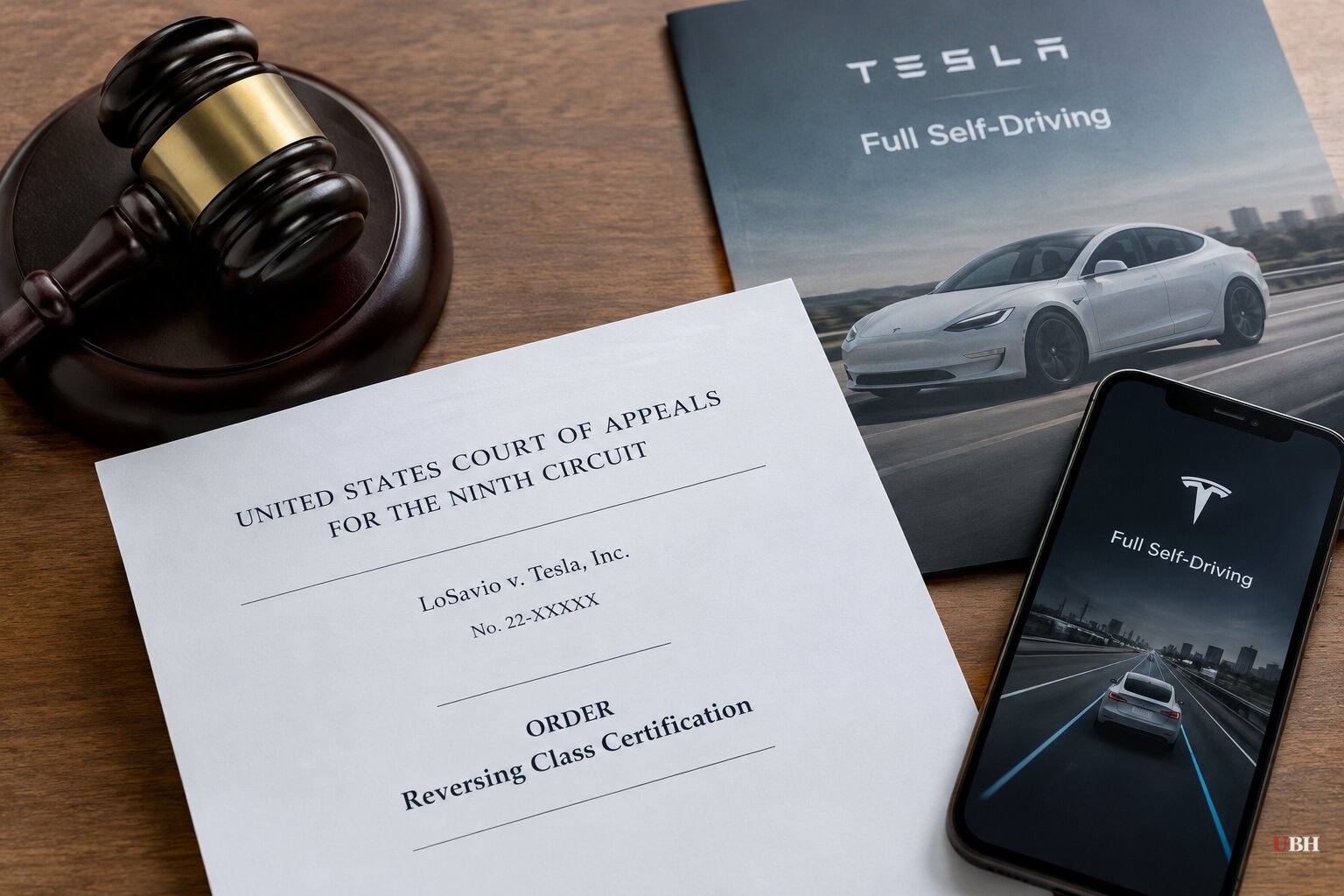
Since U.S. District Judge Rita Lin certified a class of California Tesla buyers in August 2025, the Full Self-Driving advertising lawsuit has been the biggest consumer-fraud threat tied to Tesla's autonomy pitch. On Friday, Oct. 16, 2026, the Ninth Circuit took that class structure apart.
A panel of Circuit Judges Ronald Gould, Jay Bybee and Daniel Bress reversed the class certification orders in LoSavio v. Tesla (No. 25-7927). The ruling undid two damages classes and one injunctive-relief class and sent the case back to Lin.
What the panel decided
The suit, brought by Thomas LoSavio and other California buyers, alleges Tesla falsely advertised that cars sold since October 2016 already had the hardware needed for full self-driving. The plaintiffs say they paid extra for software that does not work properly.
The panel's reasoning was narrow and procedural. To sue as a class, buyers generally must show they were all exposed to the same allegedly misleading statement in essentially the same way. The plaintiffs could not show that here.
The challenged hardware statement sat on Tesla's Autopilot webpage. The judges noted that the district court itself recognized "there [was] no specific requirement forcing [FSD purchasers] through the Autopilot page to complete their purchase."
That is the difference from a product label, the panel said. With a label, "every purchaser necessarily has the allegedly misleading statement in front of him." A webpage a buyer could skip does not carry the same presumption.
What Lin had found
Lin's August 2025 order rested on a different view. She found that thousands of people probably read Tesla's website claim, which ran from October 2016 to August 2024, that its cars were equipped for FSD. She also pointed to a similar claim by Elon Musk at a 2016 press conference.
She acknowledged those channels might not ordinarily establish class-wide exposure for a traditional automaker. But she wrote that "Tesla's distinctive advertising strategy warrants a departure from the typical approach." The Ninth Circuit disagreed that the departure was justified.
Lin had also cited the question of whether Tesla vehicles lacked the sensors needed for autonomy, and the company's inability to "demonstrate a long-distance autonomous drive with any of its vehicles." The appeals panel did not rule on any of that.
What the ruling does not do
The decision does not say Tesla's claims were true. The panel made no finding on the merits, and the case continues before Lin. Tesla has denied the claims and did not immediately respond to a request for comment on the ruling.
The disposition is an unpublished memorandum. Under Ninth Circuit Rule 36-3, it is not precedent for other cases.
Plaintiffs' lawyers pushed back after the ruling: "We think the panel did not fully appreciate the unique circumstances here." That is their argument that Tesla's marketing, much of it tied to the company's own website and CEO, does not fit the usual class-action mold.
The practical stakes are about scale. Class status turns thousands of small claims into one large liability. Few buyers would hire a lawyer over the price of a software package alone, because legal bills would exceed the claim. Without a class, that pooling disappears. Individual buyers can still sue, and plaintiffs can try to certify a narrower class limited to buyers who can show they saw the statement. That group would be smaller and harder to prove.
No damages figure in the case has been disclosed, so the amount Tesla avoided cannot be calculated from the public record.
The market backdrop
Tesla shares closed at $354.72 on Oct. 16, down 2.13%, according to 24/7 Wall St., which attributed the drop to a broader tech selloff rather than the ruling. The same outlet put Tesla's market value at about $1.40 trillion.
That outlet also cited 1.48 million active FSD subscriptions in the second quarter of 2026. It put quarterly revenue at $28.24 billion, non-GAAP earnings per share at $0.33 against a $0.5367 estimate, and free cash flow at negative $1.092 billion.
Those figures show how much of Tesla's valuation depends on autonomy software and robotaxis delivering. A procedural win in one California case does not change that math.
What comes next
The case returns to Judge Lin. The open question is whether plaintiffs try to certify a narrower class of buyers who can show they saw the hardware claim, or whether the claims proceed individually. No schedule for either has been announced.
Sources used for this briefing
7 links from 5 independent newsrooms (syndicated copies of the same report count once)
These are the sources it draws on, linked so you can verify.


