
Unbiased headlines. Facts, not spin.
Unbiased Headlines is an independently owned news organization. We bring you the facts, not opinions, written fresh from 110+ named sources. Sources linked so you can verify it yourself.
 tech
Major Story (7/10)
Japan's MMX Mission to Mars' Moon Phobos Is Set to Launch at 3:41 p.m. EDT Today
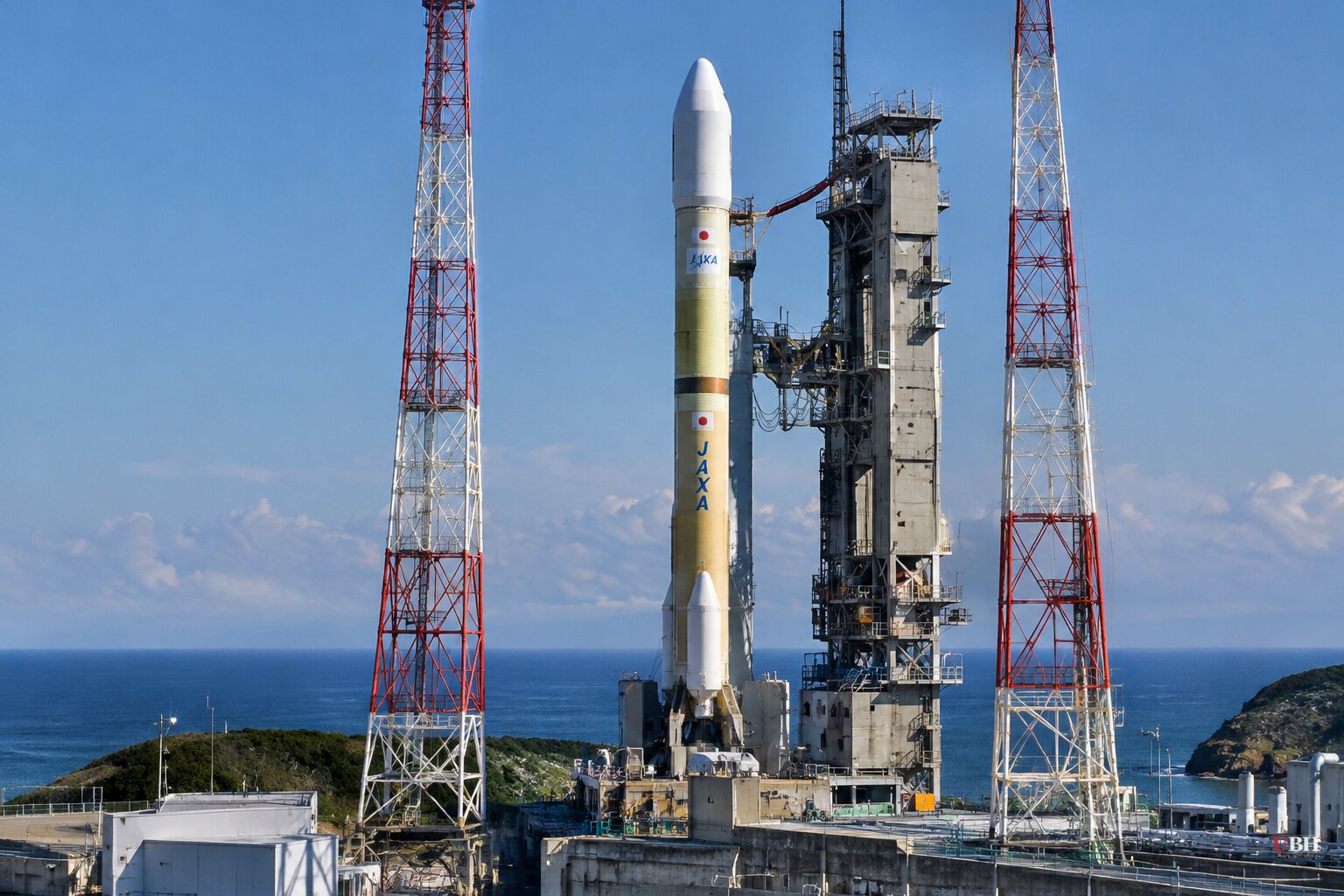
Japan is set to launch a spacecraft today, Oct. 19, that is designed to land on a Martian moon, scoop up dirt and fly it back to Earth. Nothing has left the ground yet.
The Japan Aerospace Exploration Agency (JAXA) is targeting liftoff of its Martian Moons eXploration (MMX) probe aboard an H3 rocket from the Tanegashima Space Center at 3:41 p.m. EDT (1941 GMT). That is 4:41 a.m. on Tuesday, Oct. 20, in Japan.
The flight plan
MMX is expected to reach the Mars neighborhood around August 2027, after a trip of roughly 10 months. It will then spend about three years working in the Martian system.
The spacecraft will study Deimos as it arrives, then concentrate on Phobos. It will not land on Deimos. It will make a series of flybys of that moon later in the mission.
A microwave-size rover named IDEFIX will go down first to survey the surface and help pick a safe landing site. The main spacecraft will then touch down, using a robotic arm and two samplers to collect at least 10 grams of material.
The departure for Earth is planned for November 2030. The sample capsule is scheduled to land in the Woomera region of South Australia in 2031.
Why it is hard
Phobos is about 20 km (12 miles) across. Deimos is about 10 km (6 miles).
"No one has ever landed a rover on such a small moon," said Sara Russell of London's Natural History Museum, the mission's deputy for sample analysis. Phobos has very little gravity of its own, she explained, but it sits next to a planet with much stronger gravity, which complicates getting a rover onto the surface.
IDEFIX was jointly developed by France's space agency CNES and Germany's DLR. It carries cameras plus a Raman spectrometer and a miniature radiometer to read the moon's surface composition and temperature. Japan's Mitsubishi Electric built the mission's three main modules: propulsion, exploration and return.
The question MMX is built to answer
Scientists have argued for decades over where Phobos and Deimos came from. There are two leading explanations.
Under the giant-impact hypothesis, a body slammed into Mars early in its history and the debris coalesced into the moons. Under the capture hypothesis, they are wandering asteroids from the outer Solar System that Mars' gravity grabbed.
NASA's Tom Statler, the agency's MMX program executive and program scientist, said either answer matters beyond Mars. Knowing which is right, he said, "will help illuminate that early era when Earth and the other inner planets may have been acquiring much of their water and organic compounds."
JAXA says the result will also bear on "how a habitable environment for life might have arisen on the terrestrial planets."
Skeptics on sample size
Ten grams is not much. Chrysa Avdellidou of the University of Leicester, who is working with the Japanese team, acknowledged as much.
"It's a very small [amount] actually," she said. But she argued that individual grains can support several studies. "You don't need to have kilos back from a surface in order to do science. So it's worth every gram."
NASA's role
This is a Japanese-led mission, but the U.S. is a paying partner. NASA supplied the MEGANE gamma-ray and neutron spectrometer, built by the Johns Hopkins Applied Physics Laboratory, and the Pneumatic Sampler, a technology demonstration mounted on a landing leg. The P-Sampler gathers surface material with bursts of high-pressure nitrogen gas. JAXA's own C-Sampler is designed to pull cores from a few inches deeper.
NASA also provides Deep Space Network communications and navigation support and funds U.S. scientists on the MMX science team.
In return, NASA plans to curate about 15% of the returned sample at the Astromaterials Lab at Johnson Space Center in Houston. Nicky Fox, associate administrator of NASA's Science Mission Directorate, called the sample partnership "extremely valuable."
Beyond the science
JAXA has said the mission will also test whether Phobos could serve as a "natural space station." That means working out the requirements for a round trip to Mars, which JAXA calls "essential for crewed Mars exploration."
MMX project manager Yasuhiro Kawakatsu pointed to the other milestone. Sampling Phobos would be a world first, he said, and it would also be "the first round trip to the Martian system."
JAXA modeled the approach on Hayabusa2, which returned samples from the asteroid Ryugu.
What comes next
The first real test is the launch itself, targeted for 3:41 p.m. EDT today. After that, the mission's make-or-break stretch begins when the probe arrives near Mars around August 2027 and IDEFIX attempts its first landing. A capsule in the Australian outback in 2031 would be the payoff.
Sources used for this briefing
7 links from 7 independent newsrooms (syndicated copies of the same report count once)
These are the sources it draws on, linked so you can verify.


