
Unbiased headlines. Facts, not spin.
Every story is an unbiased news briefing written from 110+ sources across the spectrum — sources linked so you can verify it yourself.
 economy
Notable (5/10)
June 6, 2026 at 12:41 PM
economy
Notable (5/10)
June 6, 2026 at 12:41 PM
New Zealand Walks a Tightrope Between China's $20B Trade and U.S. Alliance Pressure Ahead of June Summit
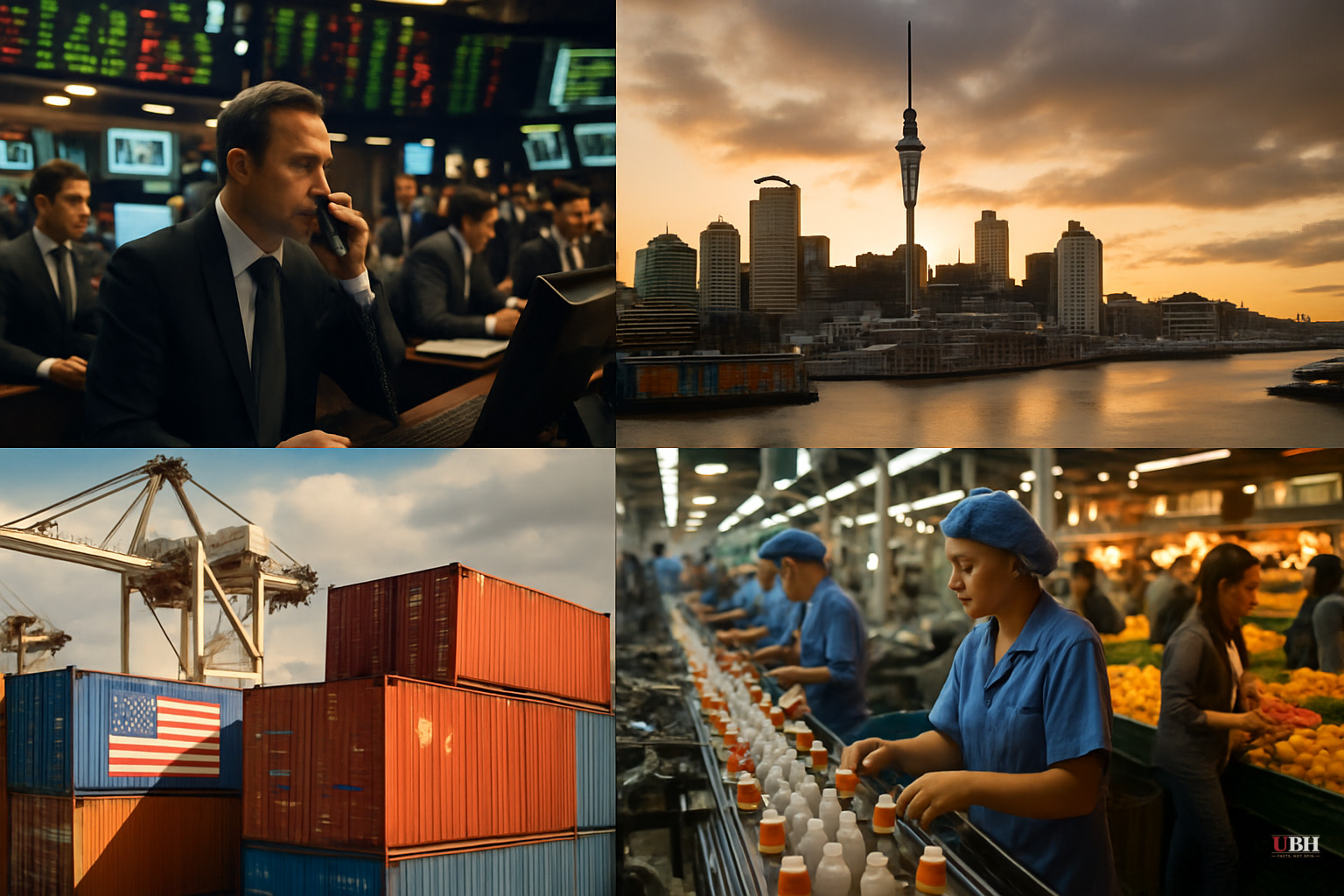
The Numbers Don't Lie
New Zealand exported nearly NZ$20 billion in goods to China in the year ending December 2025. That's close to double the combined total of its next two largest goods export markets.
China has been New Zealand's top export destination for more than a decade. It's also New Zealand's largest source of imports at NZ$18.5 billion, its third-largest source of international visitors, and a significant investor. According to the New Zealand China Council, which is promoting the June 25 summit, that trade relationship shows no signs of shrinking.
One country. That much dependency.
What the Summit Is Actually About
NZINC. and the Auckland Business Chamber are hosting the 12th China Business Summit on June 25, 2026, in Auckland. It's billed as New Zealand's premier platform for examining the economic, commercial, and political dimensions of the NZ-China relationship.
Prime Minister Christopher Luxon is set to open the event. He'll speak about an upcoming business mission to China — his first as Prime Minister — and how his government intends to navigate a relationship that has rarely been more complicated. Chinese Ambassador Wang Xiaolong will offer Beijing's perspective directly.
Also on the program: Pulitzer Prize-winning journalist Andy Browne and ANZ economist Raymond Yeung decoding the U.S.-China dynamic, plus sessions covering agribusiness, aviation, services, and trade.
The Pressure From Washington
Washington's tariff agenda has fundamentally reshaped global trade flows.
U.S. tariffs on Chinese goods reached extraordinary levels in 2025 before being partially walked back through successive truces. Legal challenges to the use of emergency powers to impose tariffs continue to work through the courts — a development that carries significant implications for how any future U.S. administration can wield trade as a weapon.
For New Zealand, the question isn't abstract. If Chinese goods get squeezed out of American markets, they land somewhere else — often at discounted prices. New Zealand's domestic manufacturers already compete with cheap Chinese imports. More trade diversion makes that harder.
The Middle East Wild Card
According to the China Business Summit's own briefing materials, the 2026 Middle East crisis — specifically tensions in the Strait of Hormuz — has exposed both China and New Zealand to oil supply disruptions. Energy costs are up. Supply chains are strained.
This has accelerated green technology adoption, with Chinese EVs growing in New Zealand's new vehicle market, Chinese-manufactured solar panels underpinning much of the country's solar buildout, and Chinese AI models increasingly embedded in business operations.
New Zealand's energy transition is being built substantially on Chinese technology. That's a strategic dependency that deserves more scrutiny than it's getting.
The Security Contradiction
New Zealand is a Five Eyes member. It shares intelligence with the United States, United Kingdom, Australia, and Canada. Washington has been blunt with its allies: doing business with China carries security risks, particularly in technology and critical infrastructure.
Yet New Zealand is simultaneously running NZ$20 billion in exports to Beijing, deploying Chinese solar panels across its grid, and hosting China's ambassador as a keynote speaker at its premier business conference.
Luxon is trying to thread a needle that may not have a thread. Closer alignment with traditional security partners while deepening commercial ties with China isn't a long-term strategy — it's a holding pattern.
South Korea prepares to host APEC later this year. China's diplomatic offensive in the Pacific is NOT slowing down.
The Missing Angle
Most mainstream coverage of NZ-China relations frames this as a delicate balancing act that Wellington is managing admirably.
The real story is that New Zealand has allowed itself to become structurally dependent on a single trading partner that operates under fundamentally different political rules. The Chinese Communist Party controls market access. When Beijing decides New Zealand's salmon, beef, or dairy is unwelcome — as it has done to Australia — the economic consequences are severe.
Australia learned this lesson the hard way after 2020, when Beijing imposed sweeping trade restrictions worth billions following Canberra's call for an independent COVID-19 inquiry. New Zealand watched that happen and largely kept quiet to protect its own access. That's a choice — but it should be called what it is.
The Vulnerability
If you're a farmer, a tourism operator, or work in export services, China IS your market. That's real and it matters.
But if that relationship ever fractures — through geopolitical miscalculation, a Taiwan crisis, or a diplomatic dispute — New Zealand has ZERO short-term alternatives at that scale. Diversification takes years. The vulnerability is baked in right now.
The June 25 summit will produce good speeches and useful networking. The hardest question remains unanswered: What does New Zealand do the day China decides the relationship is over?
That question won't be on the official agenda. It should be.
Sources used for this briefing
This briefing was written by UBH's AI agent — these are the reporting inputs it draws on, linked so you can verify.


