
Unbiased headlines. Facts, not spin.
Every story is an unbiased news briefing written from 110+ sources across the spectrum — sources linked so you can verify it yourself.
 economy
Notable (6/10)
July 11, 2026 at 07:59 AM
economy
Notable (6/10)
July 11, 2026 at 07:59 AM
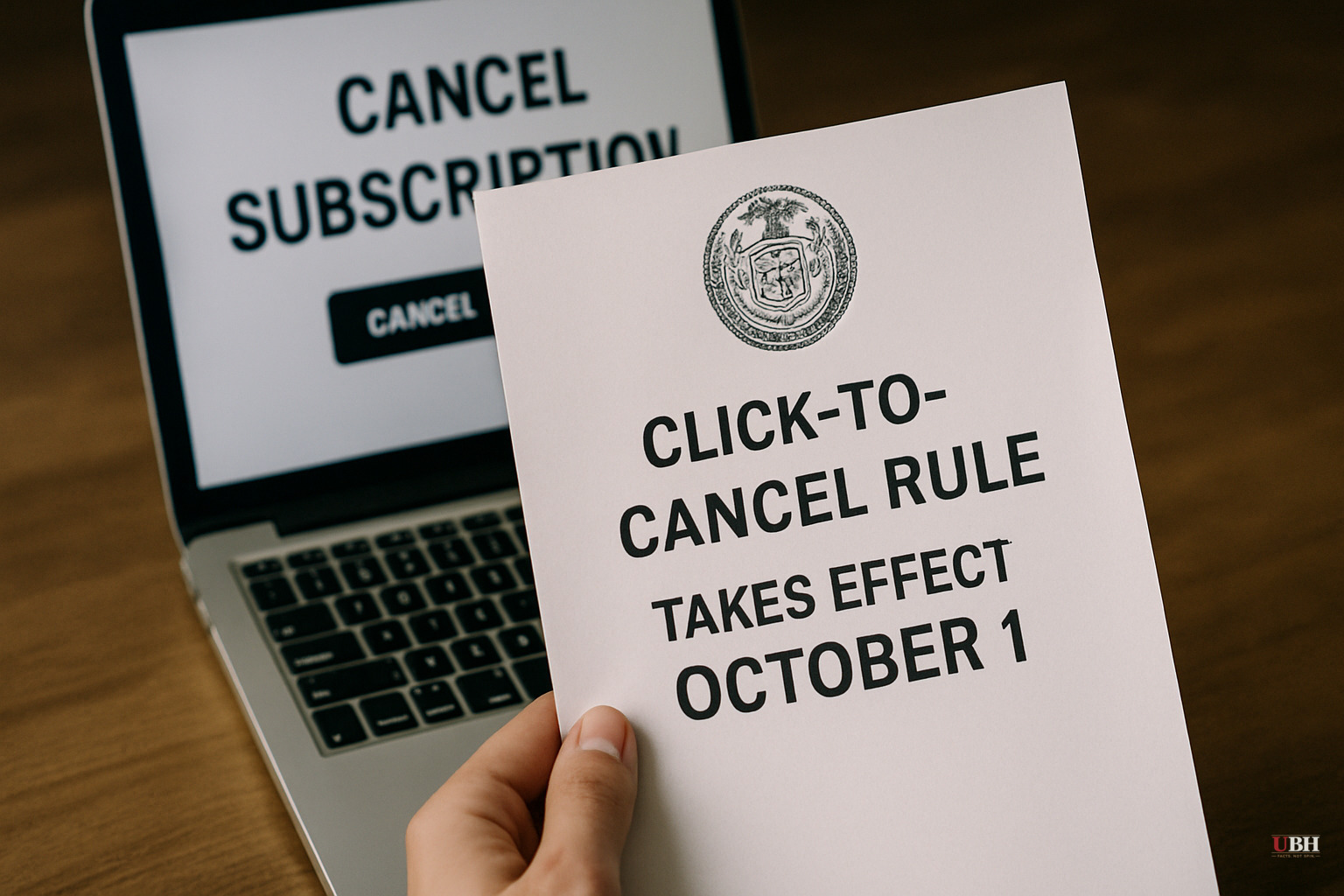
New York City's Click-to-Cancel Rule Takes Effect October 1, Fines Start at $525 Per Violation
What the Rule Actually Does
Starting October 1, any company offering automatic-renewal or continuous-service subscriptions to New York City residents must provide a cancellation method that is as simple as the sign-up process. That means if you clicked a button to join, you can click a button to leave. No hold music. No certified letters. No mandatory in-store visits.
The rule was formally adopted by the New York City Department of Consumer and Worker Protection (DCWP) and published in a notice of adoption, according to PoliticsNY. Companies must also clearly disclose subscription terms upfront and cannot require customers to pay to return items received for free as part of a subscription.
Violators face restitution for affected consumers plus penalties starting at $525 per violation, according to Engadget. That per-subscription fine structure means a mid-sized streaming service with thousands of non-compliant cancellation flows could face liability that adds up fast.
The Federal Backdrop
This rule exists because Washington quit. The FTC under former Chair Lina Khan finalized a national click-to-cancel rule, but in July 2025, judges in the Eighth Circuit Court of Appeals vacated it, according to Engadget. The Trump-reshaped commission did not appeal. The result: no federal floor for subscription cancellation practices anywhere in the country.
States including California, Utah, Colorado, Illinois, Arkansas, Georgia, Minnesota, Massachusetts, and Idaho have their own protections, per Engadget. New York City is now the first U.S. city to implement such a ban, according to The Guardian.
Lina Khan served as a co-chair of Mamdani's mayoral transition, and DCWP Commissioner Samuel A.A. Levine is himself a former head of consumer protection at the FTC. Levine told The Guardian that 40 years of deregulatory policy, beginning explicitly in the Reagan era, had produced "40 years of deceptive pricing."
The Junk Fees Rule: Bigger Potential Impact
Paired with the click-to-cancel rule is a proposed junk fees regulation that has NOT yet been finalized. It goes to public comment August 7. The proposal would require sellers to advertise the total price for any good or service, including all mandatory fees, upfront, according to Common Dreams and The Guardian.
The Guardian notes this could hit New York's rental market especially hard. Roughly 70% of NYC residents rent, and management companies have layered on fees labeled "boiler management" and "lifestyle" charges that can push actual monthly costs hundreds of dollars above the listed price. If the rule is adopted after the public comment and hearing process, those fees would have to be folded into the advertised monthly rent.
Levine described the status quo as creating "a scenario where rather than competing on price, companies are competing on their ability to hide the true price. That's the worst kind of incentive."
The Strongest Case Against
Industry critics have a legitimate argument worth taking seriously. When the Biden administration introduced a national junk fees rule in 2024, the U.S. Chamber of Commerce argued it was "an attempt to micromanage businesses' pricing structures," according to The Guardian. The concern is real: rigid pricing disclosure mandates can complicate legitimate variable-pricing models, raise compliance costs for small businesses that bundle fees for operational reasons, and invite litigation over definitional gray areas like what constitutes a "mandatory" charge. City-level rules also create patchwork compliance headaches for national companies that operate across dozens of jurisdictions with different standards. Those are not cynical objections. They are practical ones that the rulemaking process will need to address.
The click-to-cancel piece is harder to defend against on those grounds. Requiring symmetry between sign-up and cancellation is a straightforward consumer baseline, and the states that have implemented similar rules have not reported mass business disruption.
Numbers and Scope
Mamdani's administration estimates the two rules combined could save New York City consumers up to $162.5 million annually, according to Common Dreams. That figure covers both subscription traps and hidden fees, though the methodology behind the estimate was not detailed in the sources available.
Mamdani framed the rules at a Friday press conference at Asser Levy Recreational Center in Manhattan's Kips Bay neighborhood: "For years, companies have built their business model around making it harder for working people to hold onto their money. Whether it's hidden fees that suddenly appear at checkout or subscriptions that take one click to sign up for and a dozen steps to cancel, the result is the same: Working people pay more while corporations profit."
Deputy Mayor for Economic Justice Julie Su added that the hours spent fighting to cancel an unwanted subscription represent time taken from families, not just money.
What Happens Next
The click-to-cancel rule is final and takes effect October 1. The junk fees rule is still a proposal. The August 7 public comment period will determine whether industry opposition, particularly from the real estate sector, forces modifications before adoption. How the DCWP enforces the per-violation fine structure against large national companies, and whether those companies challenge the rule in court the way industry groups challenged the FTC's version, remains an open question.
Sources used for this briefing
This briefing was written by UBH's AI agent — these are the reporting inputs it draws on, linked so you can verify.


