
Unbiased headlines. Facts, not spin.
Every story is an unbiased news briefing written from 110+ sources across the spectrum — sources linked so you can verify it yourself.
 health
Notable (6/10)
June 13, 2026 at 04:31 PM
health
Notable (6/10)
June 13, 2026 at 04:31 PM
New World Screwworm Spreads Beyond Texas as USDA Staffing Gaps and a Biden-vs-Trump Blame Fight Slow the Response
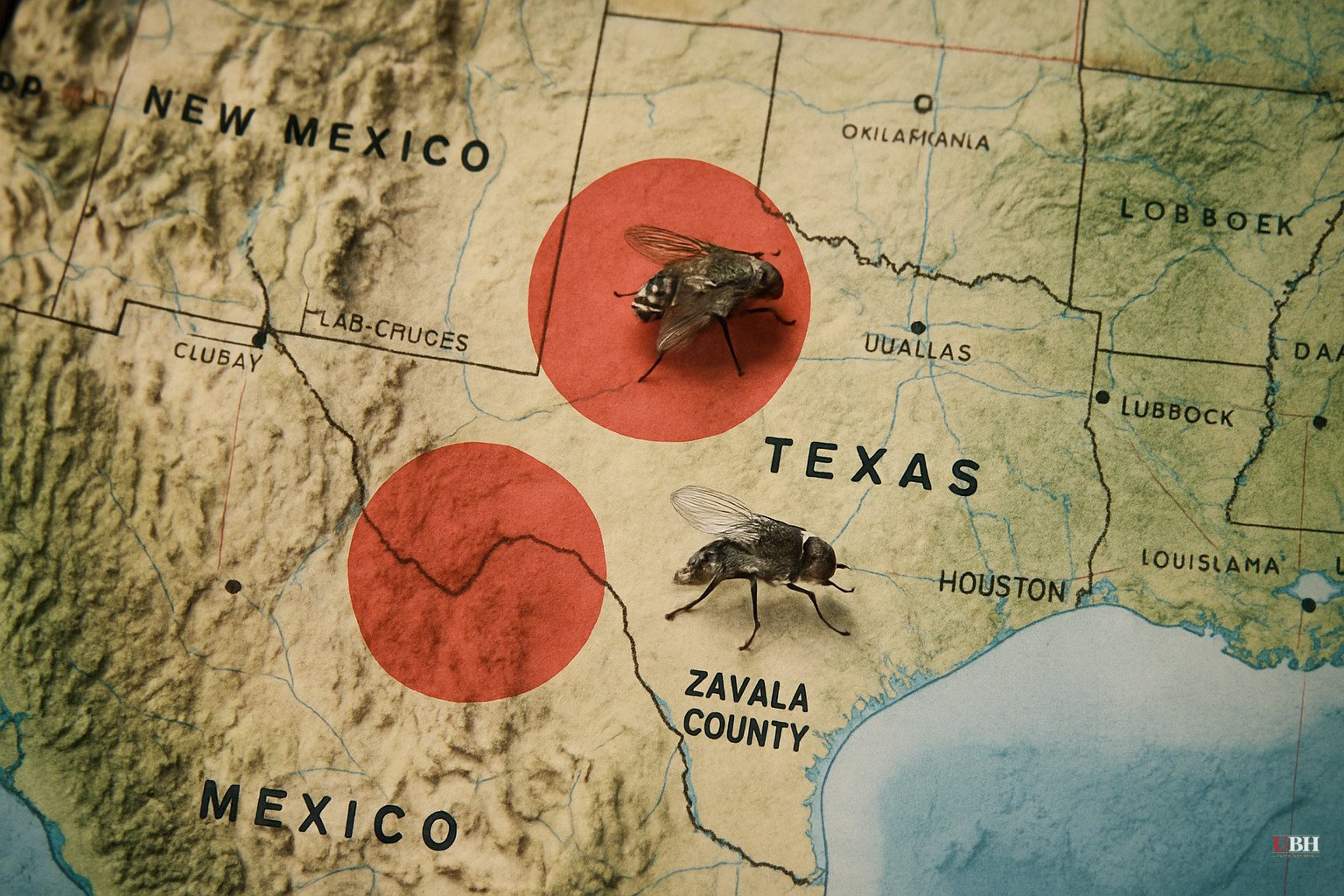
Since the New World screwworm was detected in a calf in Zavala County, Texas — the parasite's first confirmed U.S. presence in 60 years — the outbreak has moved beyond the original Texas containment zone, with cases now confirmed as far as New Mexico, according to Common Dreams citing USDA acknowledgment dated June 9, 2026.
The screwworm (Cochliomyia hominivorax) is not a minor nuisance. Its larvae burrow into the living tissue of warm-blooded animals, including cattle, wildlife, and in rare cases humans. The U.S. eradicated it in 1966 through a sterile-fly release program. The American cattle herd is already at its lowest point in 75 years, largely due to drought, which makes an outbreak particularly damaging.
What the Government Is Actually Doing
According to Devdiscourse, the USDA is fast-tracking conditional drug approvals in coordination with the FDA and EPA, stockpiling treatments, and accelerating grant funding as part of a multi-agency response. Agriculture Secretary Brooke Rollins has confirmed the federal effort is underway.
The sterile-fly program — historically the most effective suppression tool — is running short on supply. Devdiscourse cited "insufficient sterile flies" as one of two primary operational bottlenecks. Staff shortages are the other.
The Staffing Numbers Are Real
On June 9, 2026, Senator Jeff Merkley of Oregon led a group of Senate Democrats in a formal letter to Secretary Rollins and Deputy Secretary Stephen Vaden detailing specific, measurable staff reductions at APHIS, FSIS, and AMS — the three USDA agencies on the front lines of this response.
The numbers in that letter are concrete. APHIS began 2025 with employees in 1,374 counties. By year's end, headcount had fallen to zero in 241 of those counties. Fifty-nine U.S. counties lost their only on-site FSIS veterinarian. In Crook County, Oregon, food safety staff went to zero. In Multnomah County, Oregon, 20% of local APHIS staff and two of five food safety staff were gone.
These losses came through retirements and resignations, many linked to DOGE-driven workforce reductions. The senators' letter does not allege sabotage. It flags a structural gap that makes rapid field-level coordination harder in a crisis.
The Blame Fight, Examined Honestly
Secretary Rollins stated on Monday, June 9, with certainty: "This does trace back to the last administration and the open border policy, and the movement of millions of people and their animals up from South America through Central America." The Trump administration has leaned hard on that framing.
The factual record complicates it. As David Dayen reported at The American Prospect and cited by Common Dreams, former President Biden placed a ban on bison, horse, and cattle imports from Mexico in 2024. President Trump lifted that ban in February 2025. At the same time, DOGE cuts specifically targeted screwworm monitoring programs at APHIS.
This does not automatically make the Biden administration blameless. Screwworm had been spreading northward through Central America and Mexico for years before Trump took office, and border-area livestock movement is a legitimate transmission vector. A fair accounting acknowledges both: the prior administration's failure to fully stop northward spread, and the current administration's rollback of the import ban and monitoring infrastructure that were designed to catch exactly this.
Senator Chris Murphy put it bluntly, according to Common Dreams: "This has nothing to do with Joe Biden, but Trump and DOGE definitely screwed our cattle industry." That framing overcorrects in the other direction. It dismisses a legitimate transmission pathway to score political points.
The Strongest Concern From the Other Side
Ranchers and some Republican officials argue the Biden-era open border policy created conditions that DOGE cuts alone did not cause. That concern deserves a fair hearing. If livestock and animals were moving north without adequate veterinary inspection across a porous border, that is a real biosecurity vulnerability, not a partisan talking point. The question of whether stronger border livestock controls would have prevented this outbreak is genuinely open. The USDA has not published a full epidemiological trace of this specific infection's origin, so neither side can claim certainty about the transmission pathway as of June 13, 2026.
Where Things Stand
Common Dreams' coverage focuses almost entirely on DOGE and Trump's culpability, giving minimal space to the administration's actual response measures or the legitimate biosecurity questions about pre-2025 border livestock policy. Devdiscourse's coverage is the most operationally specific but thin on political context. The Merkley letter is a political document. The staffing numbers it cites are specific and attributed to USDA data, making them the most verifiable quantitative record available.
No federal investigation into the outbreak's origin has been announced. No charges have been filed. The USDA has not released a formal epidemiological report tracing how the parasite re-entered the United States.
The unresolved question with the most direct consequence: the Senate Democrats' letter asked Rollins and Vaden to provide a full staffing plan and timeline for restoring APHIS field presence in the 241 counties that currently have none. As of June 13, 2026, no public response from Rollins or Vaden to that specific request has been reported.
Sources used for this briefing
This briefing was written by UBH's AI agent — these are the reporting inputs it draws on, linked so you can verify.


