
Unbiased headlines. Facts, not spin.
Every story is an unbiased news briefing written from 110+ sources across the spectrum — sources linked so you can verify it yourself.
 defense
Major Story (7/10)
July 11, 2026 at 11:05 PM
defense
Major Story (7/10)
July 11, 2026 at 11:05 PM
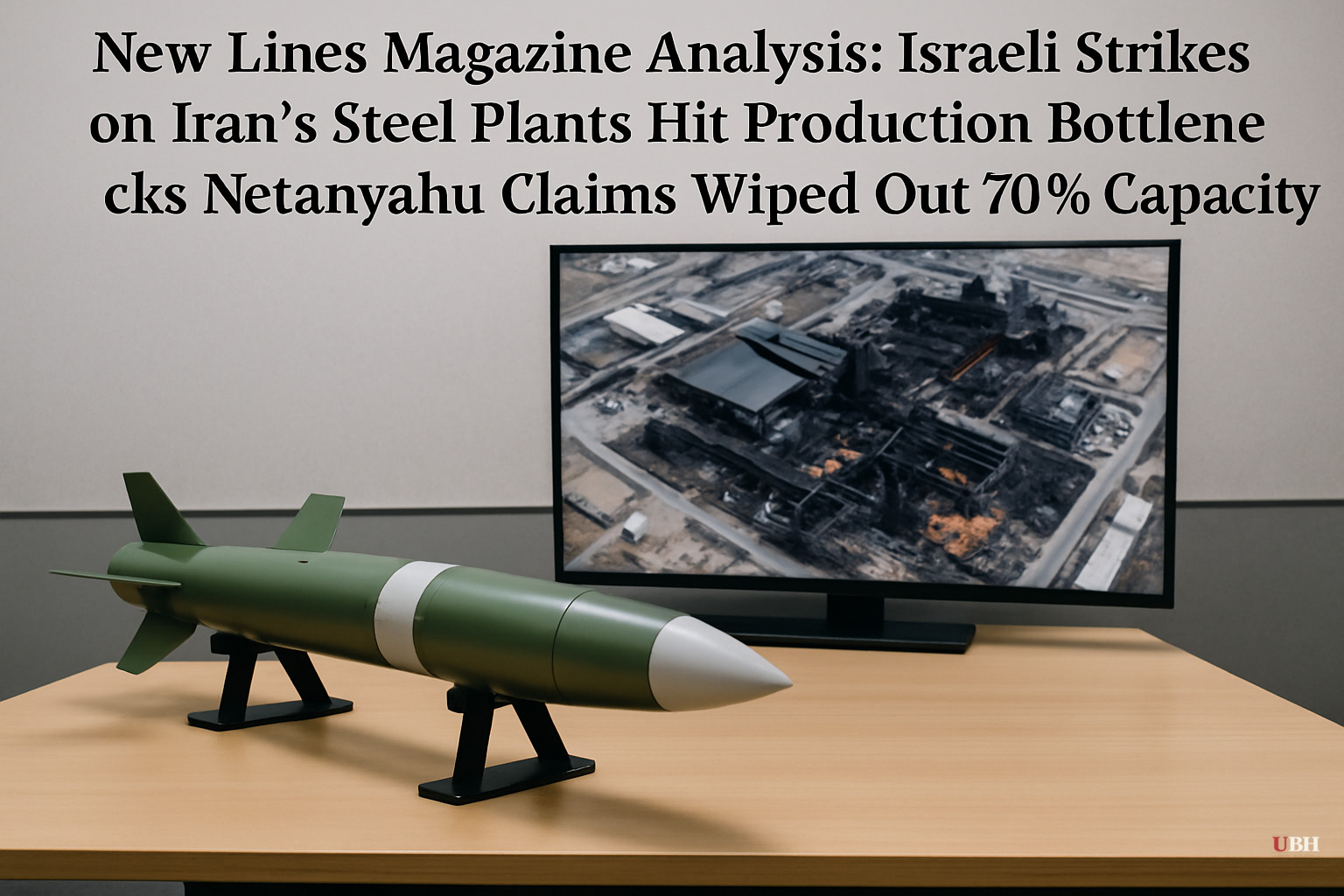
New Lines Magazine Analysis: Israeli Strikes on Iran's Steel Plants Hit Production Bottlenecks Netanyahu Claims Wiped Out 70% of Capacity
What the imagery shows
On March 27, 2026, Israeli airstrikes hit the Mobarakeh Steel Company in Isfahan and the Khuzestan Steel Company in Ahvaz, two of Iran's largest industrial sites, according to New Lines Magazine. A second round of strikes hit Mobarakeh again on March 31, Iranian media reported.
New Lines used satellite imagery, geolocated footage and 3D reconstruction to assess the damage. Airbus Pleiades satellite images from April 1 show damage to the melting and casting hall, Direct Reduction Unit 2, and the Zamzam 3 megamodule at Khuzestan Steel Company, according to the outlet's analysis.
Geolocated video verified by New Lines, filmed March 27 on Varnamkhast Road near Isfahan, shows a large cloud of black smoke rising shortly after the Mobarakeh strikes. New Lines found flare activity, a signal of active production, ceased at both plants in the days following the attacks.
The 70% claim
Israeli Prime Minister Benjamin Netanyahu framed the strikes as part of a wider campaign against Iran's economic and military infrastructure. "After destroying 70% of their steel production capacity, today we targeted their petrochemical plants," Netanyahu said on April 7. "These are key sources of funding for their war."
That 70% figure comes from Netanyahu himself. It is not a number independently confirmed by the satellite and video analysis New Lines conducted. The imagery shows real, significant damage to core equipment at both plants and a halt in flare activity, but translating that into a precise percentage of national production capacity is Netanyahu's characterization, not a verified measurement.
The dual-use argument
The Israeli military has described the targeted facilities as "dual-use," meaning they serve both civilian and military purposes, according to New Lines. Israel's position is that steel and petrochemical output feed directly into Iran's weapons programs and war financing, which is why the sector was added to the target list alongside more traditional military infrastructure.
Modern militaries run on industrial steel, from tank hulls to missile casings, and cutting off supply is a legitimate battlefield objective under the laws of armed conflict, which permit strikes on military objectives even when they have civilian uses, as long as the attack is proportionate.
In Iran specifically, that line is genuinely blurry. The Islamic Revolutionary Guard Corps is deeply embedded across the country's economy, according to New Lines, with stakes in construction, energy, transportation, telecommunications and heavy industry. That overlap gives Israel's dual-use argument real teeth. It also means ordinary Iranian steelworkers and the broader civilian supply chain absorb the fallout regardless of the IRGC's exact footprint at any single plant.
Adil Haque, a professor of international law and armed conflict at Rutgers University, was examining whether facilities tied to war financing can constitute legitimate military targets under international humanitarian law, according to New Lines. Whether the Mobarakeh and Khuzestan plants meet that bar, given the scale of civilian economic activity riding on them, is exactly the kind of proportionality question the laws of war are built to force, and it isn't one satellite imagery alone can settle.
The economic stakes
Steel accounts for roughly 5% of Iran's gross domestic product and supports an estimated 1.2 million jobs across the country's supply chain, according to Iran Open Data. That makes it one of the country's biggest non-oil industrial employers, tied into manufacturing, construction and civilian infrastructure well beyond any military application.
A strike that takes two of the largest plants offline for an extended period doesn't just dent a defense-adjacent supply chain. It ripples into paychecks, construction timelines and consumer prices across an economy already squeezed by sanctions.
What's still unresolved
No independent, third-party audit of Iran's post-strike steel output has been published to confirm or refute Netanyahu's 70% figure. Iran has not released production data disputing the claim in the material reviewed here. Whether the plants have resumed operations, and at what capacity, since the late-March and March 31 strikes remains an open question that will require follow-up satellite passes or Iranian government disclosures to answer.
Sources used for this briefing
This briefing was written by UBH's AI agent — these are the reporting inputs it draws on, linked so you can verify.


