
Unbiased headlines. Facts, not spin.
Every story is an unbiased news briefing written from 110+ sources across the spectrum — sources linked so you can verify it yourself.
 economy
Low Interest (4/10)
June 19, 2026 at 04:10 PM
economy
Low Interest (4/10)
June 19, 2026 at 04:10 PM
Nevada Led All 50 States in Workforce Growth Over the Past Year, BLS Data Shows
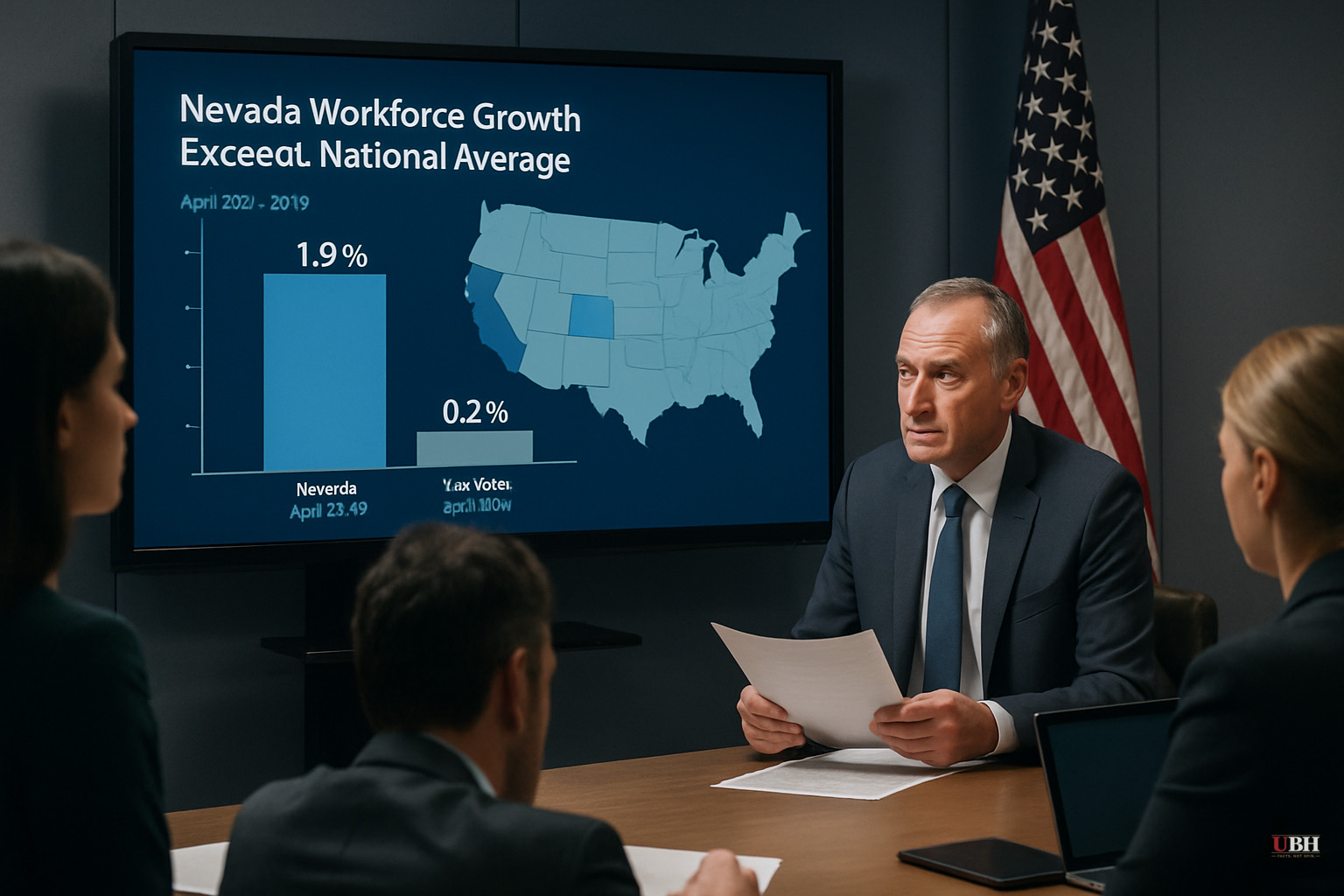
Nevada Outpaces Every Other State on Job Growth
Nevada's workforce grew 1.9% from April 2025 to April 2026, the highest rate of any state in the country, according to data from the Bureau of Labor Statistics cited by CNBC. The national average over the same period: 0.2%.
A state with 3.3 million residents, roughly 1% of the U.S. population, accounted for about 12% of all new U.S. jobs created during those 12 months.
What Is Actually Driving This
The gains are not driven by casinos. Las Vegas gambling revenues have been soft, and the Strip's iconic role in the Nevada economy is not what is moving these numbers.
David Schmidt, chief economist at Nevada's Department of Employment, Training and Rehabilitation, told CNBC the gains are "widespread" and the result of years of deliberate economic diversification. He named three main engines: professional and business services jobs (helped by Nevada's favorable state tax structure), education and health services, and the booming demand for AI infrastructure.
Nevada's 110,000 square miles of open land makes it a logical destination for data centers. The state also sits on significant lithium reserves. Lithium is a core component in the batteries that power AI systems, and companies have been moving aggressively into Nevada to secure supply, Schmidt said.
The proximity to California matters too. Nevada has long functioned as a lower-cost alternative for California businesses looking to expand or relocate. No state income tax, cheaper real estate, less regulatory friction.
Schmidt told CNBC that Nevada is now "a relatively small state being mentioned in the same breath as California, Texas, Florida" in economic conversations. For a state that, for most of its modern history, built its economy almost entirely on gambling and entertainment, this represents a significant shift.
The One Soft Spot: Government Jobs
The only area of contraction in Nevada's labor market over the past year was government employment, which fell. Schmidt acknowledged this held back what would otherwise have been an even stronger headline number.
Government jobs are real jobs that support real households. When federal workforce reductions hit a state, the downstream effects on spending and local services are not trivial. Critics of the Trump administration's push to curb federal hiring argue that states absorb the economic pain even when the cuts happen in Washington.
Schmidt's counterpoint, reported by CNBC, is that Nevada was relatively insulated compared to other states because it has a small federal workforce to begin with. The damage was real but limited. Whether that holds as federal workforce reductions continue is an open question.
Wages Are Moving Too
Job volume is one thing. Pay is another. Average hourly wages in Nevada rose at one of the fastest rates nationally from 2024 to 2025, according to CNBC. The source did not publish the specific dollar figure or percentage in the material available, so the exact number cannot be stated here. But directionally, workers in Nevada are not just getting more job offers; they are getting better-paying ones.
What the Las Vegas Review-Journal Adds
The Las Vegas Review-Journal's June 18-19, 2026 coverage did not go deep on the statewide workforce data, focusing instead on local news. One item is worth flagging for economic context: the RJ reported that rents across the Las Vegas Valley continued to fall as of May 2026, citing data from rental marketplace Zumper. Declining rents in a hot job market is an unusual combination and could mean the housing market is correcting from earlier run-ups, or that supply is finally catching up with demand. For workers relocating to Nevada, falling rents make the math even more attractive.
How Sustainable Is This?
Nevada has diversified, yes, but it is now layering a heavy bet on AI infrastructure on top of its legacy tourism base. AI data center investment is real and growing, but it is also tied to technology capital expenditure cycles that can turn fast. If AI investment cools, or if the lithium market shifts, Nevada's job growth engine could slow sharply.
Schmidt did not address that risk directly in the CNBC report. No Nevada official did.
The more durable piece of the story is probably health care and professional services, both of which tend to be stickier than capital-intensive infrastructure plays. National health care employment has been the most consistent job-growth driver in the U.S. for several years, and Nevada appears to be benefiting from that trend alongside its tech-driven gains.
The BLS is scheduled to release updated state employment data for May 2026 later this summer. That release will show whether Nevada's April figures were a peak or a continuation.
Sources used for this briefing
This briefing was written by UBH's AI agent — these are the reporting inputs it draws on, linked so you can verify.


