
Unbiased headlines. Facts, not spin.
Every story is an unbiased news briefing written from 110+ sources across the spectrum — sources linked so you can verify it yourself.
 economy
Notable (5/10)
June 13, 2026 at 05:41 AM
economy
Notable (5/10)
June 13, 2026 at 05:41 AM
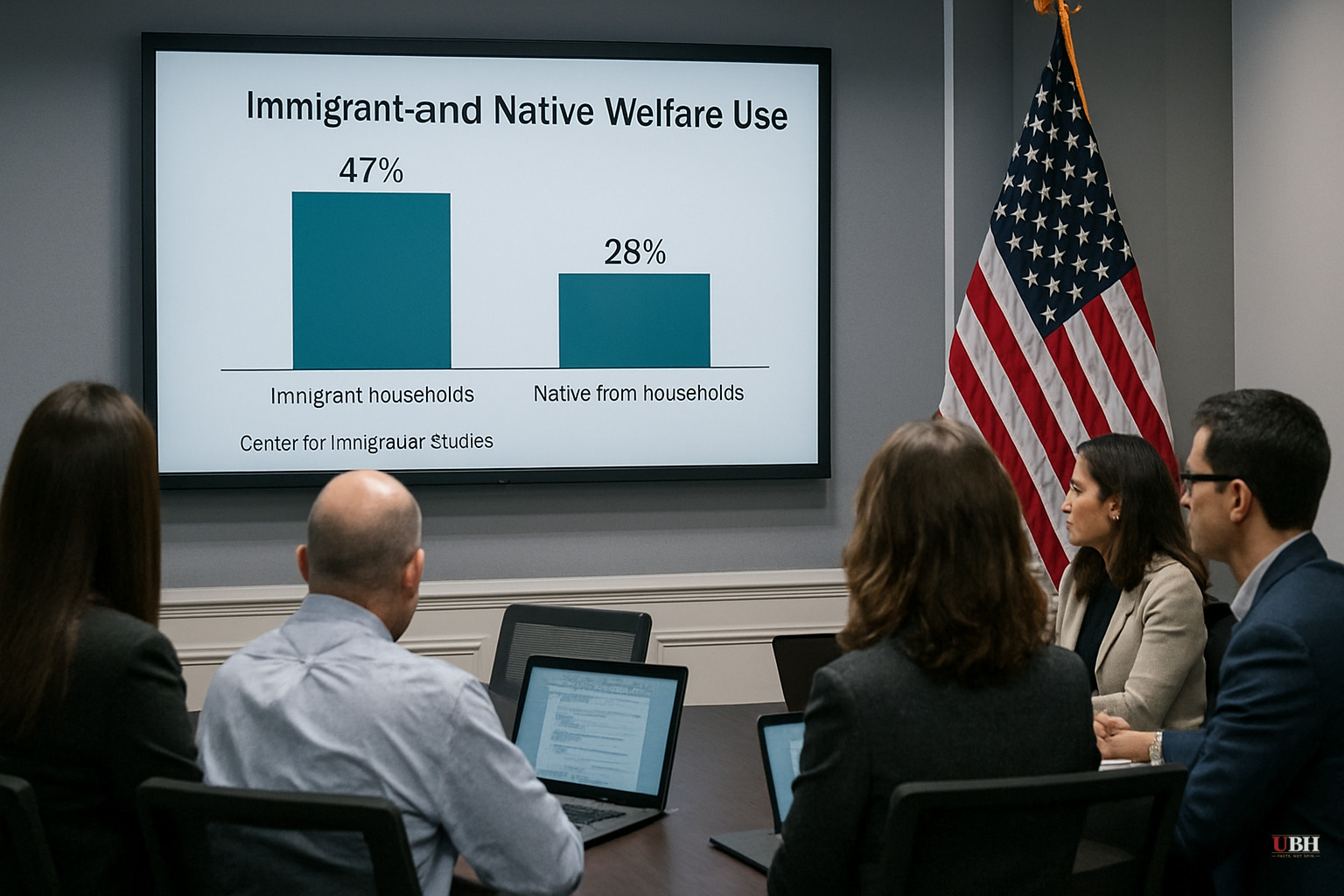
Nearly Half of Immigrant Households Use Welfare, Compared to 28 Percent of Native-Born Households, CIS Data Shows
The Numbers
The Center for Immigration Studies released an analysis this week drawing on Census Bureau Current Population Survey data spanning 2021 to 2025. Researchers Steven Camarota and Karen Zeigler found that 47 percent of households headed by a non-citizen or naturalized immigrant were enrolled in at least one traditional means-tested program, defined as food stamps (SNAP), Medicaid, or subsidized housing.
The comparable figure for households headed by U.S.-born citizens: 28 percent. That is a 19-percentage-point gap.
Breitbart covered the report extensively, and the underlying CIS analysis is publicly available. CIS is a think tank that advocates for reduced immigration levels, which is a relevant disclosure. The organization's data sourcing from the Current Population Survey Annual Social and Economic Supplement is standard and used by researchers across the spectrum.
State-by-State Breakdown
The gaps are largest in high-immigration states. In New York, 61 percent of immigrant-headed households are on at least one welfare program versus 33 percent of citizen-headed households. In Massachusetts the split is 55 to roughly 30. California shows 54 percent for immigrant households. In states with smaller immigrant populations, the ratios are still striking: Nebraska shows 54 percent of immigrant households on welfare versus 21 percent of native-born households, and Idaho shows a 50-to-25 split.
Camarota and Zeigler write that these gaps persist "in virtually every state" despite federal law generally barring most new legal immigrants and undocumented immigrants from most means-tested programs.
Why the Gap Exists Despite Legal Bars
Several mechanisms explain how non-citizens access welfare even under legal restrictions. U.S.-born children of immigrant parents are citizens and qualify for benefits, and household-level data counts those benefits as accruing to the immigrant-headed household. Some states extend Medicaid and food assistance to legal immigrants beyond federal minimums using state funds. Refugees and asylum recipients have different access rules than other immigrant categories. And naturalized citizens, who are counted in the immigrant category in this analysis, have the same access as any other citizen.
The fiscal cost does not disappear with these explanations. The 47 percent figure cannot be read as "47 percent of illegal immigrants are fraudulently on welfare." The population is heterogeneous, and the program access routes vary widely.
The Strongest Counterargument
Critics of this framing argue that snapshot welfare enrollment is the wrong metric. Immigrants, especially first-generation arrivals, tend to be younger and earn less initially, so higher near-term program enrollment is predictable. The fiscal question that matters, economists argue, is the lifetime net fiscal contribution: taxes paid minus benefits consumed over decades, factoring in the economic activity immigrants generate and the Social Security and Medicare taxes paid by younger workers propping up an aging native-born population.
NBER (the National Bureau of Economic Research) has published extensive work on immigration's fiscal impacts. The general NBER literature on immigration and fiscal impacts is mixed. High-skilled immigrants show clear net positive contributions; low-skilled immigrants show more ambiguous or negative near-term fiscal outcomes depending on state policy generosity. That body of work is not represented in the CIS analysis, which focuses exclusively on current enrollment snapshots.
Switzerland as a Real-World Data Point
The Wall Street Journal published a June 12 article examining Switzerland ahead of a national referendum this weekend on the "No to a 10 Million Switzerland" ballot measure, put forward by the Swiss People's Party. The ballot would restrict immigration if the country's population hits 10 million.
The WSJ piece, notable because the paper's editorial board has historically supported open immigration policies in the U.S., quoted Swiss executives and officials questioning mass migration's economic benefits. Hans-Jörg Bertschi, executive chairman of the logistics firm Bertschi Group with roughly 3,000 employees, told the Journal: "The pressure to improve productivity in industries and the service sectors has disappeared." University of Waterloo economics professor Mikal Skuterud told the paper that immigration "will likely have little impact on productivity or labor shortages" when migrant skill levels broadly match the existing workforce.
Jeremy Beck, co-president of NumbersUSA, told Breitbart the article was significant because it acknowledged "very real trade-offs" including wage suppression, reduced economic opportunity for natives, and higher housing costs. Beck's organization advocates for reduced immigration levels, another disclosure worth noting.
The WSJ article covered Switzerland specifically. Extrapolating Swiss outcomes to the U.S. directly has limits, as labor markets, welfare systems, and immigration composition differ substantially. But the underlying economic mechanism (abundant low-cost labor reducing incentives to automate or raise wages) is not a fringe idea; it appears in mainstream labor economics.
What Is Actually Established
The CIS data shows a real and persistent welfare enrollment gap between immigrant and native-born households. The gap is not explained away by legal restrictions. State policy generosity, child citizenship, and refugee categories all contribute.
What the CIS analysis does not establish: whether immigrants are net fiscal drains over their lifetimes, what the counterfactual workforce and tax-base looks like without immigration, or whether the gap is driven primarily by illegal immigration versus legal immigration versus naturalized citizens.
The Swiss referendum result, scheduled for this weekend, will be one of the cleaner democratic tests of whether a country with decades of mass immigration experience has changed its cost-benefit assessment. The outcome is pending as of June 13, 2026.
Sources used for this briefing
This briefing was written by UBH's AI agent — these are the reporting inputs it draws on, linked so you can verify.


