
Unbiased headlines. Facts, not spin.
Unbiased Headlines is an independently owned news organization. We bring you the facts, not opinions, written fresh from 110+ named sources. Sources linked so you can verify it yourself.
 health
Major Story (7/10)
health
Major Story (7/10)
Nature Study: Microplastics Generate Reactive Molecules When They Touch Water
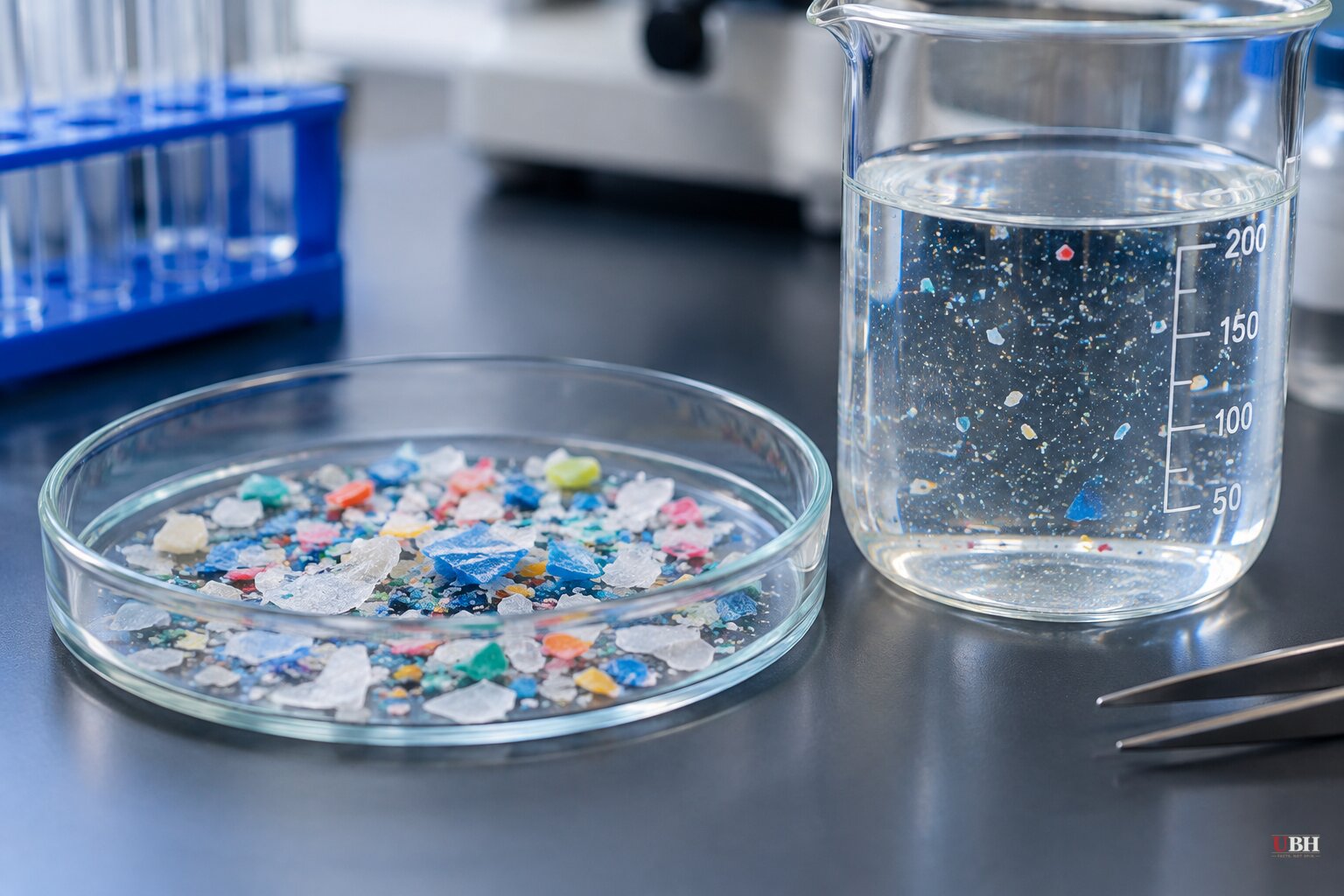
Plastic has long been treated as inert. A study published in Nature today, Oct. 14, says that assumption breaks down once plastic gets small enough and meets water.
Researchers at Columbia University and the University of California, Berkeley report that microplastic surfaces spontaneously generate highly reactive molecules in water. The team, led by Columbia chemistry and biomedical engineering professor Wei Min, did not need sunlight or added chemicals to see it happen.
What the experiments showed
The first clue was a yellow dye. It slowly lost its color over 10 days after being stirred with plastic particles in water. The dye stayed stable when the particles were mixed into other liquids such as alcohol, which pointed to water as the key ingredient.
Further tests showed the plastic surfaces were producing hydroxyl radicals, a highly reactive form of oxygen. Computer simulations helped explain the mechanism. The team then tested what those molecules did to proteins and to red blood cells from mice.
The researchers tested six common plastics: polyethylene, polypropylene, polystyrene, PVC, PET and acrylic. All six produced radicals. Some produced far more than others. The most water-repelling plastics, polyethylene and polypropylene, were the most reactive. PET and acrylic were the least.
Why size matters
Min says plastic repels water, so water molecules at the surface cannot form the hydrogen bonds they normally do. That changes the local electrical environment and makes electron transfer, and therefore radical formation, easier.
Breaking plastic down multiplies the effect. Min gave one example: a credit card fragmented into particles about 10 microns across has more than 200 times the surface area it started with.
"As plastic fragments into smaller and smaller particles, its surface area increases enormously," Min said. "Then microplastics change the water that surrounds them, generating high-energy, reactive radicals that very likely contribute to biological damage that we see in animals and potentially in humans as a result of microplastic exposure."
Co-author Naixin Qian said the particles "spontaneously generate what we call reactive oxygen species," which she described as textbook examples of molecules that can damage animal and human tissue.
The human-health gap
The study is a chemistry result, not a clinical one. Min himself says how this might contribute to tissue damage in people is still unclear. "Ultimately, we hope to connect fundamental interfacial chemistry with quantitative measurements of biological effects," he said.
That caveat is important because the claimed link to human harm runs through water. Human blood is mostly water, and the researchers suggest that particles reaching the bloodstream or cells could stay chemically active there. That is a hypothesis the experiments point toward. It has not been demonstrated in human patients.
Outside scientists see the work as a new tool, not a verdict. Martin Wagner, a toxicologist at the Norwegian University of Science and Technology who was not involved, called the findings exciting. Lisa Patel, a clinical associate professor of pediatrics at Stanford and executive director of the Medical Society Consortium on Climate and Health, also not involved, said the field has long assumed any harm came from added chemicals or pollutants stuck to the particles. "This study suggests the surface of the plastic particle can be chemically active on its own," she said.
The finding fits earlier lab work linking microplastics to inflammation, oxidative stress and reduced mitochondrial activity. It offers a possible mechanism for those effects. It does not prove that mechanism is what causes them.
A separate liver finding
A different study, from Texas A&M University and highlighted by its College of Veterinary Medicine and Biomedical Sciences, looked at polyethylene microplastics and the liver. Researchers led by associate professor Adi Joshi found exposure was associated with signs of fatty liver disease. The signs were more pronounced when exposure coincided with a diet high in fat, fructose and cholesterol.
The Texas A&M team worked with scientists at the University of Oklahoma using spatial transcriptomics to probe the biology. The researchers said the findings do not establish how much polyethylene exposure contributes to liver disease in people.
Polyethylene is the same plastic the Columbia-Berkeley team found among the most reactive. It is also used in food wrappers, storage containers and the linings of some disposable cups. No source links the two studies. They simply point at the same material from different angles.
Where exposure comes from
Co-author Beizhan Yan, an environmental geochemist at Columbia's Lamont-Doherty Earth Observatory, listed routes by which micro- and nanoplastics form or enter the environment. They include discharges from plastic manufacturers and laundromats, microwave heating, sunlight exposure of stored bottled water and IV injections in healthcare settings.
The same Columbia team led a 2024 study that used a laser-based microscope to count plastic in bottled water. It found an average of about 240,000 detectable fragments per liter, mostly nanoplastics. That was 10 to 100 times higher than earlier estimates.
Policy backdrop
In April, the U.S. Department of Health and Human Services announced a $144 million program to build "the definitive toolbox for measuring, researching, and affordably removing microplastics and nanoplastics (MNPs) in the human body."
President Donald Trump has taken a different tone on plastic products. In an early 2025 Truth Social post he wrote, "BACK TO PLASTIC!" in support of single-use plastic items.
Min says the findings may force a rethink of how plastics are evaluated. "We may need to rethink how we evaluate the chemical safety of plastics," he said. It is unclear whether the radicals measured in lab water form at meaningful levels inside living tissue, and the Columbia team says connecting those measurements to biological effects is its next goal.
Sources used for this briefing
7 links from 6 independent newsrooms (syndicated copies of the same report count once)
These are the sources it draws on, linked so you can verify.


