
Unbiased headlines. Facts, not spin.
Unbiased Headlines is an independently owned news organization. We bring you the facts, not opinions, written fresh from 110+ named sources. Sources linked so you can verify it yourself.
 health
Major Story (7/10)
health
Major Story (7/10)
Annual Climate Report: 7 of 16 Planetary Vital Signs at Record Extremes, Warming Rate Up Sharply
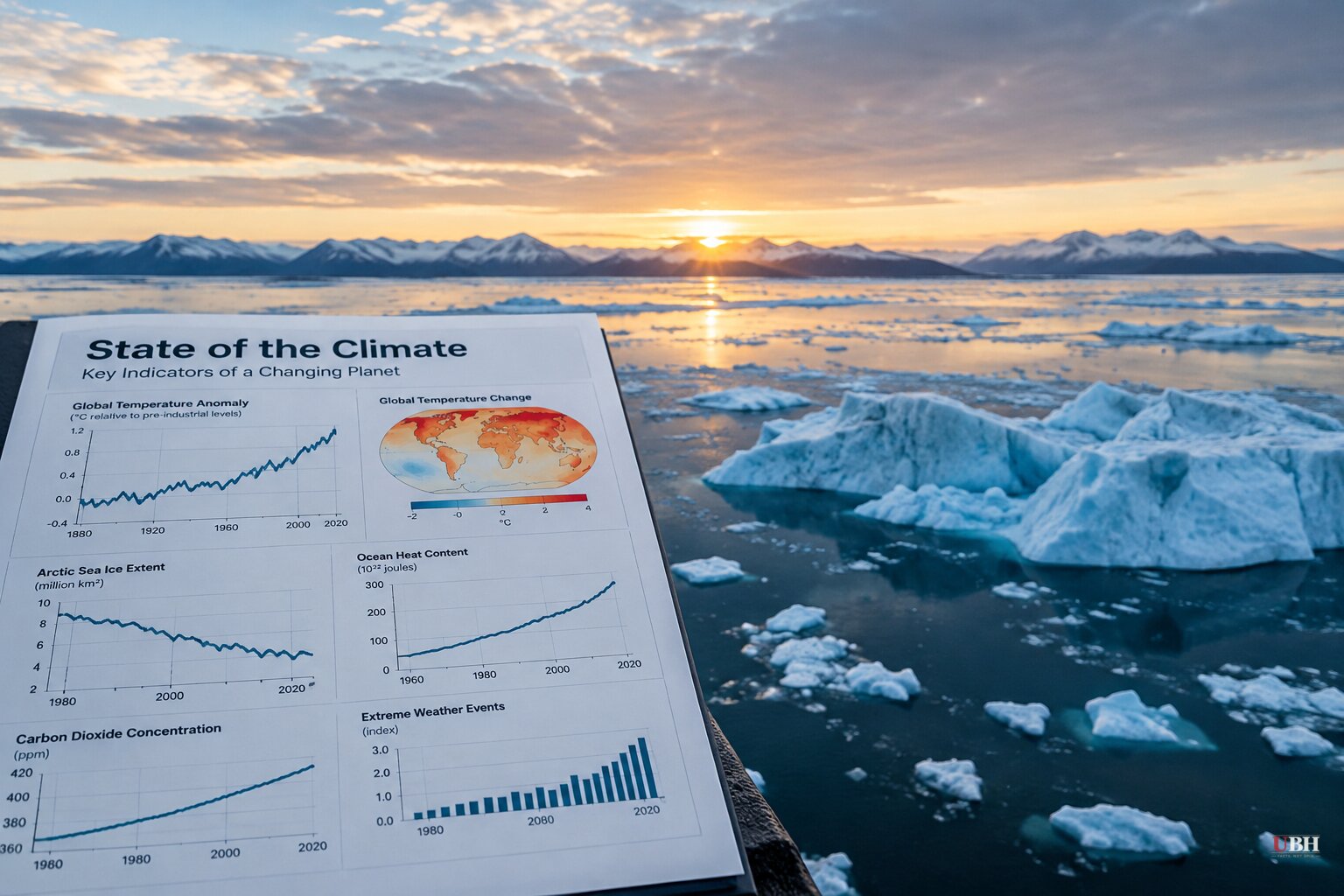
A coalition of scientists led by Oregon State University researchers published its seventh annual State of the Climate report today, Oct. 14, in the journal BioScience. The headline finding: of the 16 indicators the team tracks, seven are at record extremes.
The report is titled "The 2026 state of the climate report: challenges and opportunities." It states that "Earth's climate system is moving deeper into uncharted territory."
What the indicators show
The authors say the rate of warming has sped up. They put it at about 0.05°C per decade between 1880 and 1970, versus roughly 0.36°C per decade between 2010 and 2024.
They warn the 2°C threshold could be reached before 2050. They also warn that the acceleration raises the risk of feedback loops and tipping points, the thresholds beyond which changes can become self-reinforcing and often irreversible.
Atmospheric carbon dioxide topped 428 parts per million in May 2026. That is roughly 50% above pre-industrial levels and higher than at any time in the last 2 million years, the authors say. Sea levels and greenhouse gas concentrations are among the indicators at record extremes. Wildfire burned area and ocean heat show signs of acceleration or abrupt shifts.
July 2026 was the hottest month on record for the contiguous United States, and global ocean temperatures also hit a record that month.
TIME, reporting on the study, also cited preliminary estimates of about 35,000 excess deaths from back-to-back European heat waves this year. It also noted that several regions, including Utah, Ontario, France, Spain, Britain and Belgium, have had or are on track for their worst wildfire years. TIME cautioned that scientists do not yet have enough information to tie individual weather events to climate change.
Fossil fuels still climbing
Fossil fuel consumption rose 0.9% in 2025, with oil, coal and gas each reaching record highs, according to the report. Annual energy-related CO2 emissions passed 41 gigatons for the first time.
The authors also report that low-carbon sources supplied about 43% of global electricity in 2025, and that solar and wind consumption grew by roughly 18%.
"With low-carbon sources now providing about 43% of global electricity, we may be witnessing the emergence of what we call the 'Age of Electricity,'" said co-lead author Christopher Wolf, a former Oregon State postdoctoral researcher. "That is a reason for hope, but fossil fuel use and emissions are still at record levels, so the transition needs to accelerate dramatically."
Clean-energy growth and record fossil consumption both appear in the same dataset.
What the authors want
Co-lead author William Ripple, a distinguished professor emeritus in Oregon State's College of Forestry, said the report is meant to push leaders away from the "business-as-usual approach." That is an advocacy goal, stated openly.
"Rapid destabilization is now a diagnosis rather than a warning for the future," Ripple said.
The authors say emission cuts remain essential but are "no longer sufficient by itself." They call for adaptation measures including urban cooling, wetland and mangrove restoration, wildfire preparedness, water conservation, distributed solar and more resilient food systems. None of the sources put a price tag on that agenda. Who pays, and how much, is a question for legislatures and taxpayers.
TIME also reports that the world passed its first climate tipping point in 2025, with coral bleaching and mortality driven by warming seas, acidification, overfishing and pollution.
A separate study points to a faster timeline
A separate peer-reviewed paper by Q. Jin and B. Pu, published in 2026 in npj Climate and Atmospheric Science, reaches a more aggressive projection. It finds the warming rate rose from 0.18°C per decade in 1971–2010 to 0.40°C per decade in 2011–2025.
If that recent rate persists, the authors project sustained warming of 1.5°C by 2028 (95% confidence interval: 2026–2031) and 2°C by 2040 (95% confidence interval: 2036–2051). They say the average of 26 climate models underestimated recent warming by about 28%.
Those figures refer to sustained warming, not single years crossing a threshold, and they depend on the recent rate continuing.
The two papers use different baselines and periods, so the numbers are not interchangeable. The BioScience authors say 2°C could arrive before 2050. Jin and Pu's central estimate is 2040, with a range that runs to 2051.
Not everyone buys it
Skepticism is easy to find online. Under a social media post summarizing the Jin and Pu paper, a commenter using the handle davehep101 wrote that "every ten years or so, the same pattern, we are all going to die, unless we add more taxes," and cited 1970s predictions that the world would run out of oil. That is a reader's comment, not a rebuttal of the data. Nothing in the report's published figures addresses it directly.
What comes next
The central unresolved question is whether the 0.36°C-per-decade pace holds. The projections in both papers are conditional on the recent rate continuing. If it does, the Jin and Pu interval puts the 1.5°C mark as early as 2026 to 2031. The next State of the Climate report, due around this time next year, will show whether the record-setting indicators kept climbing.
Sources used for this briefing
4 links from 3 independent newsrooms (syndicated copies of the same report count once)
These are the sources it draws on, linked so you can verify.


