
Unbiased headlines. Facts, not spin.
Unbiased Headlines is an independently owned news organization. We bring you the facts, not opinions, written fresh from 110+ named sources. Sources linked so you can verify it yourself.
 health
Notable (5/10)
Event date: October 12, 2026 ·
health
Notable (5/10)
Event date: October 12, 2026 ·
Radiologist Says Only 20% of U.S. Practices Use AI on Mammograms as New Risk-Prediction Tools Arrive
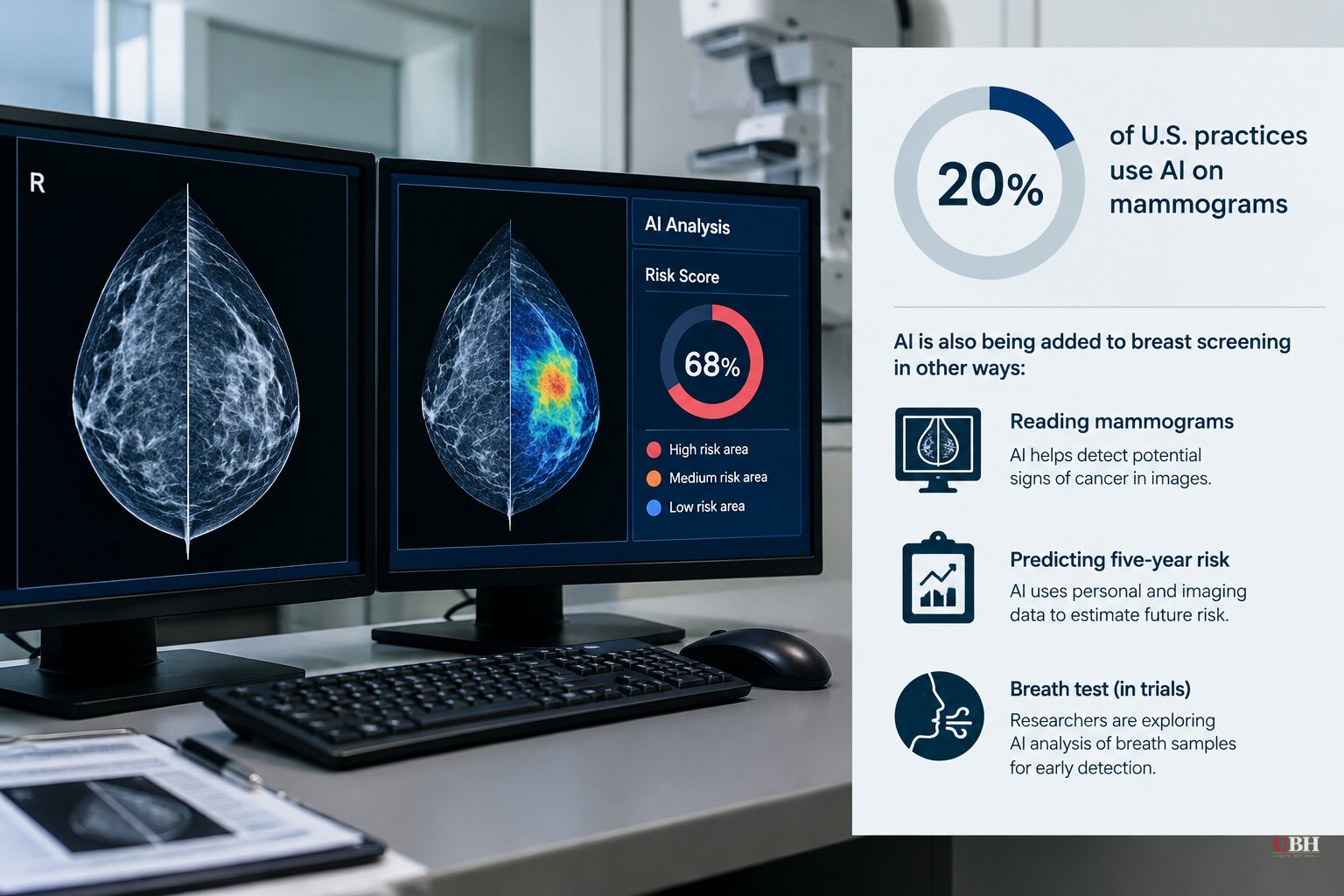
Artificial intelligence is moving into breast cancer screening on several fronts at once. The uptake is uneven, and the price tag is part of the story.
Dr. Rachel Brem, director of Breast Imaging and Intervention at George Washington University, said in an interview published today, Oct. 14, that only about 20% of practices nationwide use AI with their mammograms. At many of them, she said, the AI reading costs extra, which can put it out of reach for some patients.
At GW, she said, the software has been used on every mammogram for more than four years at no added charge.
What the AI is doing
Brem helps develop Transpara, a screening program from ScreenPoint Medical. She said research shows mammograms paired with AI can find cancer "up to five years earlier" by spotting warning signs a mammogram alone can miss. She also said the software can estimate future risk even when a mammogram shows nothing.
"AI is going to change everything in medicine, and certainly breast cancer detection," Brem said.
She went further on timing. If women began AI-enhanced screening at 35, she said, the software would keep learning from each analysis. That is younger than the starting age recommended by several major medical organizations.
Sutter Health's numbers
Sutter Health, a California not-for-profit system, has the most concrete operational figures. It launched an AI pilot in September 2023 and has since rolled the technology out across its network.
Sutter says the software has analyzed more than 380,000 of its mammograms alongside a radiologist. About 1 in 10 exams is scored as highly suspicious. In the regions Sutter has measured, radiologists using AI found 159 more breast cancers in the first year than before AI was in place.
Sutter performs more than 370,000 mammogram screenings a year at more than 60 imaging locations and diagnoses about 4,100 people with breast cancer annually.
"The radiologist still makes the call," said Dr. Jason Wiesner, chair of Sutter's Imaging Service Line. He said that in some regions fewer patients are being called back for extra imaging they did not need.
Those are Sutter's own figures from its own system.
Predicting risk from images already taken
Researchers at NYU Langone Health and its Perlmutter Cancer Center tested an AI model that estimates a woman's risk of developing breast cancer within five years. The study appears in the American Journal of Roentgenology.
The model was built on more than 313,000 mammograms from more than 161,000 women. It looks at several years of a woman's 3D mammograms to track changes in breast tissue over time, not just the latest scan.
Dr. Connie Lehman, a Harvard Medical School radiology professor who was not involved in the study, told Fox News Digital the tool could flag women whose risk would otherwise go unnoticed. Those women could then discuss additional screening, such as MRI, with their doctors. Women at average risk could stay on routine mammograms.
The technology can also analyze mammograms a woman has already had, so the added risk information would not require another exam or more radiation, Lehman said.
A similar tool is already on the market. Everlywell, a digital health company, announced it will offer patients nationwide access to Clairity Breast, an FDA-approved AI tool that predicts five-year breast cancer risk from a single recent mammogram.
The breath test
Brem is also helping develop a breath test. Diseased tissue gives off a chemical compound that becomes gas, and scientists believe it could point to who needs further screening. "It's not available yet," she said.
A study is under way in Canada. The IWK Health Centre in Halifax has become the second partner in a trial with Breathe BioMedical, a New Brunswick company. Patients breathe into a tube, and the device collects compounds and looks for patterns tied to breast cancer.
Eligible participants are 40 to 70 years old and will have had a routine breast biopsy. A 2018 to 2023 pilot in Saint John showed 88% overall accuracy across about 111 patients, according to CBC News.
A pilot that size is small. The Halifax study is the next test of whether the number holds.
The open question: does finding more save lives?
Brem frames AI as a way to narrow gaps in care. "One of the things AI can do is really equalize the inequalities," she said, noting that Black women die from breast cancer at a rate 40% higher than White women and that women with fewer resources have less access to mammograms. Dr. Elisa Port, Mount Sinai's breast surgery director, says AI can reduce false positives, particularly for women with dense breasts, and could draw in the 30% to 40% of women who do not get regular mammograms.
There is a counterweight. Dr. Ruth Etzioni, a biostatistician at Fred Hutchinson Cancer Center who studies cancer screening, said in a separate discussion of a multi-cancer blood test: "Finding a cancer earlier does not mean you will change that cancer's fate." She warned that earlier diagnosis can mean overdiagnosis, where a cancer that would never have caused harm gets treated anyway.
Her comments concerned the Galleri multi-cancer test, not breast AI. In the Galleri trial, cited in the same discussion, the test did not meet its primary goal of reducing late-stage diagnoses across 12 prespecified cancer types. The trial did not test whether the screening reduced cancer deaths.
Sutter's 159 extra cancers are a detection count. Whether AI-assisted screening also cuts deaths, and how much overdiagnosis it adds, is not answered by the figures in this story.
For now, the Halifax breath study has just added its second site. Results from that trial have not been released.
Sources used for this briefing
7 links from 7 independent newsrooms (syndicated copies of the same report count once)
These are the sources it draws on, linked so you can verify.


