
Unbiased headlines. Facts, not spin.
Unbiased Headlines is an independently owned news organization. We bring you the facts, not opinions, written fresh from 110+ named sources. Sources linked so you can verify it yourself.
 health
Major Story (8/10)
Event date: October 12, 2026 ·
health
Major Story (8/10)
Event date: October 12, 2026 ·
Ebola in DR Congo reaches 8,978 confirmed cases as Germany trains East African medical staff
The Ebola outbreak in eastern DR Congo has passed 8,900 confirmed cases, and it is still adding dozens more every day.
As of Oct. 11, the DRC reported 8,978 confirmed cases and 4,336 related deaths, according to the European Centre for Disease Prevention and Control (ECDC). Those figures run through Oct. 10, when 64 new confirmed cases and 21 deaths were logged. Of the new cases, 30 came from Ituri, 25 from North Kivu, seven from Haut-Uele and two from Tshopo.
A total of 945 patients are hospitalised in isolation. Another 2,356 people infected with Bundibugyo virus have recovered. Contact tracing reaches 81% of identified case contacts in the affected provinces, per the ECDC.
Seven provinces, 65 health zones
Ituri remains the center of the outbreak with 6,639 cases and 3,074 deaths across 28 of its 36 health zones. North Kivu has 1,883 cases and 1,075 deaths. Haut-Uélé has 379 cases, Tshopo 59, Bas-Uélé 13, South Kivu three and Sud Ubangi two. In all, 65 of the 167 health zones in seven provinces are affected.
The DRC says its case and death data are under continuous review and harmonisation, so the totals will move.
The outbreak has been running since May. Authorities in September said it had peaked as infection rates slowed. Africa CDC has since warned that while cases have declined in Ituri, more infections are turning up in North Kivu and Haut-Uele. Maximilian Gertler, an epidemiologist at Berlin's Charité hospital, said this week the situation is still not under control.
Kenya records an imported death
On Oct. 6, Kenya's Cabinet Secretary for Health announced the country's first confirmed imported Ebola case. The patient, a Kenyan citizen who had been living in the DRC, traveled through Uganda and arrived in Nairobi on Oct. 3. The patient died.
On Oct. 11, the Cabinet Secretary said 108 of the 122 listed contacts are in quarantine and have not developed symptoms.
Uganda had its own outbreak tied to this crisis: 20 cases between May and June. The WHO declared it over on Aug. 25 after 42 days without a new confirmed case.
Outside Africa, cases have been handled through medical evacuation. A US citizen was flown to Germany in May. France reported an imported case on June 24. A second US citizen, working for a humanitarian group, was evacuated to Germany on July 13. A DRC-based health worker who tested positive on Sept. 29 was admitted to the high-level isolation unit at Leiden University Medical Center in the Netherlands on Oct. 1.
The workforce is the choke point
About 200 health workers are known to have been infected on the job, according to Gertler. He puts the number of people currently infected or in treatment in Ituri and North Kivu at between 800 and 1,000, and the fatality rate in this outbreak at 50%.
Protective gear limits how long staff can work in the red zone to roughly 45 to 60 minutes at a time in the equatorial heat. More than 10,000 protective suits are used and burned every day.
Abdou Sebushishe, who helps lead front-line emergency operations for the International Medical Corps, told Bloomberg there are only so many experienced people to go around. Each time cases appear in a new place, a new team has to be staffed. He worries about colleagues already exhausted, from engineers building treatment centers day and night to clinicians working punishing shifts.
Attacks have made it harder. In September, a senior member of the DRC's ruling party was beaten to death by a mob shortly after calling for stronger Ebola measures on a radio program. The Red Cross has said attacks on health workers are making the response harder.
Germany trains, and debates its checkbook
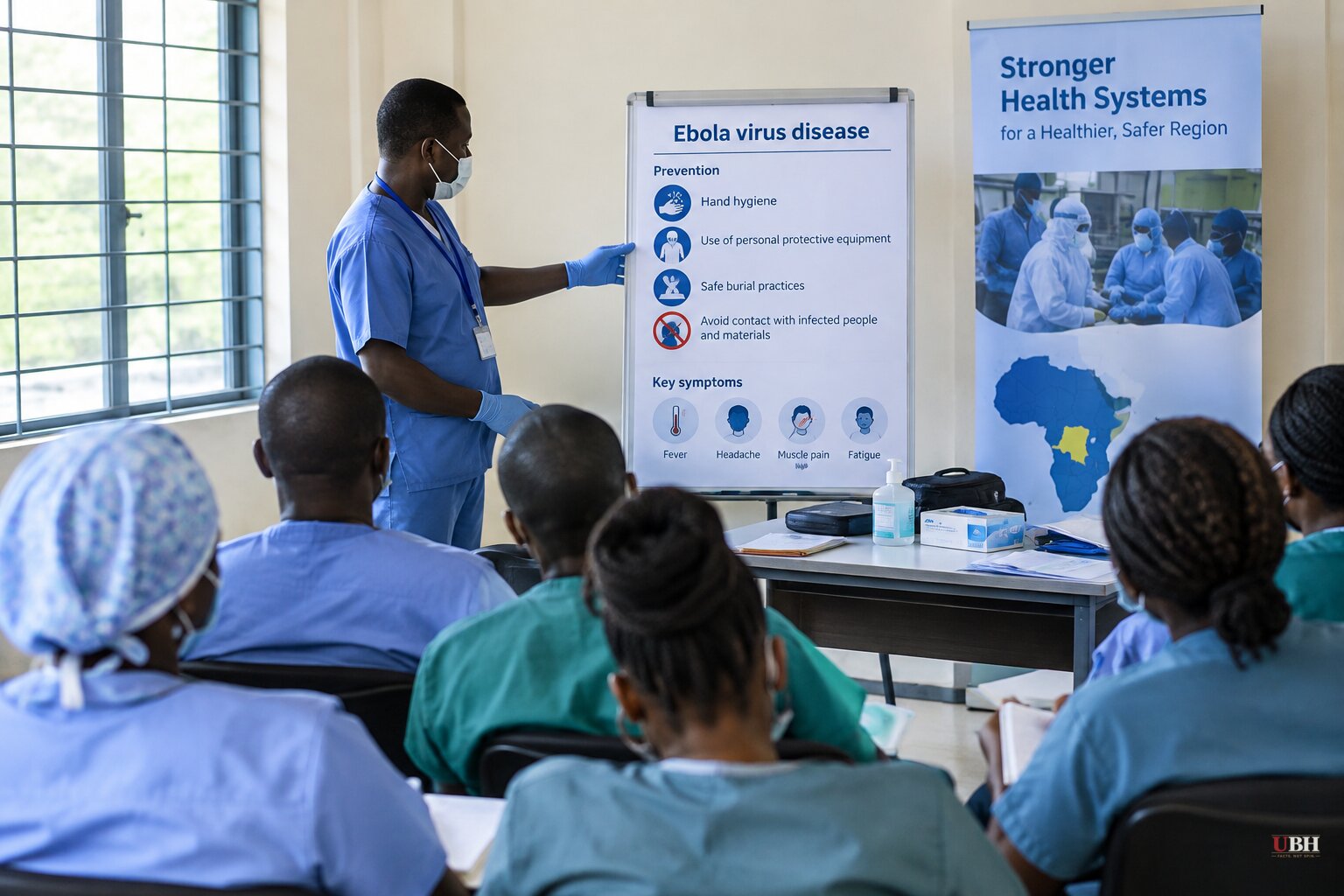
Louise Gotze, an intensive care nurse in Charité's isolation unit, was in Entebbe, Uganda, two days ago training about 30 doctors and nurses. She has traveled to the region seven times this year and is planning another trip. "These training sessions are absolutely essential to ensure that staff do not become infected," she told Euronews.
Gertler said Charité is training about 120 doctors from East African Community partner states. DRC graduates have begun running their own sessions in Kinshasa in case the virus reaches the capital. The stated goal is a regional network of trained workers who teach others. German Development Minister Reem Alabali-Radovan and East African Community Secretary-General Stephen Patrick Mbundi attended a demonstration in Berlin.
The money behind that work is a live argument. Health Policy Watch reports that the Bundestag is considering a 2027 budget growing by almost 6%, mostly for defense. The same budget would cut the health ministry's fund for strengthening international health by 15.3%, from €55.9 million to €47.33 million. Of the $262 million Germany pledged to the WHO at the 2024 World Health Summit, only a third has been budgeted, the outlet reports.
The publication argues Germany arrives at this week's World Health Summit in Berlin with no working global health strategy, no ministerial coordinator and no parliamentary committee on the issue. Olumide Abimbola of the Africa Policy Research Institute told its reporter that Germany is "very bad" at strategic planning. The outlet also blames the Merz government for treating global health as "a budget line to be cut." The government's response to those criticisms has not been published.
The budget is still before the Bundestag. Whether the cut to international health funding survives, while teams like Gotze's keep rotating into an outbreak that is still adding dozens of confirmed cases a day, is the next concrete decision to watch.
Sources used for this briefing
7 links from 7 independent newsrooms (syndicated copies of the same report count once)
These are the sources it draws on, linked so you can verify.


