
Unbiased headlines. Facts, not spin.
Unbiased Headlines is an independently owned news organization. We bring you the facts, not opinions, written fresh from 110+ named sources. Sources linked so you can verify it yourself.
 health
Notable (5/10)
health
Notable (5/10)
Science Corporation Says First Stargardt Patient Got PRIMA Implant in May and Read a Word by Second Session
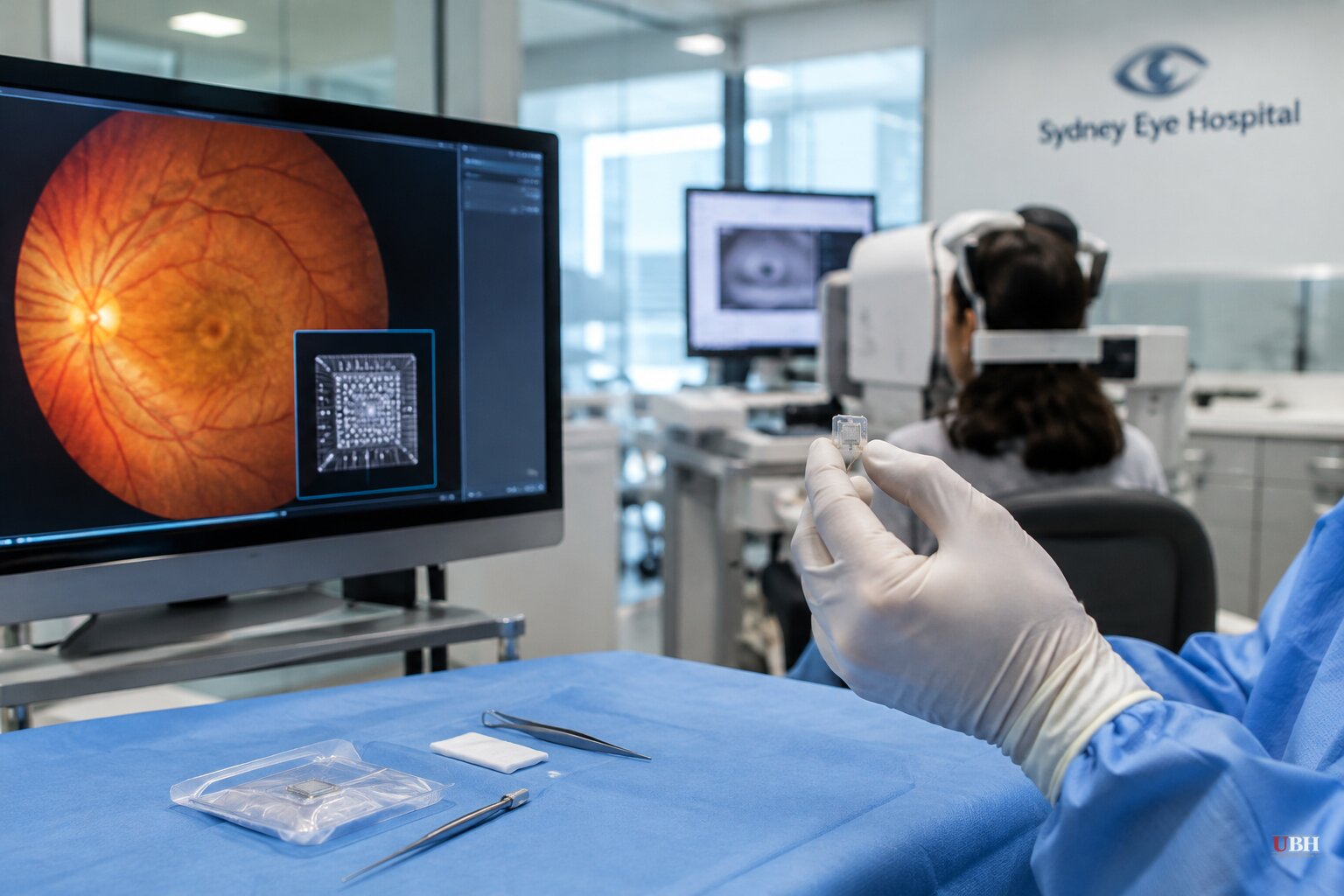
Science Corporation has taken its PRIMA retinal implant beyond the disease it was built for. CEO Max Hodak announced on stage at TechCrunch Disrupt on Oct. 13 that the first patient with Stargardt disease received the device in May, as part of an ongoing trial at the Sydney Eye Hospital in Australia.
The company's account of the result is short. In the patient's first rehabilitation session, he saw a letter. In the second, he read a word. Science Corporation published a trial update with video the same day.
That is the full extent of what has been disclosed. It is one patient, reported by the company, with no peer-reviewed data and no control group.
What Stargardt disease is
Stargardt is an inherited eye disease that gradually destroys central vision. It produces a central blind spot that enlarges over time. Roughly 150,000 people worldwide have lost vision to it, by the figure cited with the announcement, and it is currently considered incurable.
The disease damages the outer retina, where the light-sensing cells die. The inner retina, which passes signals to the brain, can be spared. Science Corporation says that is the same pattern seen in geographic atrophy, an advanced form of age-related macular degeneration, and it is the reason the company thinks one device can work across several conditions.
Science's trial page says it announced earlier this year the start of clinical trials of PRIMA in both Stargardt disease and retinitis pigmentosa.
How the device works, and its limits
Patients undergo an hour-long procedure that places a 2 mm by 2 mm chip at the back of the eye, where the photoreceptors have degenerated. They then wear glasses with a camera that sends the view of the world to the chip. The implant acts as artificial photoreceptors.
Hodak was blunt about what that delivers. "It's like looking through a straw," he said. "It is not a big field of view color vision. It's a patch in their central vision where... it's black and white, but it is sharp." Patients can see "a couple letters at a time."
His stated next step is a larger field of view. A bigger implant has to deal with the curvature of the eye, he said, and the electrodes need to get smaller to approach native levels of detail. Hodak gave no timeline for that.
The geographic atrophy record behind it
PRIMA is already on sale in Europe for geographic atrophy. Ophthalmology Times reports that Science received a CE mark in July 2026, making the device commercially available across 30 European countries. FDA review is ongoing.
The 12-month results of the PRIMAvera trial appeared in the New England Journal of Medicine in October 2025. Science says 84 percent of the 32 patients assessed at 12 months reported being able to read letters, numbers and words. Separately, Ophthalmology Times cites 26 of 32 participants (81.3%) with a clinically meaningful gain in prosthetic visual acuity. Those are different measures and should not be treated as one number.
Safety is the other half of that record. Ehsan Rahimy, a retina specialist at the Palo Alto Medical Foundation who holds an adjunct faculty appointment at Stanford, presented 36-month safety data at the American Academy of Ophthalmology meeting. He reported 29 serious adverse events across 38 implanted participants, 83 percent of them in the first six months. The 12-month report had recorded 26 serious events in 19 participants, most within the first two months.
Rahimy described the events as primarily procedure-related, such as transient pressure spikes, localized subretinal hemorrhage or retinal tears. In his reading, the profile looks like that of a complex vitreoretinal surgery and not a progressive hazard from the implanted material. He is presenting the trial data, and he also says longer-term safety and patient-selection criteria are the central questions for retina specialists fielding patient inquiries.
The BCI pitch
Hodak, a co-founder and former president of Neuralink, framed PRIMA as part of a broader brain-computer interface business. "The retina is part of the central nervous system," he said. "We consider cochlear implants, retinal prostheses, motor prostheses, these are all different types of BCIs."
His argument is that vision is electrical activity down the optic nerve, so if the optic nerve signals the rest of the brain correctly, vision can be provided. He said he sees BCIs expanding into a wide range of medical applications, not just controlling computers.
What comes next
The Stargardt result so far is two rehabilitation sessions in one patient. The company has not disclosed how many more patients the Sydney trial will enroll, or when it expects to report results. Until it does, the open question is whether the early letter-and-word gains hold up and repeat in more patients, and whether a bigger implant can widen the field of view without the added surgical risk that the geographic atrophy data show clustering early.
Sources used for this briefing
7 links from 6 independent newsrooms (syndicated copies of the same report count once)
These are the sources it draws on, linked so you can verify.


