
Unbiased headlines. Facts, not spin.
Unbiased Headlines is an independently owned news organization. We bring you the facts, not opinions, written fresh from 110+ named sources. Sources linked so you can verify it yourself.
 health
Notable (6/10)
Event date: October 9, 2026 ·
health
Notable (6/10)
Event date: October 9, 2026 ·
Up to $1.2 Billion AI Protein Deal Announced; UW Model's Nine Binders Confirmed in Lab
The money arrived first. The science is still catching up.
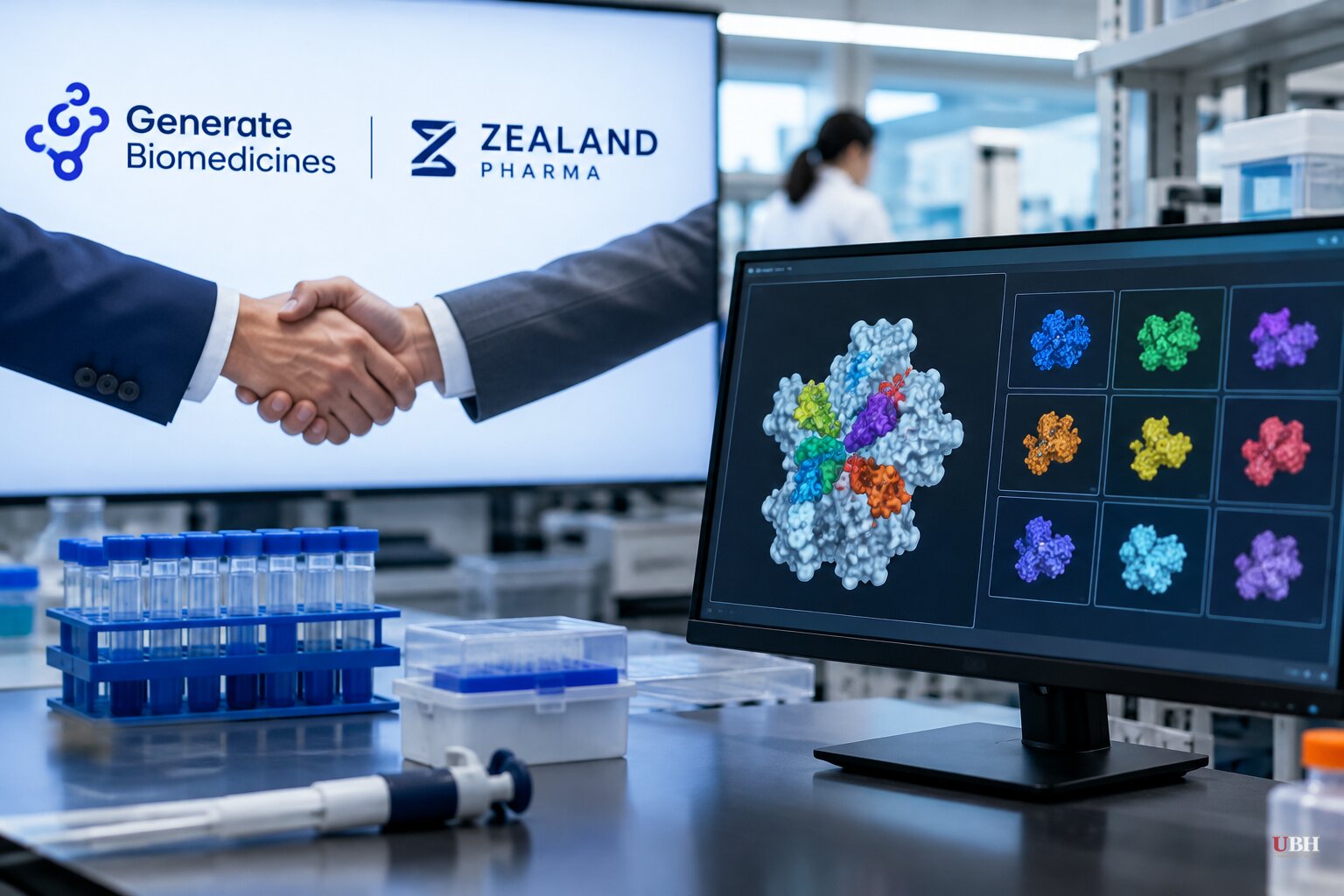
On Oct. 13, Generate Biomedicines and Zealand Pharma announced a deal worth up to $1.2 billion to develop AI-designed protein therapeutics for obesity and metabolic disease. "Up to" matters here. Figures like that typically depend on milestones being hit, and neither company's announcement establishes how much is guaranteed.
A model that takes instructions in plain English
Four days earlier, on Oct. 9, a University of Washington research team posted results for a protein-design model called Prompteina to arXiv. The paper has been accepted to the NeurIPS 2026 main conference.
The pitch: instead of specifying a design objective in a rigid technical format, a researcher types what the protein should do, the way a text-to-image tool takes a written description.
The team reports that nine de novo protein binders, designed against a rare disease target with no previously reported designed binders, bound that target in wet-lab experiments. The strongest reached an affinity of 107 nanomolar.
That is a real result, and it is a first step. A binder that sticks to a target is not a drug. Safety, stability, delivery and whether binding changes the disease all remain ahead of it.
The field already has a strong benchmark
Proteina-Complexa, a binder-design framework built by NVIDIA's Digital Biology group with Baker Lab researchers, was published at ICLR 2026. It reported 91 percent wet-lab hit rates across a 133-target phage display screen.
Prompteina enters a crowded area. The new model's distinction is the interface and the rare-disease target, not a higher hit rate. A system that ordinary biologists can instruct in plain language could widen who uses these tools. Whether it beats existing methods across many targets has not been shown by one nine-binder result.
What an AI-designed drug looks like in human testing
The most advanced example in this reporting is rentosertib, a drug candidate aimed at TNIK, an enzyme linked to fibrosis-related signalling. AI was used in both target selection and molecule design.
A phase 2a trial, published in Nature Medicine by Xu et al., enrolled 71 people with idiopathic pulmonary fibrosis for 12 weeks. It reported an encouraging lung-function signal.
The limits are in the same paper. Lung function was a secondary endpoint. The groups were small. Twenty-two participants lacked week-12 spirometry. Seven stopped treatment because of liver injury or dysfunction.
The trial did not demonstrate reversal of lung scarring or lasting benefit. A September 2026 update to the EnzymeNews write-up records that phase 3 testing has started. A trial launch is not a result, and the candidate remained investigational at that update.
The prediction versus the data
Anthropic CEO Dario Amodei has predicted that AI could help cure most major diseases within the next five to 10 years, arguing the technology will change how scientists study biology and medicine.
The trial data on the leading AI-designed candidate point to a slower and less certain path. A secondary-endpoint signal, missing week-12 measurements and seven of 71 participants stopping treatment over liver injury or dysfunction are the kind of details that decide whether a drug reaches patients. Amodei did not address that trial. The timeline he gave is a forecast by the head of a company that sells AI.
The pharmaceutical industry is betting heavily anyway, and it has reason to: if AI design cuts the cost and time of finding candidates, that is worth real money. The Generate-Zealand deal shows companies willing to commit large sums on that expectation.
What comes next
The phase 3 testing of rentosertib is the nearest hard test of whether an AI-designed molecule can clear the bar regulators set for approval. Prompteina's binders would need further lab work before any therapeutic claim is made. The Generate-Zealand collaboration has no clinical data yet to evaluate.
Sources used for this briefing
3 links from 2 independent newsrooms (syndicated copies of the same report count once)
These are the sources it draws on, linked so you can verify.


