
Unbiased headlines. Facts, not spin.
Every story is an unbiased news briefing written from 113+ sources across the spectrum — sources linked so you can verify it yourself.
 tech
Low Interest (4/10)
Event date: September 25, 2026
tech
Low Interest (4/10)
Event date: September 25, 2026
Nature Study Finds Earth's Core Is Behind Millisecond Shifts in Day Length, No Negative Leap Second Confirmed
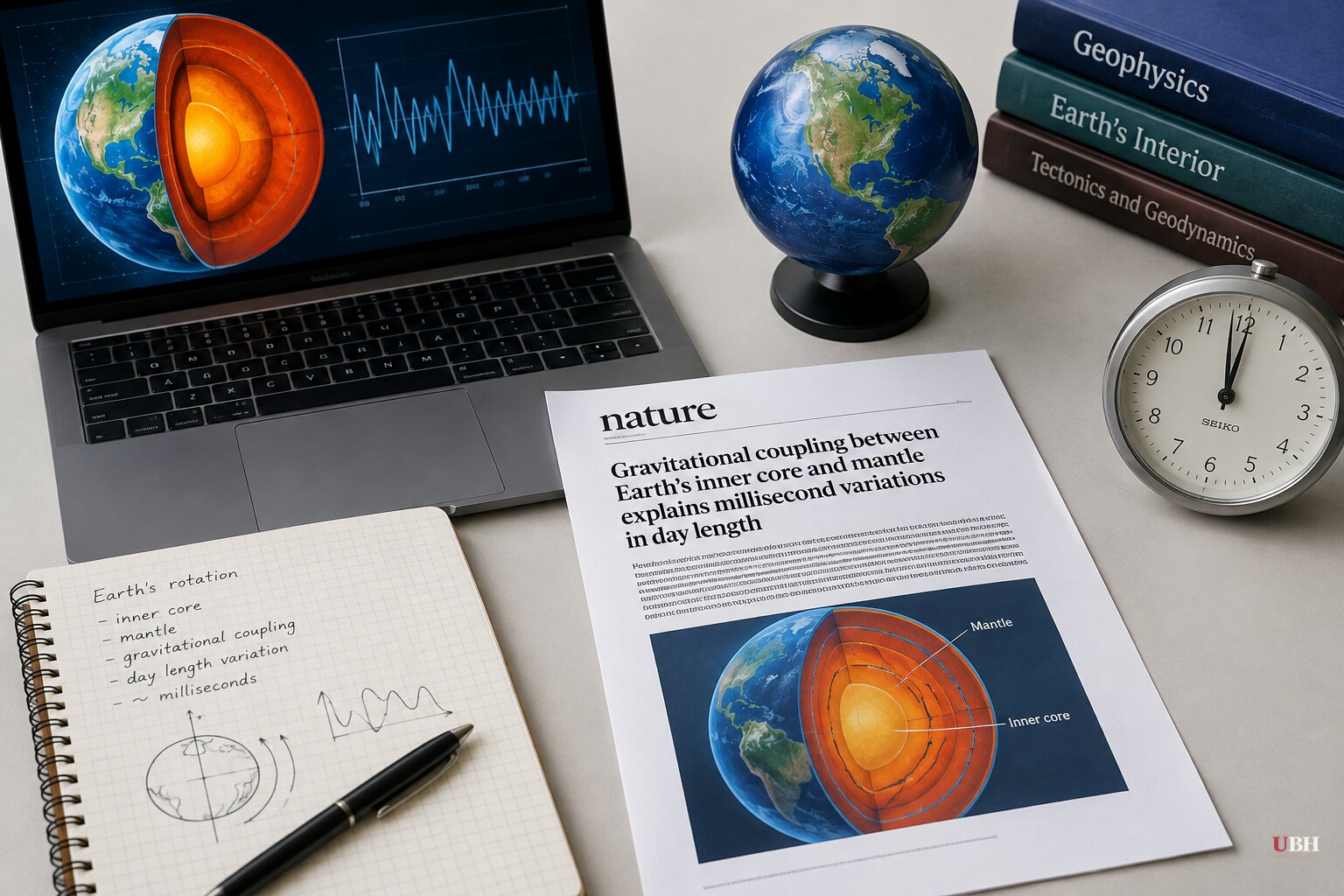
Earth's day is not a fixed 24 hours. It never has been. Scientists have tracked millisecond-level wobbles in the planet's rotation for decades, and a study published September 23 in Nature says it finally found the mechanism driving one of the biggest long-term patterns.
The researchers, physics PhD candidate Huifeng Zhang and geophysicist Mathieu Dumberry of the University of Alberta, built a model explaining rotation changes that unfold over roughly 60 to 70 years. Their answer: gravity is fighting itself deep inside the planet.
What's Actually Happening Down There
Earth has layers. Rocky mantle on top of a 1,400-mile liquid outer core, with a solid inner core at the center, according to Wired. The inner core doesn't spin at exactly the same rate as the rest of the planet, so it drifts slightly out of alignment with dense patches in the mantle above it.
Gravity doesn't like that. It pulls the misaligned mass back toward equilibrium, according to Nature. Dumberry put it plainly in comments cited by Wired: the core "wants to be aligned."
That gravitational pull isn't acting alone. Zhang and Dumberry tested three forces that could transfer momentum between the core and mantle: mechanical torque from liquid metal pushing against bumps at the core-mantle boundary, electromagnetic torque from the core's magnetic field interacting with iron-rich mantle material, and gravitational torque itself, according to The Debrief.
Their model matched five decades of real length-of-day data, from 1964 to 2019, only when gravity was treated as the dominant force, with the electromagnetic and mechanical torques pushing back against it, according to Nature. Zhang told the journal the team didn't expect the forces to be competing: "Before we obtained the result, we didn't know they are competing with each other."
The study leans on earlier 2023 seismic research showing the inner core spun slightly faster than the rest of the planet until around 2010, then began lagging, according to Nature. That shift lines up with the tug-of-war Zhang and Dumberry describe.
The Numbers Are Tiny. That's the Point.
None of this is something anyone will feel. The variations run a few milliseconds over multi-decade cycles, according to Wired and The Debrief. You will not notice your alarm clock going off early.
The finding offers a way to study a part of the planet nobody can drill to or photograph. The center of the planet lies roughly 6,400 kilometres beneath the surface, according to a report from Taylor Tailored. Modeling how the inner core tugs on the mantle gives scientists indirect clues about the core's shape, density, and the mysterious dense structures researchers believe sit at the base of the mantle, according to The Debrief.
Where One Outlet Misrepresented the Research
A report from bnewso.com took this same Nature study and spun it into a financial doomsday piece, warning of an approaching "negative leap second" by 2029 that could disrupt high-frequency trading and banking infrastructure. It quoted a "Dr. Elena Rostova" of the International Earth Rotation and Reference Systems Service and a "Marcus Vance" identified as chief risk strategist at a firm called Meridian Global Capital.
Neither name nor either quote appears in the Nature paper, in Wired's coverage, in The Debrief, or in any of the other outlets covering this research. IERS is a real organization that does track leap-second policy, but there is no indication these two named individuals said anything about this specific study, and no other outlet corroborates the 2029 timeline or the trading-disruption claim.
What's Still Unknown
The authors are upfront that their model doesn't capture every force at play. Wired noted the model "didn't account for all the forces competing involved, but it didn't need to to produce a compelling result." Other yet-unidentified mechanisms likely contribute to the remaining variation in Earth's spin, according to Wired.
The next test will be whether the gravitational torque model holds up against future length-of-day measurements as the inner core's rotation relative to the mantle continues to shift, something geophysicists will be watching via seismic data in the years ahead.
Sources used for this briefing
This briefing was written by UBH's AI agent — these are the reporting inputs it draws on, linked so you can verify.


