
Unbiased headlines. Facts, not spin.
Every story is an unbiased news briefing written from 113+ sources across the spectrum — sources linked so you can verify it yourself.
 tech
Major Story (7/10)
September 26, 2026 at 02:11 PM
tech
Major Story (7/10)
September 26, 2026 at 02:11 PM
Chinese Data Center Makers Pitch Prefab Speed to US AI Builders as Washington Weighs New Bans
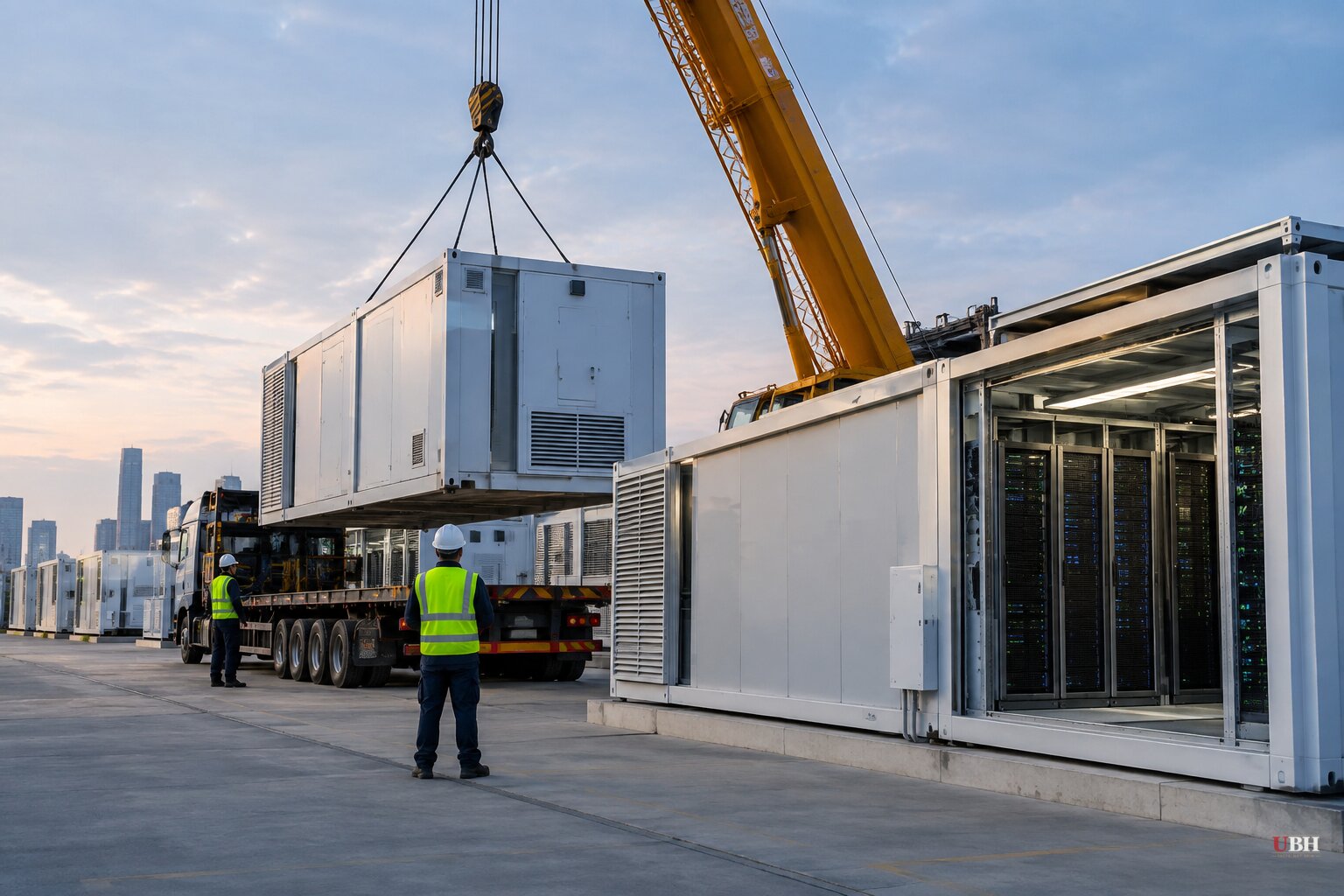
Chinese data center manufacturers want a piece of America's AI buildout, and they're betting speed and cost will get them in the door despite Washington's growing suspicion of Chinese hardware in critical infrastructure.
Brightray, a Singapore-registered AI infrastructure company, told CNBC it sees "very big potential in the U.S. market." Its sole manufacturer is Chinese firm PrefabDC, which builds prefabricated data centers; Brightray manages the construction. "The China market is equally important, but we can see that there's a stronger demand in the U.S.," said S.K. Lee, Brightray's global vice president.
The Numbers Behind the Pitch
The scale gap is real, at least by one measure. The Stanford Institute for Human-Centered Artificial Intelligence counted 5,427 AI data centers in the US in 2025, versus 449 in China, according to CNBC. Alphabet, Microsoft, Meta and Amazon are estimated to spend roughly $765 billion combined on AI infrastructure this year, and JPMorgan Chase CEO Jamie Dimon has said that figure could hit $1 trillion in 2027. China's government has outlined $295 billion in data center investment over five years, a fraction of what four US companies alone plan to spend in twelve months.
Jeffrey Ding, an AI expert and assistant professor at George Washington University, told CNBC the gap comes down to revenue: Chinese AI companies "just are not generating as much revenues from their AI services" as US rivals, which limits what they can plow back into infrastructure.
Brightray's sales pitch is speed. Superpower Daily reported the company says building much of a facility inside a factory, including the exterior shell, can cut construction time by at least half against the industry's typical two-to-three-year timeline. Brightray's claim hasn't been verified against a completed US project. Superpower Daily also reported no US contract for Brightray had been identified as of its reporting.
Washington's Security Calculus
The timing lands awkwardly. President Trump hosted Chinese President Xi Jinping in Washington for three days that included AI as a central topic of discussion, according to Latitude Media. At the same time, CNBC and Traders Union both reported the Trump administration is considering bans on Chinese open-weight AI models and new restrictions on Chinese-made data center components, citing cybersecurity risk and fears of US dependence on a strategic rival for critical infrastructure.
That concern is legitimate on its face: handing a geopolitical competitor a foothold inside facilities that run sensitive AI workloads is a real risk, and the Committee on Foreign Investment in the United States has stepped up scrutiny of foreign real estate deals near military bases and power infrastructure. But no charges, investigation, or confirmed breach tied to Chinese-made data center hardware appears in these reports. Claims about hidden "backdoors" in Chinese equipment remain warnings from unnamed industry sources, not proven findings, and should be read as allegations rather than fact.
The supply chain reality cuts against a clean ban. Benjamin Boucher, a supply-chain analyst at Wood Mackenzie, told CNBC that Chinese companies already supply transformers, batteries and fiber-optic cables into US data centers, and that American shortages of electrical equipment make Chinese suppliers attractive purely on delivery time. "It is a very challenging environment between the geopolitics recently between the tariffs we've been seeing and the recent bans," Boucher said.
Is China Really Behind?
The widely repeated CNBC framing that China's buildout "trails far behind" the US deserves a closer look. A building-level tracking model published by SemiAnalysis on September 25 puts China's actual data center capacity at more than 24 gigawatts, larger than all of EMEA, built off more than 1,000 tracked facilities across 60-plus operators. SemiAnalysis notes published estimates of China's capacity vary by as much as 15-fold because the country's biggest tenant, ByteDance, files no public disclosures and many of its landlords have never listed publicly. Alibaba, Tencent and Baidu combined spent $20 billion on capex in the second quarter of 2026 alone, more than double the prior year, all three posting negative free cash flow for the first time on record. Facility counts and gigawatt capacity measure different things, so the Stanford figure and the SemiAnalysis figure aren't directly contradictory, but the scale of China's actual buildout looks considerably bigger than the "449 facilities" framing alone suggests.
Separately, a TechBuzz.ai account of this story attributes the current wave of restrictions to "the Biden administration," which doesn't match the rest of the reporting here: Xi's Washington visit and the AI-ban discussions under review are happening on President Trump's watch, per CNBC and Latitude Media.
What happens next depends on regulators, not manufacturers. If the Trump administration finalizes bans on Chinese data center components, Brightray's US pitch may never clear customs, let alone a construction site.
Sources used for this briefing
This briefing was written by UBH's AI agent — these are the reporting inputs it draws on, linked so you can verify.


