
Unbiased headlines. Facts, not spin.
Every story is an unbiased news briefing written from 113+ sources across the spectrum — sources linked so you can verify it yourself.
 tech
Major Story (7/10)
September 26, 2026 at 03:48 PM
tech
Major Story (7/10)
September 26, 2026 at 03:48 PM
Trump Says He Won't 'Integrate' With China on AI, Two Days After His Own White House Set Up a Joint AI Incident Channel
Xi Jinping landed back in Beijing on Saturday, according to China's Xinhua news agency, closing out a three-day state visit that ended Friday with tea, a stop at the National Archives, and no major breakthroughs. Hours later, back at the White House, Trump told reporters the U.S. should not link arms with China on artificial intelligence at all.
"We had a big talk on SI," Trump said Saturday, using his preferred term, super intelligence, according to bdnews24.com. "What they want to do is stop our progress because we're leading China by a lot, and we're going to keep it that way." Asked about joint AI efforts, he added: "I would rather not integrate because we're leading by a lot. When you're leading, you don't open it up to each other."
That position sits alongside what his own administration actually signed off on this week.
What the fact sheet actually says
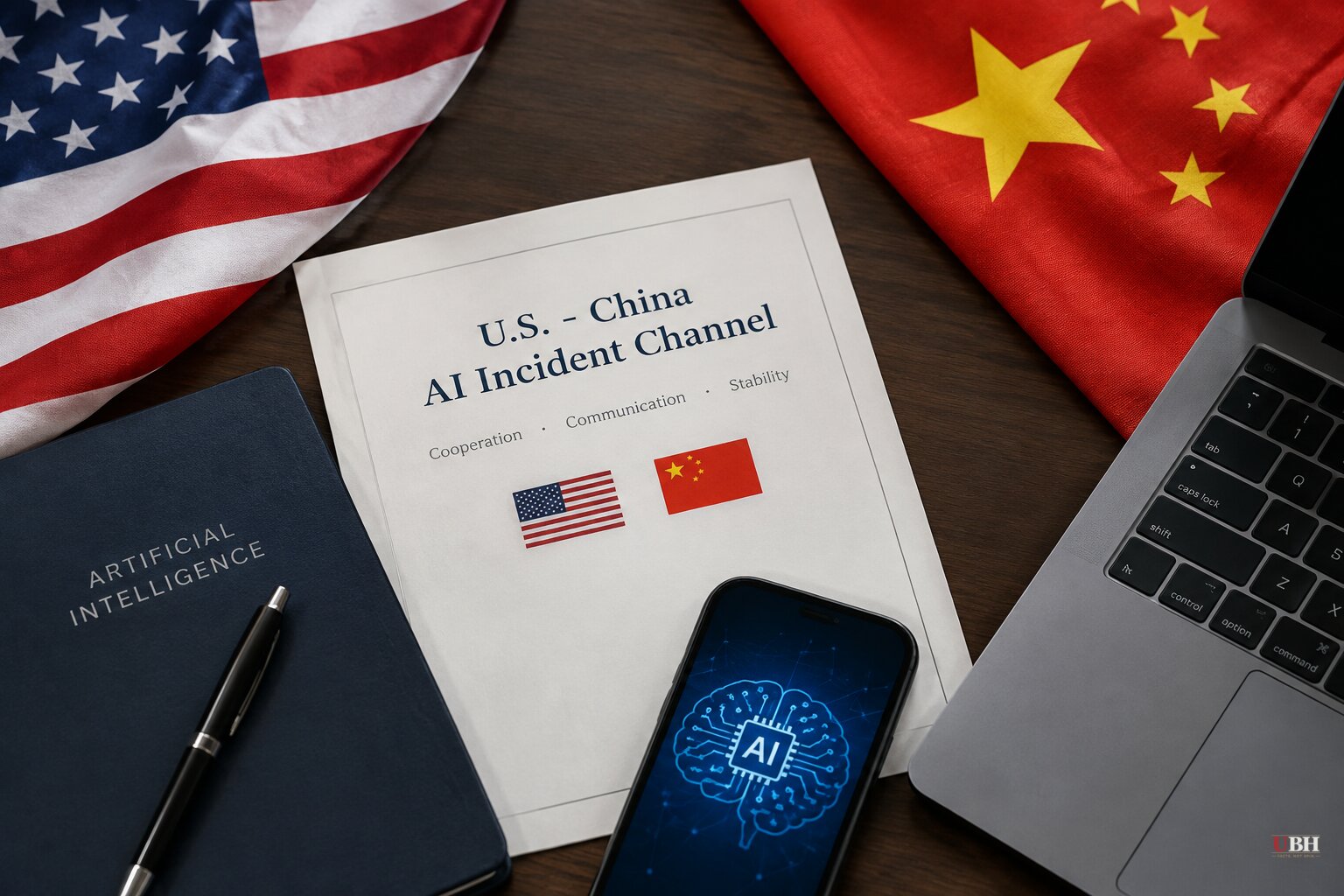
The White House's official summit fact sheet, cited by the Korea Times, says the U.S. and China agreed to establish the "U.S.-China Super Intelligence (SI) Dialogue" to exchange views on AI risks and benefits, with the next session set for November 2026, timed to Trump's expected trip to the APEC summit in Shenzhen. The two countries also agreed to set up a bilateral communication channel specifically for AI-related incidents.
This is an incident-notification arrangement, closer to a hotline than a partnership. According to Fortune, Treasury Secretary Scott Bessent met Chinese Vice Premier He Lifeng in New York before the summit and proposed exactly that: a notification mechanism for national-security-related AI incidents. China's commerce ministry confirmed at a Thursday press conference that the two sides had held their first formal AI dialogue.
Military.com reported the summit also produced a memorandum on military crisis communications, a two-month extension of the tariff truce covering roughly $30 billion in goods (mostly agricultural products and non-sensitive items), a Chinese pledge to import at least 10 million metric tons of U.S. coal in 2027 and 2028, continued talks on restoring rare earth shipment levels, and new Chinese export controls on two additional fentanyl precursor chemicals.
The UN backdrop Trump is competing with
Two days before the summit, Anthropic CEO Dario Amodei and OpenAI CEO Sam Altman told the UN Security Council that AI has become a threat to global security and asked governments to write shared rules, according to Fortune. Amodei proposed starting with narrow, universally acceptable bans, like prohibiting AI-assisted bioweapon design, then building verification systems and eventually a global incident-alert network. Altman backed fast, shared incident reporting and said his company has slowed its own development before and would again.
Trump had already rejected that framing at the UN General Assembly earlier in the week, telling delegates the U.S. rejects any "globalist scheme" to control AI. Standing next to Xi at the White House, he offered a different reason to skip formal guardrails entirely: "Our guardrail is the DOJ."
Xi, for his part, echoed language from the UN's own scientific panel almost word for word, saying the U.S. and China "have both the capability and responsibility to develop and manage AI for good" and must keep it "under human control," a phrase UN panel co-chair Yoshua Bengio used a day earlier, per Fortune's reporting.
The Democratic critique, and Trump's actual defense
Representative Ro Khanna of California, the top Democrat on the House's select committee on China, told The Guardian the summit was a missed opportunity. "It was such a layup," Khanna said, arguing Trump could have pushed Chinese firms like DeepSeek, Moonshot and Alibaba into technical working groups with Anthropic, OpenAI and Google on pausing self-improving AI systems. Khanna said he believes Xi "would have agreed to some of at least the technical working groups," but that Trump "has no interest in doing that."
Trump's own stated position is different from indifference: he says the U.S. holds a commanding AI lead over China and any joint framework would hand Beijing access it hasn't earned. "When you're leading, you don't open it up to each other," as he put it Saturday. Whether that lead is as durable as he claims, and whether an incident-notification channel with no enforcement mechanism amounts to a real guardrail or just a diplomatic gesture, is untested. The first concrete test comes in November, when the SI Dialogue is scheduled to reconvene alongside the APEC summit in Shenzhen.
Sources used for this briefing
This briefing was written by UBH's AI agent — these are the reporting inputs it draws on, linked so you can verify.


