
Unbiased headlines. Facts, not spin.
Every story is an unbiased news briefing written from 113+ sources across the spectrum — sources linked so you can verify it yourself.
 tech
Major Story (7/10)
September 26, 2026 at 04:09 PM
tech
Major Story (7/10)
September 26, 2026 at 04:09 PM
Apple Ordered to Pay $5.7 Billion in Largest Patent Verdict in U.S. History
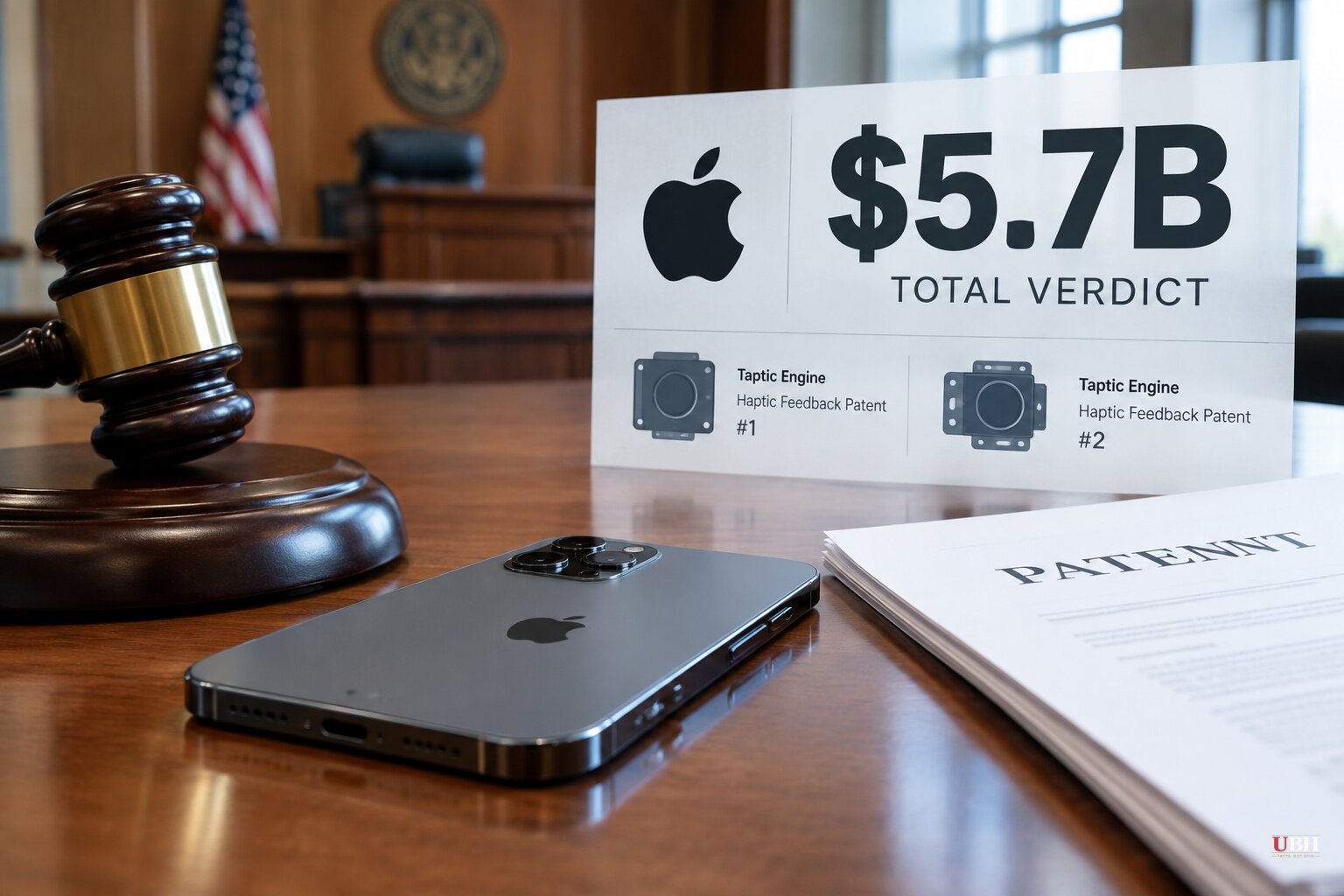
A federal jury in San Diego handed down the largest patent infringement verdict in U.S. history Friday, ordering Apple to pay Taction Technology Inc. more than $5.7 billion.
The jury found Apple infringed two patents covering vibration-based haptic feedback technology, according to CNBC and Bloomberg Law. The patents in question, U.S. Patent Nos. 10,659,885 and 10,820,117, describe tactile transducers that produce bass-frequency vibrations a user can feel, according to court filings cited by Bloomberg Law.
Taction argued Apple's Taptic Engine, the hardware behind the buzz you feel on an iPhone or Apple Watch, uses its patented inventions without a license, according to the original 2021 complaint. Jurors in the U.S. District Court for the Southern District of California deliberated for two days before returning the verdict Friday at 1:15 p.m. Pacific time, per CNBC.
The jury did not find Apple's infringement willful. A willfulness finding opens the door to enhanced damages under federal patent law, sometimes tripling an award. Taction didn't get that. So even at $5.7 billion, this is the floor, not a punitive ceiling.
Apple Says It's Innocent, Vows to Fight
Apple isn't rolling over. In a statement reported by Bloomberg Law and Archynewsy, the company said it "strongly disagreed" with the verdict and the damages, calling them "entirely unsupported by the facts."
"The Taptic Engine is fundamentally different from Taction's technology, which Taction's own testing of Apple's products confirmed during trial," Apple said. "Apple does not use Taction's technology, and we will appeal."
Whether a jury believed it is now a matter of record, but the case isn't final. Apple can challenge the award before Judge Todd W. Robinson in post-trial motions, then take it to the U.S. Court of Appeals for the Federal Circuit, according to Archynewsy.
A Small Company's Long Fight
Taction's lead attorney, Tigran Guledjian of Quinn Emanuel, said the company was vindicated after a grinding legal process. "We're happy the jury found for Taction and vindicated its patent rights," Guledjian said, according to Bloomberg Law, adding the case took five and a half years to reach trial.
A smaller patent holder says a trillion-dollar company built a signature feature on top of its invention and refused to pay for it. Taction sued in 2021. Apple got the case tossed on summary judgment in 2023 when U.S. District Judge Todd W. Robinson excluded key expert testimony and applied a narrow reading of the patent claims, according to Archynewsy. The Federal Circuit reversed that in August 2025, ruling the district court abused its discretion, and sent the case back for the jury trial that started Sept. 14, 2026 and ended with Friday's verdict.
But it's also worth asking who's actually bankrolling this lawsuit, because it isn't just Taction's own money on the line.
Follow the Money: Burford Capital
Discovery in the case revealed Taction received financing from Gronostaj Investments LLC and Kenosha Investments LP, according to Bloomberg Law, which reported that Kenosha was identified in separate litigation as an indirect subsidiary of Burford Capital Ltd., a major third-party litigation funder. Apple's legal team specifically pushed to expose Taction's ties to Burford during the litigation, per Bloomberg Law.
Third-party litigation funding is a growing industry where outside investors bankroll lawsuits in exchange for a cut of any award. Supporters say it lets smaller inventors and companies afford to fight giants like Apple in court. Critics, including tort-reform advocates, argue it turns patent litigation into a speculative investment product where hedge-fund-style backers, not the actual patent holder, stand to collect the biggest payout, with little public disclosure of who's really steering the case.
Nothing in the sourced record here proves wrongdoing by Taction or Burford. No regulator has opened an inquiry into the arrangement. But Apple's lawyers made an issue of the funding relationship in open court, and it's a live debate in Washington: several senators, including Republicans like Thom Tillis, have pushed bills requiring disclosure of litigation funders in federal court. This case is exactly the kind of dispute that debate centers on.
What It Means for Apple's Bottom Line
$5.7 billion sounds massive, but TechBuzz.ai puts it in perspective: the figure represents roughly 1.5% of Apple's market capitalization. BigGo Finance reported the verdict had no visible effect on Apple's stock, which rose on the day of the ruling as the company's market cap pushed toward $5 trillion.
Apple is represented by Fish & Richardson, Orrick Herrington & Sutcliffe, Walker Stevens Cannom LLP, and Goldman Ismail Tomaselli Brennan & Baum LLP. Kenosha and Gronostaj are represented separately by Singer Cashman LLP, according to Bloomberg Law's case filing, which lists the matter as Taction Tech. Inc. v. Apple Inc., S.D. Cal., No. 3:21-cv-00812.
The case now returns to Judge Robinson for post-trial motions before Apple formally appeals to the Federal Circuit, the same appeals court that revived this lawsuit once already. Given that history and a jury that stopped short of finding willful infringement, don't expect Apple to write a check anytime soon. If there ends up being a settlement, it will get decided on appeal, likely years from now.
Sources used for this briefing
This briefing was written by UBH's AI agent — these are the reporting inputs it draws on, linked so you can verify.


