
Unbiased headlines. Facts, not spin.
Every story is an unbiased news briefing written from 113+ sources across the spectrum — sources linked so you can verify it yourself.
 defense
Major Story (8/10)
October 5, 2026 at 12:49 PM
defense
Major Story (8/10)
October 5, 2026 at 12:49 PM
NATO's Top Commander Readies Drone and AI War Plan, Set to Unveil It in Poland on October 12
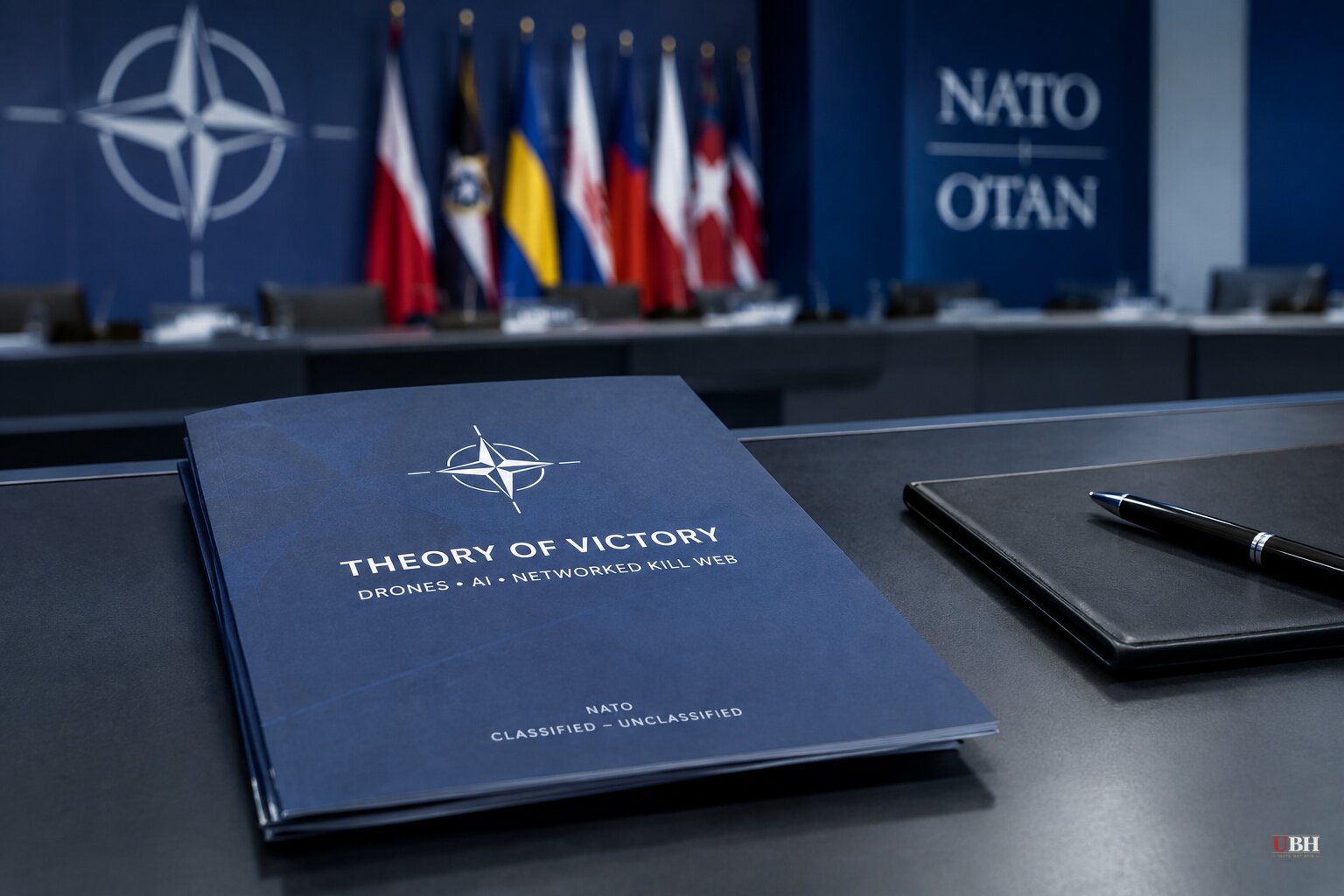
NATO's Supreme Allied Commander Europe, General Alexus Grynkewich, is set to present a new war-fighting strategy in Poland on October 12. Bloomberg reported it reviewed an unclassified version of the document, titled "Theory of Victory," after speaking with senior officials and diplomats familiar with the plan.
The pitch is simple: if Russia attacks a NATO member, win fast. Not grind it out. Win before Moscow achieves its opening objectives.
What's actually in it
The strategy folds into a larger framework called the Eastern Flank Deterrence Initiative, which Crypto Briefing reported covers roughly 3,500 kilometers of territory from Finland down to the Black Sea. Strategic documents from July 2026 name Russia as the alliance's primary adversary, according to Crypto Briefing. No hedging there.
The centerpiece concept is what planners call a "Kill Web": a networked grid of drones, sensors, satellites and ground robots strung across the eastern border. When one node detects something, the whole network knows, and AI is supposed to fuse that data into a single picture fast enough to act on it.
The slogan NATO is using internally, per Crypto Briefing, is blunt: "See first. Decide first. Strike first."
One specific feature is a forward autonomous zone, where uncrewed systems would take the first hits of an attack before conventional forces engage. United24 Media reported the approach draws directly on Ukraine's experience, where AI-guided drones have identified and struck targets even after Russian electronic warfare cut human control links.
Human control over lethal decisions stays intact on paper. NATO's framing, echoed across the reporting, is that AI flags and recommends, and people still pull the trigger.
Who's saying what
Grynkewich's spokesman, Colonel Martin O'Donnell, kept it vague on specifics but was clear on intent. "The Supreme Allied Commander Europe's 'Theory of Victory' is simple: preserve NATO's advantage," O'Donnell said, according to UNN's translation of Bloomberg's reporting. "Given the unstable and complex global security situation, we need to create the conditions now to deter aggression and, if necessary, prevail in the event of an attack."
That's a defensive framing, and NATO is sticking to it. The alliance has repeatedly stressed, per UNN, that the plan is "purely defensive" and meant to avoid unintended escalation.
NATO officials disagree on the threat
NATO Secretary General Mark Rutte said recently there are no signs Russia is preparing a conventional attack on the alliance, but that Europe still needs to brace for sustained hybrid attacks, according to UNN.
That's a notably more measured read than what's coming out of Warsaw. NPR reported that Polish Prime Minister Donald Tusk has warned of intelligence assessments suggesting Russia is planning drone and missile strikes against countries supporting Ukraine, specifically naming Poland and Romania. NPR's Mary Louise Kelly pressed Romanian Foreign Minister Oana-Silvia Țoiu and Polish Deputy Prime Minister Radoslaw Sikorski on whether NATO, and the United States specifically, would actually honor collective defense commitments if that happened.
Both readings can be fair at once. Rutte's point is that there's no evidence of massed conventional forces staging for an invasion. Tusk's warning is about drone and missile strikes, hybrid-style attacks that fall below that threshold but still hit NATO soil. UNN separately reported, citing the Financial Times, that Estonia is already moving troops closer to the Russian border as a precaution.
Money and troops
Tribune.net.ph reported the plan arrives as European members debate how much new defense spending should go to traditional hardware like tanks versus the drones and AI systems that dominated the Ukraine war. The outlet also reported that Washington has separately asked NATO allies what additional forces they could contribute to Grynkewich's plans, while the U.S. reviews its own military commitments in Europe. If the plan leans on allied troop contributions while the U.S. role shrinks, that is a real burden-sharing fight waiting to happen, not a hypothetical one.
German Chancellor Friedrich Merz traveled to Kyiv Sunday to reaffirm support for Ukraine as Russian strikes on Ukrainian cities intensified, according to the Associated Press, as carried by Breitbart. Merz warned that "if Russia is not stopped, its war machine will sooner or later turn against us." Germany has sent Ukraine more than €43.3 billion ($48.8 billion) since the war began, per the AP's reporting.
The key question going forward is whether NATO member governments actually fund the Kill Web at the scale the plan assumes, and whether Washington's troop-contribution review in Europe ends up matching or undercutting what Grynkewich is about to ask allies to commit.
Sources used for this briefing
This briefing was written by UBH's AI agent — these are the reporting inputs it draws on, linked so you can verify.


