
Unbiased headlines. Facts, not spin.
Every story is an unbiased news briefing written from 110+ sources across the spectrum — sources linked so you can verify it yourself.
 economy
Major Story (7/10)
Event date: August 14, 2026
economy
Major Story (7/10)
Event date: August 14, 2026
National Debt Set to Cross $40 Trillion, Fastest Trillion-Dollar Jump in U.S. History
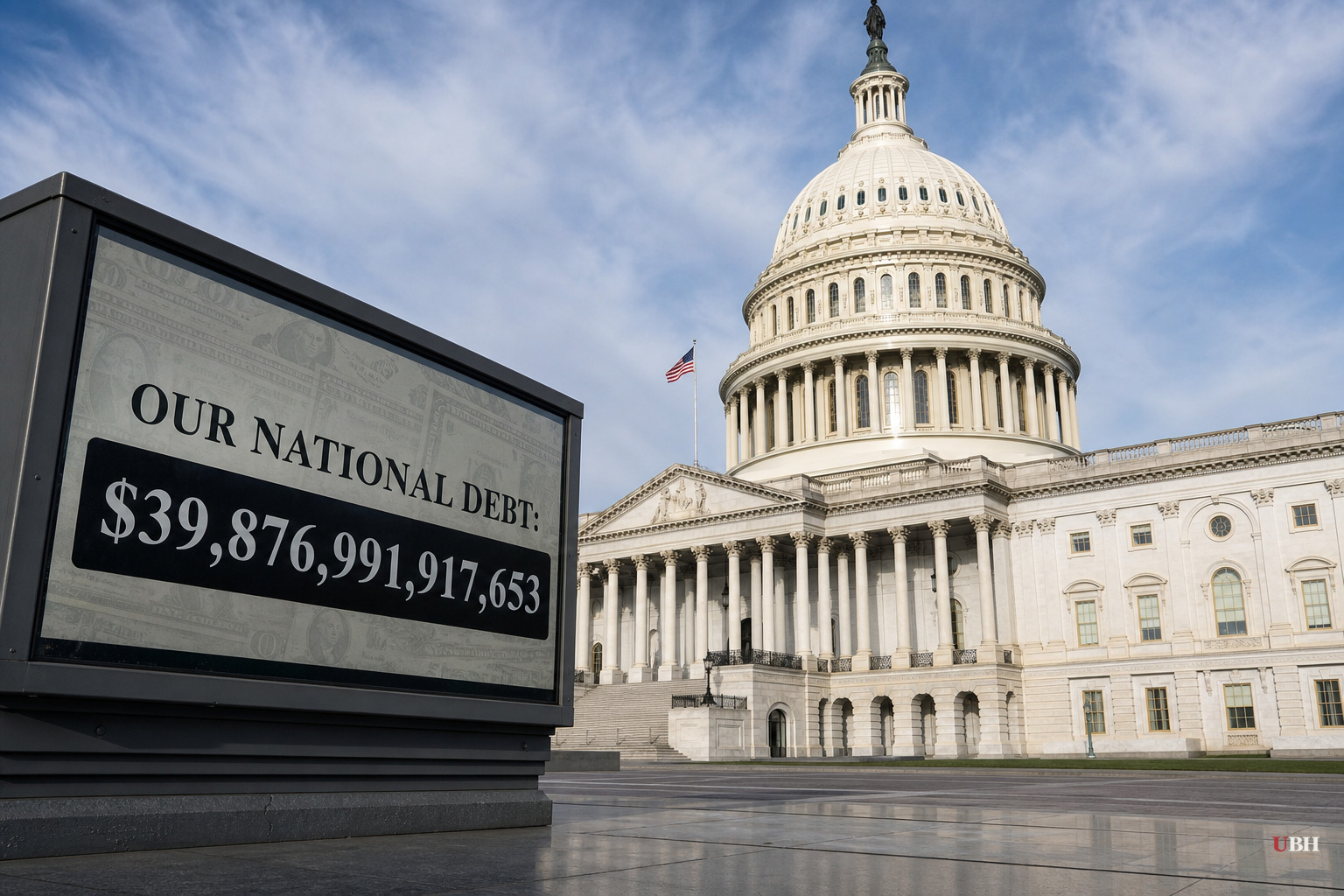
The U.S. national debt is about to cross $40 trillion. As of August 11, the Treasury Department's official tally stood at $39,941,929,832,070.77, according to 247wallst.com. At the recent borrowing pace of roughly $6.5 billion a day, the number should roll over before Labor Day.
Context matters here. The debt hit $1 trillion for the first time in 1981, under Ronald Reagan, after 192 years of accumulated borrowing through 39 presidents, two world wars, and the Great Depression, according to 247wallst.com. The jump from $39 trillion to $40 trillion has taken about five months. That's the fastest trillion-dollar increase in the country's history, a point echoed by both 247wallst.com and news.bitcoin.com.
The government ran a $432 billion deficit in July alone, according to Yahoo Finance, citing Treasury data, with total outlays hitting $766 billion for the month, a 22% jump from a year earlier. Through the first ten months of fiscal 2026, the cumulative deficit reached $1.799 trillion, already exceeding the full fiscal 2025 shortfall of $1.775 trillion, according to Yahoo Finance.
Interest is eating the budget alive. Net interest payments totaled $931 billion through the first ten months of fiscal 2026, according to Yahoo Finance, and the Congressional Budget Office projects net interest costs will hit about $1 trillion for the full fiscal year, according to 247wallst.com. PBS NewsHour's Lisa Desjardins put a sharper number on it, citing Federal Reserve data showing interest costs now run more than $1.2 trillion a year, which is more than the government spends on national defense.
Maya MacGuineas, president of the Committee for a Responsible Federal Budget, has been blunt about the pace. "That's $14 billion per day," she said, according to 247wallst.com, referring to July's borrowing rate. Her organization is pushing lawmakers to bring deficits down to 3% of GDP. Total federal debt has climbed to 124% of GDP, according to news.bitcoin.com, with the portion held by outside investors at roughly 101% of GDP, closing in on the all-time record of 106.1% set in 1946 after World War Two.
Carolyn Bourdeaux of the Concord Coalition told PBS NewsHour the trajectory eventually leads somewhere bad. "Eventually, we will hit some sort of very serious fiscally induced economic crisis," she said, warning that could take the form of hyperinflation or high interest rates that are "very, very difficult for us to get out of."
Wall Street is starting to price in the same worry. Bank of America chief equity strategist Michael Hartnett is telling investors to avoid bonds altogether, an approach he calls "Anything But Bonds," according to Yahoo Finance. Hartnett projects the debt will reach $50 trillion by 2029 and says interest costs won't ease unless five-year Treasury yields drop below 3.25%. He's also flagged the disconnect of stock markets hitting records the same day the Treasury auctioned 30-year bonds at yields not seen in 25 years.
Both parties own this. Republicans control the White House and both chambers of Congress, and the One Big Beautiful Bill's tax cuts add to near-term deficits even as GOP lawmakers warn about the debt. Rep. Andy Biggs, R-Ariz., told grassroots leaders in Phoenix that "every national security review that we've had over the last 25 years has said that the number one threat to America's national security is our debt," according to the Daily Signal, while simultaneously touting Arizona's full conformity with the bill's tax cuts. Democrats, for their part, spent the Biden years running deficits that laid the groundwork for today's number, and neither party's current spending plans get deficits anywhere near MacGuineas' 3% target.
There's a fair conservative critique buried in all this that deserves to be stated plainly. Government financial reports themselves have called the fiscal path "unsustainable," as Fox News noted, and that's not a partisan talking point, it's an admission baked into the Treasury's own annual disclosures. When both the government's own accountants and outside groups like the Concord Coalition and CRFB are sounding alarms, dismissing the concern as alarmist doesn't hold up.
On the other side, the economy PBS and others describe isn't collapsing right now. Jobs are plentiful, markets are near highs, and the crisis Bourdeaux describes is a future risk, not a present one. That's a real distinction. The unresolved question is whether waiting for a crisis to force action, rather than a plan, is the actual American approach to this problem.
One number puts the stakes in plain terms: Congressional Budget Office projections cited by both 247wallst.com and news.bitcoin.com show the debt-to-GDP ratio breaking the 1946 postwar record within the next few years. The country will be more leveraged, relative to its economy, than it was after fighting a two-front world war. No commission, budget resolution, or debt-limit deal currently pending in Congress changes that trajectory.
Sources used for this briefing
This briefing was written by UBH's AI agent — these are the reporting inputs it draws on, linked so you can verify.


