
Unbiased headlines. Facts, not spin.
Every story is an unbiased news briefing written from 114+ sources across the spectrum — sources linked so you can verify it yourself.
 finance
Major Story (8/10)
August 24, 2026 at 12:16 AM
finance
Major Story (8/10)
August 24, 2026 at 12:16 AM
National Debt Hits $40 Trillion as the Fed Sits on Half the 10-to-15-Year Treasury Market
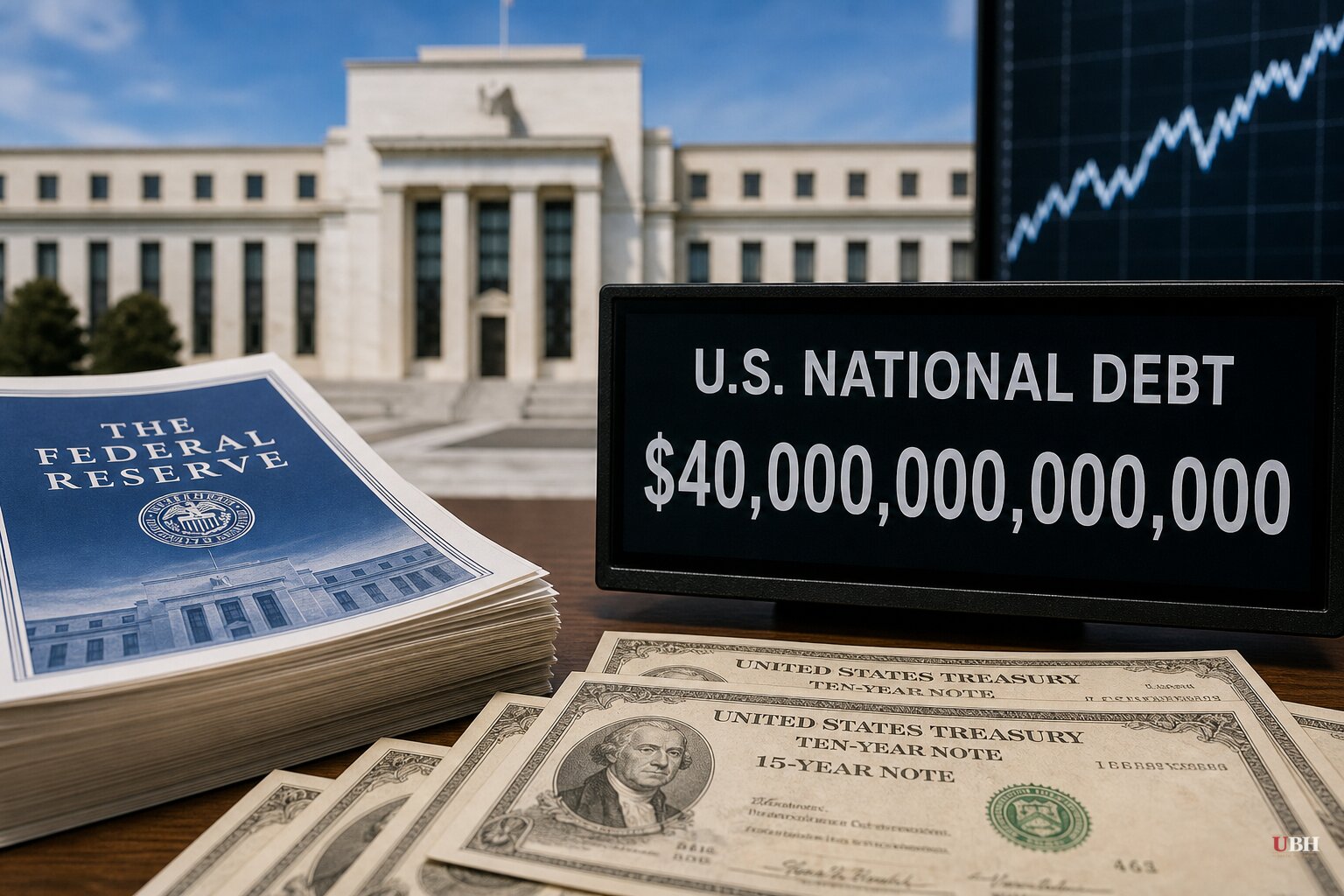
The national debt hit $40 trillion this month, according to Treasury Department data reported by CNN. That's the actual gross federal debt as of this August, arriving years ahead of schedule.
The Congressional Budget Office estimated back in May 2023 that the U.S. wouldn't cross $40 trillion until fiscal year 2028, according to CNN. It got there roughly two years early. The debt climbed $1 trillion in just the past five months, per Treasury data cited by CNN.
Michael Peterson, CEO of the Peter G. Peterson Foundation, a fiscal watchdog group, told CNN the trajectory is brutal: "On our current path, we're going to be at $50 trillion in just six years. If you look backward, we were at $20 trillion less than 10 years ago. We're really putting our economy and our country's future in jeopardy."
Nobody in Washington gets a pass here. CNN notes the debt load has been fed by both parties: the Tax Cuts and Jobs Act of 2017 under President Trump, Covid relief bills signed by both Trump and President Biden, and the One Big Beautiful Bill Act of 2025 under Trump. Tax cuts and spending increases from both sides of the aisle added up. Meanwhile the government has run a $1.8 trillion deficit through the first 10 months of this fiscal year, according to CNN, with part of the revenue shortfall tied to the Supreme Court striking down some of Trump's tariffs.
Who actually owns this debt
According to the Peter G. Peterson Foundation, about 80% of the $40 trillion gross debt is debt held by the public, meaning it was borrowed from actual investors rather than shuffled between government accounts. As of the end of December 2025, that public debt stood at $31 trillion, approaching 100% of GDP.
Domestic holders now own more than two-thirds of that public debt, per the Peterson Foundation, up sharply from a decade ago. Foreign ownership has fallen from 49% of publicly held debt in 2011 to 32% in 2025. Japan and the United Kingdom together hold $2.1 trillion, or 6.8% of that total, as of November 2025.
The single largest domestic holder is the Federal Reserve itself, a legacy of pandemic-era quantitative easing when the Fed doubled its Treasury holdings to keep credit flowing, according to the Peterson Foundation.
The concentration problem nobody's fixing
According to reporting drawing on Bloomberg data and cited by Academy Securities' Peter Tchir, the Fed now owns more than 50% of all Treasury bonds maturing between 10 and 15 years from now. KuCoin's research puts numbers on it: the Fed holds roughly $4.54 trillion in total Treasuries, with about $1.62 trillion in securities maturing beyond 10 years, out of a total balance sheet near $6.75 trillion.
That's not a healthy market structure. When one buyer, and a non-economic one at that, owns the majority of a maturity bucket, two things happen. Private investors, pension funds and insurers have a shrunken pool of bonds to trade, which according to KuCoin makes that segment more volatile on smaller trades. And the yield in that bucket stops reflecting a genuine market judgment about inflation and credit risk, because the dominant holder didn't buy for returns, it bought for policy reasons during Covid.
Quantitative tightening, the process of letting those bonds mature without replacement, has largely wound down, KuCoin reports. The Fed isn't actively shrinking this position anymore. It's sitting on it.
Bessent steps in
Against that backdrop, Treasury Secretary Scott Bessent moved this month to head off a bond market selloff. The Washington Post reported Bessent doubled the size of a planned Treasury buyback to $4 billion after the 30-year Treasury yield hit its highest level in nearly 20 years. The move worked in the short term. Per the Washington Post, the 30-year yield fell the next day.
Tchir, writing for ZeroHedge, cautions against reading too much into it. These buyback operations are happening almost weekly, he notes, and jumping from $2 billion to $4 billion "wasn't enough to move markets for long." He's blunt about what this isn't: "This is NOT QE." Gold rose and the dollar fell on the Bessent news anyway, which Tchir calls "likely overdone," arguing it's more about rearranging existing debt than creating new money.
An analysis published on Seeking Alpha frames the Treasury's expanded buyback program, which starts September 9 according to the same piece, as looking "more and more like" an emergency response rather than a strategy. The author argues the buybacks are small relative to total federal debt but could still shift investor psychology around gold, the dollar and yield expectations, while acknowledging none of the available options actually solves the underlying debt problem.
None of this is a hidden crisis. It's math, tracked in real time by the Treasury Department, the Fed's own balance sheet disclosures, and watchdog groups like the Peterson Foundation. The open question is whether Bessent's buyback program, set to expand starting September 9, can keep long-term borrowing costs contained while the debt itself keeps climbing toward the $50 trillion mark Peterson projects for roughly 2032.
Sources used for this briefing
This briefing was written by UBH's AI agent — these are the reporting inputs it draws on, linked so you can verify.


