
Unbiased headlines. Facts, not spin.
Unbiased Headlines is an independently owned news organization. We bring you the facts, not opinions, written fresh from 110+ named sources. Sources linked so you can verify it yourself.
 finance
Major Story (7/10)
Event date: October 19, 2026 ·
Nasdaq Drops 4.5% in Worst Week Since June as AI Debt Fears Collide With 5% Yields and $110 Oil
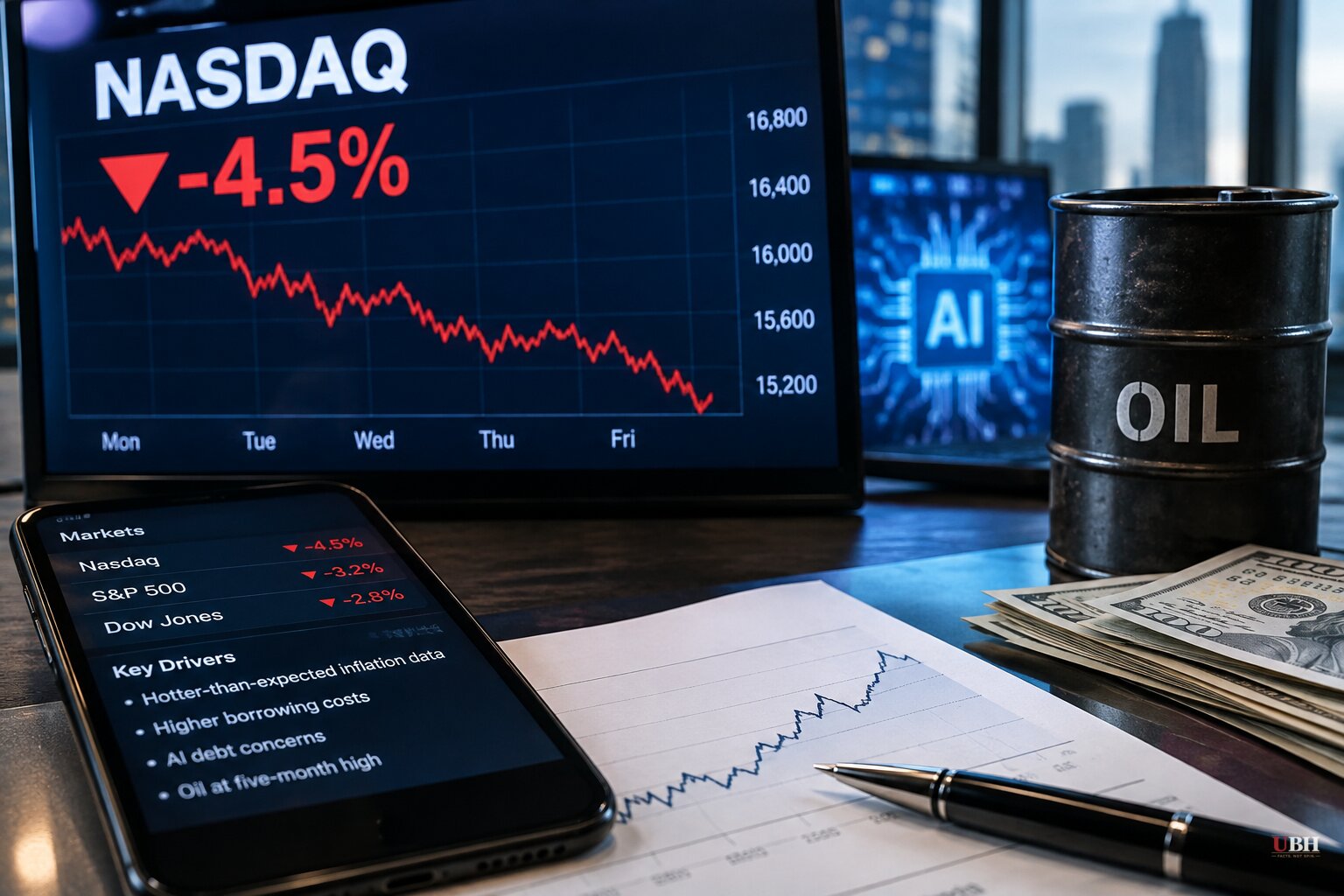
The Nasdaq Composite fell 2.14% on Friday, Oct. 23, and finished the week down roughly 4.5%. That is its worst week since June. The S&P 500 dropped 1.09% on Friday and nearly 2% for the week, also its worst since June.
Both indexes hit record highs about 10 days earlier. The Dow Jones Industrial Average, by contrast, gained 0.67% for the week and closed at 52,000. The small-cap Russell 2000 lost 3.05%.
The AI debt trade cracks
The damage was concentrated in the debt-funded corners of the AI boom. CoreWeave, the Nvidia-backed "neocloud" that rents computing power and went public in March 2025, lost about a quarter of its value for the week. It is down more than 65% from its post-IPO peak. Its bond yields have surged to levels that signal distress, and the cost of insuring its debt jumped.
Nebius Group fell more than 25% on the week. Palantir dropped 7.22% on Friday.
Gil Luria, head of technology research at D.A. Davidson, told CNN that CoreWeave may not earn enough to pay down what it borrowed. "They are the subprime tranche of the AI trade, and that's why they're selling off first," he said. Luria added that he believes AI demand is real and growing.
Nvidia CEO Jensen Huang told Bloomberg on Thursday that he is optimistic about CoreWeave. The stock rallied that day, then gave it back on Friday.
Chipmakers took a beating. The semiconductor index fell 3.8% on Friday, its eighth straight daily decline, and 11.4% on the week. That is its worst week since April 2025. The index plunged almost 7% on Thursday alone. Meta dropped nearly 8% that day.
Inflation, oil and the bond market
The sell-off followed a hotter-than-expected inflation report that pushed Treasury yields higher. The 10-year yield hit 5.36% on Oct. 7, its highest since April 2002. It was still above 5.30% midweek.
Then investors ran for safety. On Thursday the 10-year yield fell about 13 basis points to 5.05% at the close, and as much as 19 basis points intraday. It was the biggest one-day drop since March 2023. Yields stayed under 5% on Friday.
Oil keeps adding pressure. Brent crude reached a five-month high on Friday, touching $110 a barrel during U.S. hours and as high as $114 in earlier trading. Houthi attacks on Saudi Arabia drove part of the move, along with reports that the U.S. and Israel have drawn up plans for renewed strikes on Iran after the U.S. midterm elections. European natural gas rose another 4% and is almost 30% higher this month.
Skyler Weinand, chief investment officer of Regan Capital, told The Epoch Times that the inflation data strengthens his view that the Fed will begin raising rates. He expects a pause in October, then hikes starting in December and running through June 2027.
Traders are leaning the same way, though less firmly than a week ago. An implied December Fed hike probability has fallen to 85%. Almost a full quarter-point of 2027 tightening has been stripped out this week. Deutsche Bank's Jim Reid noted that the odds of a December ECB hike dropped to 69% from 90%.
Not everyone sees a warning
Breitbart Business Digest argued that the falling yields are no sign of a downturn. It said the earlier climb to 5.36% came mostly from rising real yields, which it read as a booming economy and record-low layoffs. Yields near 5% are "hardly a sign that the bond vigilantes see a downturn on the horizon," it wrote.
The same column pointed to GMO's Ben Inker and John Pease, who argued that demand for fresh capital to fund AI investment could outstrip supply. That is the funding squeeze CoreWeave is now facing.
Global spillover
The damage was not confined to Wall Street. Japan's Nikkei ended the week down more than 4%. South Korea's Kospi shed as much as 4% early Friday before closing higher. Hong Kong's Hang Seng rose 0.7% Friday after a 3% drop Thursday.
In Europe, the gap between French and German bond yields widened to levels last seen in the eurozone crisis. It eased on Friday. Societe Generale's Kit Juckes called it "a nervy market," with oil "grinding higher" and an "inevitable correction in tech after its huge run-up."
What comes next
U.S. markets are closed for the weekend. The next test is the Federal Open Market Committee meeting next week under Fed Chair Kevin Warsh. Breitbart's weekly column says markets already believe they know what the committee will do.
The open question is whether a December hike stays priced in if oil holds above $110 and AI-linked credit keeps widening, or whether the Treasury rally keeps stripping out rate-hike bets.
Sources used for this briefing
6 links from 6 independent newsrooms (syndicated copies of the same report count once)
These are the sources it draws on, linked so you can verify.


