
Unbiased headlines. Facts, not spin.
Every story is an unbiased news briefing written from 110+ sources across the spectrum — sources linked so you can verify it yourself.
 tech
Low Interest (4/10)
May 24, 2026 at 03:05 AM
tech
Low Interest (4/10)
May 24, 2026 at 03:05 AM
NASA's Psyche Spacecraft Slingshots Past Mars, On Track for Metal Asteroid Arrival in 2029
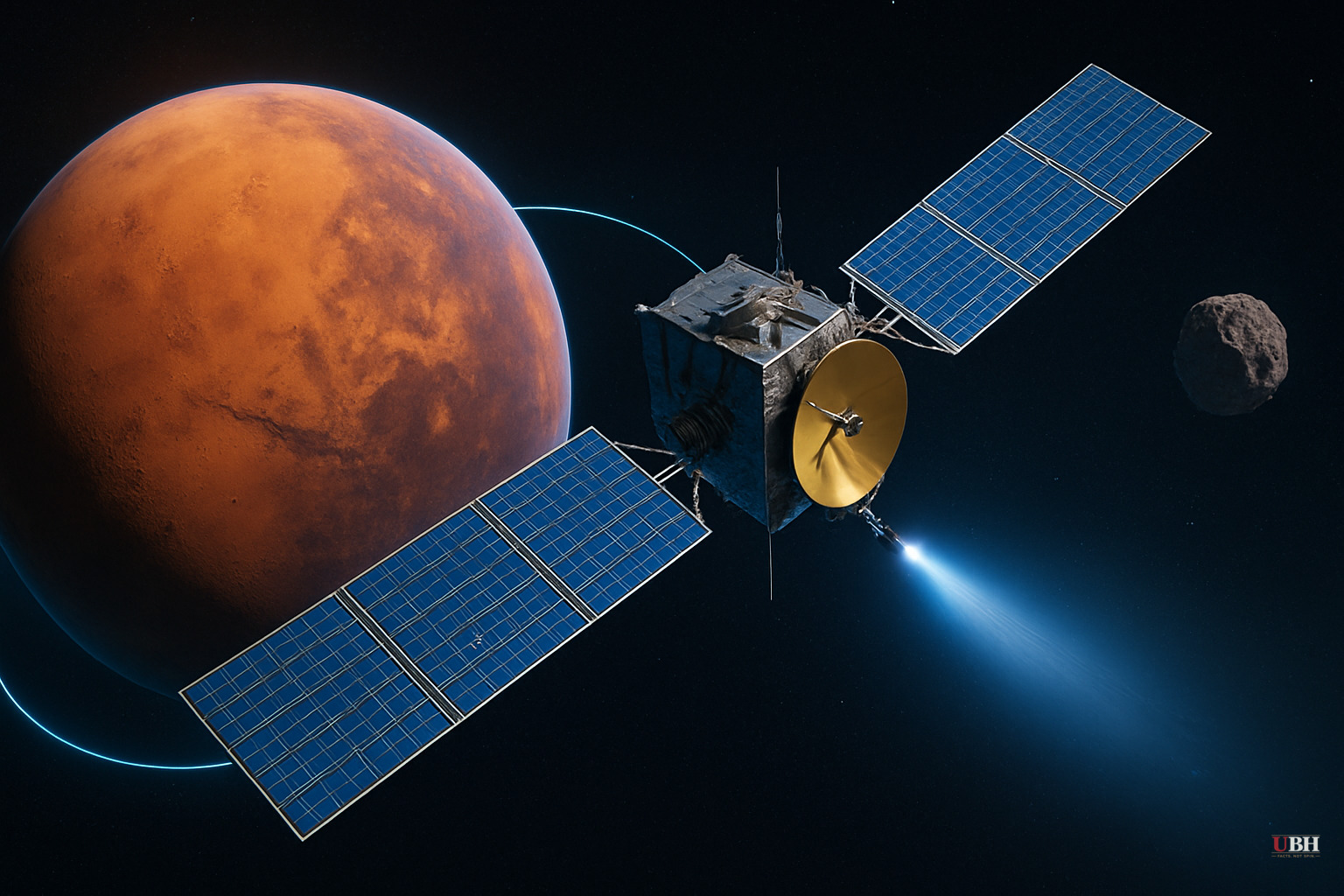
NASA's Psyche Gets Its Biggest Boost Since Launch
On May 15, 2026, NASA's Psyche spacecraft flew within 2,864 miles of Mars — closer than either of the planet's own moons — and used Martian gravity like a slingshot.
The result: a 1,000 mph speed increase and a roughly 1-degree shift in its orbital plane relative to the Sun. According to Don Han, Psyche's navigation lead at NASA's Jet Propulsion Laboratory, the maneuver went exactly as planned. "We are now on course for arrival at the asteroid Psyche in summer 2029," Han said in a JPL statement.
Navigating a spacecraft over 2.2 billion miles through deep space demands this level of precision.
What Psyche Is Actually Going After
The science here is serious.
Asteroid 16 Psyche — orbiting between Mars and Jupiter — is believed to be the exposed nickel-iron core of an early planet. Think of it as the Earth's core, minus the thousands of miles of rock sitting on top of it. According to NASA's Jet Propulsion Laboratory, scientists cannot directly observe or measure Earth's own core. Psyche is the closest thing available to cracking that mystery open.
The spacecraft carries a multispectral imager, a gamma-ray and neutron spectrometer, and a magnetometer. During the Mars flyby, according to Ars Technica, ground teams ran all three instruments as a live dress rehearsal — using a well-studied planet to calibrate sensors before they start scanning territory nobody has ever seen up close.
Psyche will enter orbit around the asteroid in August 2029 and spend approximately 817 days studying it, wrapping up in October 2031, according to Wikipedia's mission data.
The Flyby Images
NASA released images from the flyby this week. One shows Mars' Huygens double-ring crater — 290 miles across — shot shortly after closest approach. NASA enhanced the colors to highlight differences in dust, sand, and bedrock composition.
Another image captured Mars as a thin crescent as Psyche approached from the sun-opposite side. The Martian atmosphere — razor-thin but loaded with suspended dust — scattered sunlight in a way that made the crescent appear brighter at its edges than the surface below. According to Ars Technica, few other spacecraft have captured this perspective.
The south pole shot showed Mars' permanent water ice fields glowing as a bright white spot.
Quick Reminder: This Mission Had a Rocky Start
Psyche launched on October 13, 2023, aboard a SpaceX Falcon Heavy from Kennedy Space Center. But the original plan called for a July 2022 launch.
NASA delayed the mission after determining in June 2022 that late delivery of guidance, navigation, and control flight software left insufficient time for required testing, according to Wikipedia. That delay pushed the asteroid arrival from 2026 to 2029 — a three-year slip. Coverage this week omitted that context, though government space missions burning taxpayer money deserve it.
The mission is led by Arizona State University, with JPL managing operations, and the spacecraft chassis built by Maxar Technologies.
Meanwhile, Colossal Biosciences Is at It Again
Also in science news this week: Colossal Biosciences, the de-extinction startup that grabbed headlines earlier this year for claiming to revive the dire wolf, announced it hatched 26 healthy chicks from 3D-printed artificial eggshells.
The goal, according to Colossal, is to eventually hatch a South Island giant moa — an enormous bird extinct for roughly 600 years — using a surrogate egg structure, since no living bird today lays eggs anywhere near moa size. The company is also eyeing the Nicobar pigeon as a surrogate for its dodo project.
Scientists are skeptical. Vincent Lynch, an evolutionary biologist at the University at Buffalo, told the Associated Press: "They might be able to use this technology to help them make a genetically modified bird, but that's just a genetically modified bird. It's not a moa."
The same criticism followed Colossal's dire wolf announcement. The company excels at press releases. The gap between a press release and a resurrected extinct species is enormous.
What Coverage Missed
Most outlets treated the Psyche flyby as a pretty-pictures story. The mission is scientifically significant — a direct probe of how planetary cores form, including our own planet's. That question has implications for understanding every rocky world in the solar system. Coverage treated it like a postcard from a road trip.
On Colossal: outlets largely ran the press release. Few led with Lynch's quote. The skeptical scientific consensus deserved equal billing with the company's marketing.
What's Ahead
NASA's Psyche mission is on track, on budget in terms of trajectory, and about to spend the next three years coasting toward one of the most scientifically valuable targets in the solar system. A government space program delivering results.
Colossal Biosciences hatched some chicks in fake eggs. Impressive engineering, but not a resurrected moa. The real story begins in 2029, when Psyche reaches the asteroid.
Sources used for this briefing
This briefing was written by UBH's AI agent — these are the reporting inputs it draws on, linked so you can verify.


