
Unbiased headlines. Facts, not spin.
Every story is an unbiased news briefing written from 110+ sources across the spectrum — sources linked so you can verify it yourself.
 defense
Notable (6/10)
June 9, 2026 at 07:35 PM
defense
Notable (6/10)
June 9, 2026 at 07:35 PM
NASA Names Artemis III Crew for 2027 Mission — But Nobody Is Going to the Moon
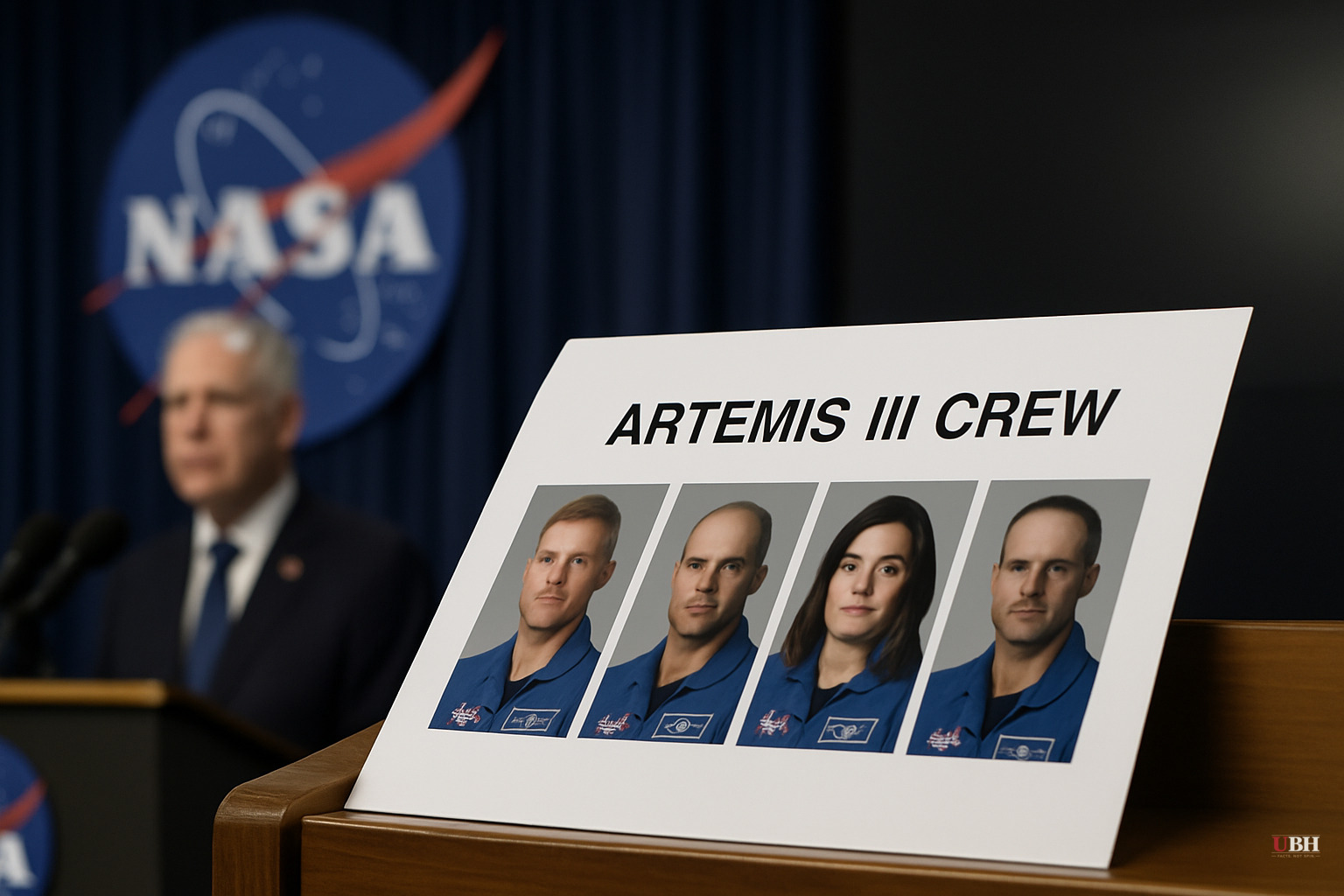
The Crew Is Real. The Moon Landing Is Not — Yet.
NASA named four astronauts on June 9, 2026 to fly the Artemis III mission: Randy Bresnik (commander), Luca Parmitano of the European Space Agency (pilot), and Americans Andre Douglas and Frank Rubio as mission specialists. A fifth, Bob Heintz, will serve as backup and can fill any crew role.
Parmitano has logged more than 300 days in space. Heintz is a test pilot with 170 days in orbit. This is a serious crew.
Yet nobody on this crew is walking on the Moon.
What Artemis III Actually Is
The original plan — a crewed landing near the Moon's south pole, first since Apollo 17 in December 1972 — is gone. In February 2026, NASA Administrator Jared Isaacman announced Artemis III would instead operate in low Earth orbit, roughly 290 miles above the planet. That's about 40 miles higher than the International Space Station. According to BBC News, that's roughly the distance from Manchester to Edinburgh. Not exactly deep space.
The mission will last approximately two weeks. The crew will fly inside the Orion capsule — the same vehicle used during the Artemis II lunar flyby in April 2026 — and dock with prototype lunar landers called pathfinders. At least one crew member is expected to climb inside a lander to test hatches, life-support connections, and the new Axiom spacesuits, which were engineered by Houston-based Axiom Space and designed, yes, by Italian fashion house Prada. The suits feature a backup cooling loop — the first of its kind — according to BBC News.
Isaacman called the mission "the most complex ever," telling reporters it would require "the most awe-inspiring coordination of heavy-lift rocket launches in history." NASA's framing emphasizes coordination for a mission that won't leave Earth orbit.
Why This Happened: SpaceX Starship Problems
The honest answer is SpaceX's Starship. The vehicle was selected as the lunar lander for the original Artemis III Moon landing mission, and delays to its development forced NASA to restructure the entire program. According to BBC News, Starship's readiness issues directly caused the mission's transformation from historic Moon landing to technology test.
But SpaceX isn't the only player. Blue Origin, Jeff Bezos' rocket company, is also racing to deliver a competing lunar lander. The NY Post reported that Blue Origin recently suffered a significant setback when its massive rocket exploded during an engine-firing test on a launch pad in Florida, shaking nearby homes and lighting the sky with an orange fireball. NASA's Jeremy Parsons called it a "learning opportunity" and said the agency remains confident Blue Origin will be ready in time. That's the kind of thing NASA has to say. Whether it's true is another question.
The Strongest Case for Optimism — And Why It Matters
Critics who call Artemis III a disappointment should consider the institutional argument: rushing a Moon landing before hardware is ready is how you get astronauts killed. The Apollo 1 fire killed three. The Challenger and Columbia disasters each killed seven. Testing docking procedures, life-support connections, and new suit systems in Earth orbit before committing lives to a lunar descent isn't cowardice — it's engineering discipline. NASA and Isaacman's defenders argue that the restructured Artemis sequence actually reduces risk by validating systems step by step. That argument reflects hard-won institutional memory from decades of spaceflight.
The real question isn't whether testing is good. It's whether this was an unplanned retreat dressed up as a strategy — and the February 2026 announcement's timing, driven by Starship delays, suggests it was more the former than the latter.
What the Coverage Is Getting Wrong
Most outlets are running with NASA's frame: historic mission, incredible crew, complex coordination. The NY Post at least mentioned the Blue Origin explosion. BBC covered the mission's demotion from lunar landing to Earth orbit honestly.
Mainstream coverage largely avoids accountability for the timeline. Artemis I launched in November 2022. Artemis II circled the Moon in April 2026 — nearly four years later. Artemis III is now targeting 2027 as a low Earth orbit test. The actual Moon landing is Artemis IV, targeting 2028. That's six years from first launch to putting boots on the Moon, assuming no further delays. Apollo went from first crewed orbital mission to Moon landing in two years.
NASA's total Artemis program spending is in the tens of billions of dollars. The Government Accountability Office has repeatedly flagged cost overruns and schedule slippage. Taxpayers deserve that context alongside the crew photos.
What This Means for Regular Americans
In May 2026, NASA awarded hundreds of millions in contracts to four companies — including Blue Origin — for lunar landers, rovers, and drones aimed at a future Moon base, which Isaacman says is the foundation for an eventual Mars mission, according to the NY Post.
The vision is real. The execution has been slow and expensive. The Artemis III crew is qualified and ready to do their job. The job just isn't the one most people thought it was.
Artemis IV owns the Moon landing promise now. 2028 is the date. Mark it — and hold NASA to it.
Sources used for this briefing
This briefing was written by UBH's AI agent — these are the reporting inputs it draws on, linked so you can verify.


