
Unbiased headlines. Facts, not spin.
Every story is an unbiased news briefing written from 110+ sources across the spectrum — sources linked so you can verify it yourself.
 tech
Notable (6/10)
June 18, 2026 at 09:26 AM
tech
Notable (6/10)
June 18, 2026 at 09:26 AM
NASA Contracts Eric Schmidt's Relativity Space to Build and Launch a Mars Orbiter by 2028
What NASA Actually Signed
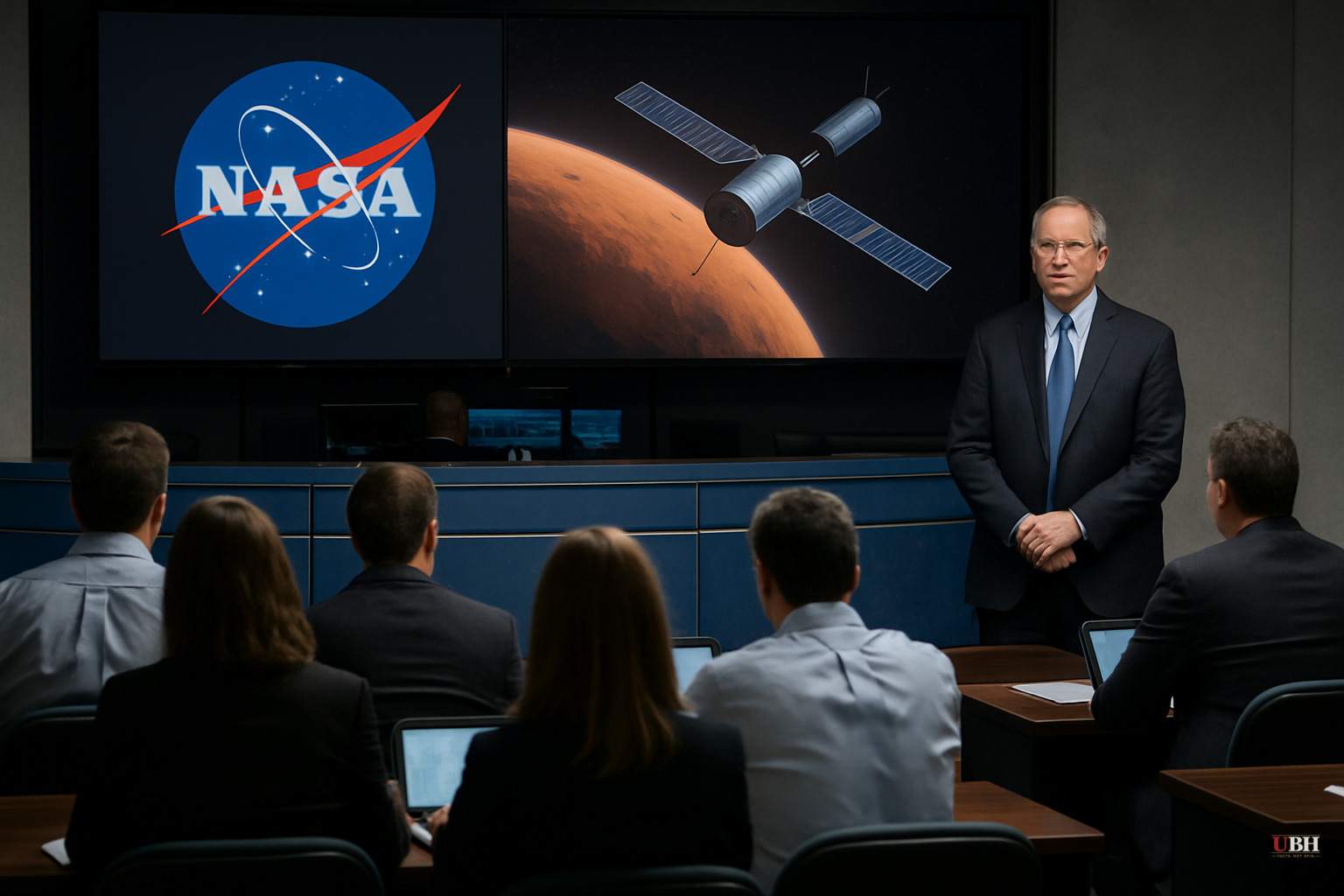
On Tuesday, NASA announced it contracted Relativity Space to build a spacecraft, launch it, and fly it to Martian orbit, according to TechCrunch. The mission is named Aeolus, after the Greek god of wind, and will carry four instruments designed to measure dust, wind speeds, and atmospheric temperatures across Mars on a daily, global basis.
NASA Administrator Jared Isaacman framed the deal as exactly the kind of public-private model he has championed since taking the job. "By pairing NASA's world-class instruments with commercial innovation and investment, we can deliver more science, more often, and reduce the time it takes to get essential data into the hands of researchers preparing for future human missions to Mars," Isaacman said in a statement. He also posted on X that he hopes the mission "can be a model for future privately funded, philanthropic efforts in space."
The structure mirrors earlier NASA deals: the agency owns the science payload, and the private company provides the rocket and spacecraft, absorbing a portion of development costs in exchange for the contract value and commercial spillover. NASA used the same model with SpaceX for ISS cargo runs and with Firefly Aerospace for a lunar lander.
NASA has NOT disclosed what it is paying Relativity. Relativity did not respond to TechCrunch's questions about the contract terms.
Who Is Relativity Space, Actually
Relativity was founded in 2015 by two engineers who had worked at SpaceX and Blue Origin. The company's core bet is that 3D printing can dramatically cut rocket manufacturing costs and lead times.
That bet has not yet paid off in flight. Relativity's first rocket, Terran 1, failed to reach orbit during a test flight in 2023, according to Zamin.uz. Eric Schmidt acquired a controlling stake in the company in 2025 after that stumble. The rocket slated to carry the Aeolus spacecraft, the larger Terran R, has not yet demonstrated it can reach orbit at all.
The Risk Is Real
Several analysts quoted by the Times of India describe the NASA selection as a "high-stakes gamble." Relativity has two years to finalize a spacecraft design and finish developing a launch vehicle capable of escaping Earth's gravity and sending a probe on an interplanetary trajectory. Those are two separate hard engineering problems, running simultaneously, with a fixed deadline.
NASA's own track record with startup partners is uneven. As TechCrunch noted, past commercial partners have gone bankrupt and at least one lunar lander arrived off-target. The agency is carrying real institutional risk here, not just Relativity.
The strongest version of the skeptic's case is this: NASA is outsourcing a Mars mission, which represents the outer edge of human capability, to a company that has never successfully launched a rocket to orbit. If Relativity's Terran R program slips or fails, the four instruments NASA is building for Aeolus could sit in a warehouse, and the atmospheric data pipeline that future crewed Mars missions would depend on simply does not exist.
The public-private model has produced genuine results. SpaceX was also an unproven cargo partner when NASA first contracted with it for ISS resupply, and that program is now routine. The argument for accepting early-stage risk is that it forces faster development cycles and costs taxpayers less upfront than a traditional cost-plus contract.
The SpaceX Angle Is Overstated
Multiple outlets, including Cadena 3 and Zamin.uz, framed this as a direct competition between Relativity and SpaceX for Mars. That framing oversells the drama for now.
SpaceX has Elon Musk's stated goal of colonizing Mars, and it has hardware that actually flies. Relativity has a NASA contract and a rocket under development. Those are not equivalent positions. If the Aeolus mission succeeds, Relativity becomes a credible second player in deep-space commercial launch. If it fails, SpaceX has no competition for this class of mission.
NASA is deliberately seeding an alternative to SpaceX in the Mars mission ecosystem. Whether that strategy produces a real competitor or just an expensive lesson depends entirely on whether Terran R flies.
What Happens Next
The 2028 launch deadline gives Relativity just two years to finalize its spacecraft design and complete development of a rocket capable of escaping Earth's gravity. Relativity has no margin for significant schedule slippage.
The unresolved question with direct consequences: Terran R has no successful orbital flight on record. Before NASA's Aeolus instruments can go anywhere near Mars, Relativity must demonstrate that its rocket can reach orbit, period. When and whether that demonstration happens is the single data point that will tell you whether this 2028 timeline is ambitious or fictional.
Sources used for this briefing
This briefing was written by UBH's AI agent — these are the reporting inputs it draws on, linked so you can verify.


