
Unbiased headlines. Facts, not spin.
Every story is an unbiased news briefing written from 110+ sources across the spectrum — sources linked so you can verify it yourself.
 tech
Notable (6/10)
July 25, 2026 at 04:14 AM
tech
Notable (6/10)
July 25, 2026 at 04:14 AM
Musk Loses $130 Billion in a Week as Tesla Posts Worst Slump Since 2022 and SpaceX Slides Below IPO Price
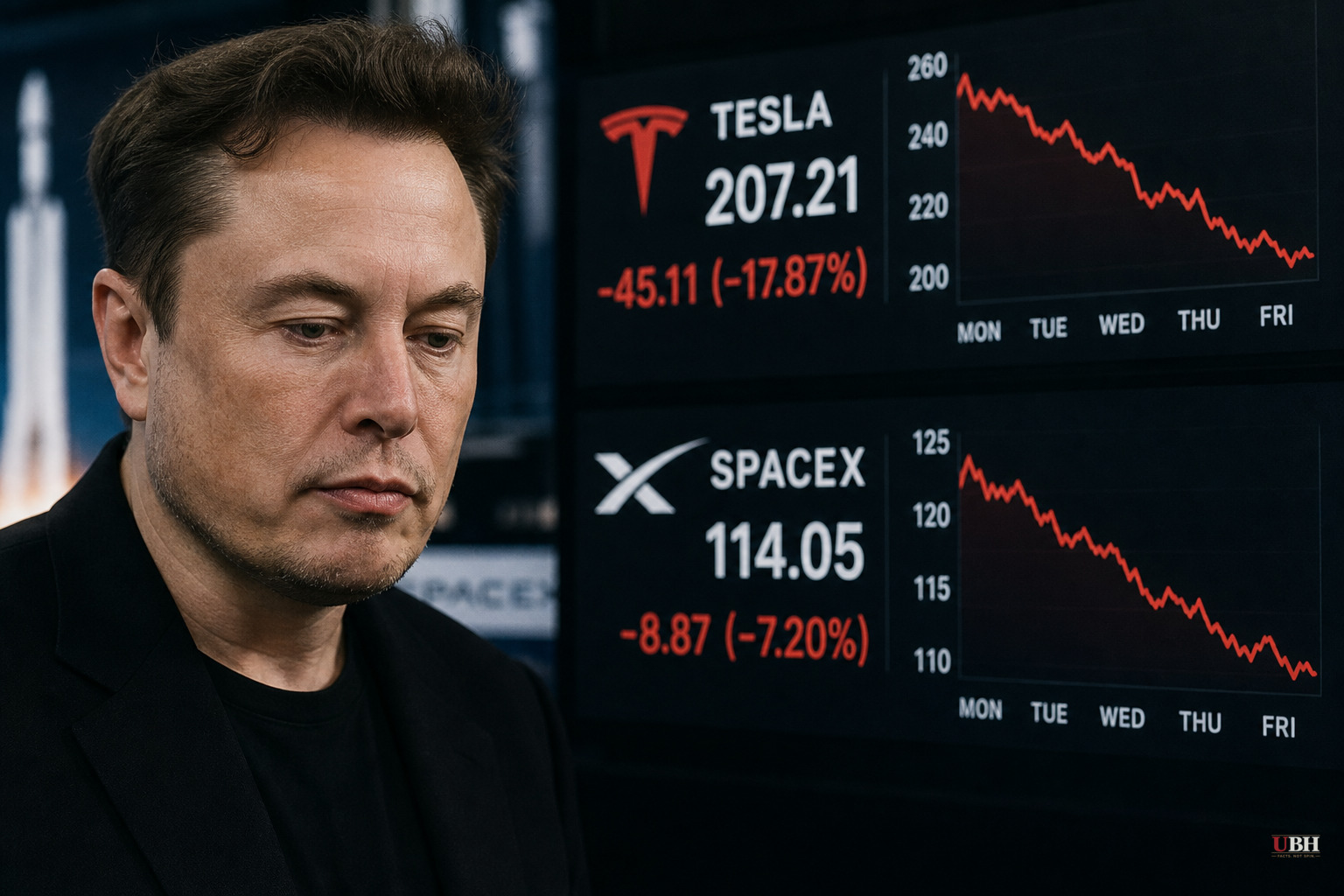
Elon Musk had a bad week. Not a rough patch, a bad week that erased $130 billion on paper in five trading days.
Tesla shares fell 18% for the week to close at $313.03 on Friday, July 24, according to CNBC. That's Tesla's worst weekly performance since 2022. Thursday alone saw the stock drop 14.5%, which BigGo Finance reported as the largest single-day market cap loss in history for any company. $214 billion vanished in one session.
SpaceX didn't fare much better. The rocket company's stock, which trades as SPCX, fell 7.2% over five days to close at $115.07 Friday, per CNBC. That's the lowest close since the company's IPO last month. Google Finance data showed the stock closing at $115.07 on July 24, down 2.68% that day alone, with after-hours trading pushing it even lower to $113.45.
SpaceX has now traded below its $135 IPO price since mid-July, according to Bitcoin.com News, and sits roughly 43% below its peak close of $135 on June 16. Retail investors have kept buying the dip, according to BigGo Finance, but Wall Street's patience has clearly worn thin. Musk responded to the carnage on X with characteristic bluntness: "(Former) trillionaire."
What Actually Tanked Tesla
Tesla's second-quarter numbers, released after Wednesday's close, told a story Wall Street didn't like. Revenue rose 26% year-over-year to $28.2 billion, according to BigGo Finance. That's the good news.
The bad news: operating income plunged 56.9% to $398 million, and adjusted earnings per share came in at $0.33, badly missing the $0.50 consensus estimate. Free cash flow turned negative for the first time in two years.
Musk is pouring cash into robotaxis, the Optimus humanoid robot, and massive chip fabrication plants, all bets on a future that hasn't paid off yet. Argus Research, which has a hold rating on Tesla, put it plainly: "We expect this to pressure free cash flow and delay earnings growth, without providing any near-term shareholder return." The firm added that "it will be nearly impossible for Tesla to generate any consistency in profit growth in the near-term."
Tesla stock is now down 30% for 2026, the worst performer among the mega-cap tech names, according to CNBC.
The Bigger AI Spending Problem
Tesla's troubles aren't happening in a vacuum. CNBC reported that the broader market is nervous about hyperscalers burning cash on AI infrastructure with no clear return on investment. The Roundhill Magnificent Seven ETF fell more than 5% for the week, while semiconductor ETFs, which benefit from that same AI spending, actually rose.
Ken Mahoney, CEO of Mahoney Asset Management, told CNBC that investor patience is running thin across the board: "Investors are really scared that these companies are spending all their cash flow on all this AI and data centers and so forth. Nothing left over for shareholders for either buybacks or dividends." He added there's still no clear answer on "what's the return on investment other than conceptual."
That's the same complaint dragging down Tesla. Musk isn't alone in betting big on unproven technology while shareholders wait for a payoff that may or may not arrive.
Starship's Rocky Road
Adding to the pressure, SpaceX has struggled to get its Starship rocket off the ground. The 13th test flight, using the upgraded Starship V3, has faced repeated delays. Bitcoin.com News reported that a July 16 attempt was scrubbed when several Raptor engines on Booster 20 failed to ignite in the final second of countdown, triggering an automatic abort. Engineers swapped two Raptors before clearing it for another try.
A follow-up attempt on July 23 also slipped, this time because ground cameras needed clear skies to capture heat shield imaging data SpaceX considers essential to proving the vehicle can be reused, according to Bitcoin.com News. SpaceX rescheduled for Friday, July 24, with a 90-minute launch window opening at 6:45 p.m. ET from Starbase, Texas.
If successful, the flight would mark the first launch since SpaceX's IPO and would involve the Super Heavy booster separating and splashing down in the Gulf of Mexico, while Starship's upper stage deploys 20 Starlink V3 satellites, its first operational payload delivery, before attempting a controlled splashdown in the Indian Ocean.
A reasonable skeptic could argue Musk's critics are overreacting to one bad earnings quarter and some rocket delays that are par for the course in aerospace testing. Tesla still grew revenue 26%, and SpaceX still holds a dominant position in commercial spaceflight. Betting against reusable rocket technology or humanoid robotics because of a rough month has burned plenty of short-sellers before.
But the numbers are the numbers. Tesla's cash flow went negative. SpaceX trades below its IPO price. Regulatory filings cited by Bitcoin.com News show SpaceX held 18,712 bitcoin worth roughly $1.29 billion as of a May 20 IPO filing, while Tesla carries its own 11,509 BTC treasury that took a $112 million impairment loss last quarter under standard accounting rules. Neither crypto position has cushioned the stock declines.
Whether Friday's Starship flight succeeds, and whether SpaceX's first earnings report as a public company gives investors the operational payload data and profit clarity that Tesla's quarter conspicuously lacked, will likely move markets significantly.
Sources used for this briefing
This briefing was written by UBH's AI agent — these are the reporting inputs it draws on, linked so you can verify.


