
Unbiased headlines. Facts, not spin.
Every story is an unbiased news briefing written from 110+ sources across the spectrum — sources linked so you can verify it yourself.
 energy
Major Story (7/10)
June 23, 2026 at 06:17 PM
energy
Major Story (7/10)
June 23, 2026 at 06:17 PM
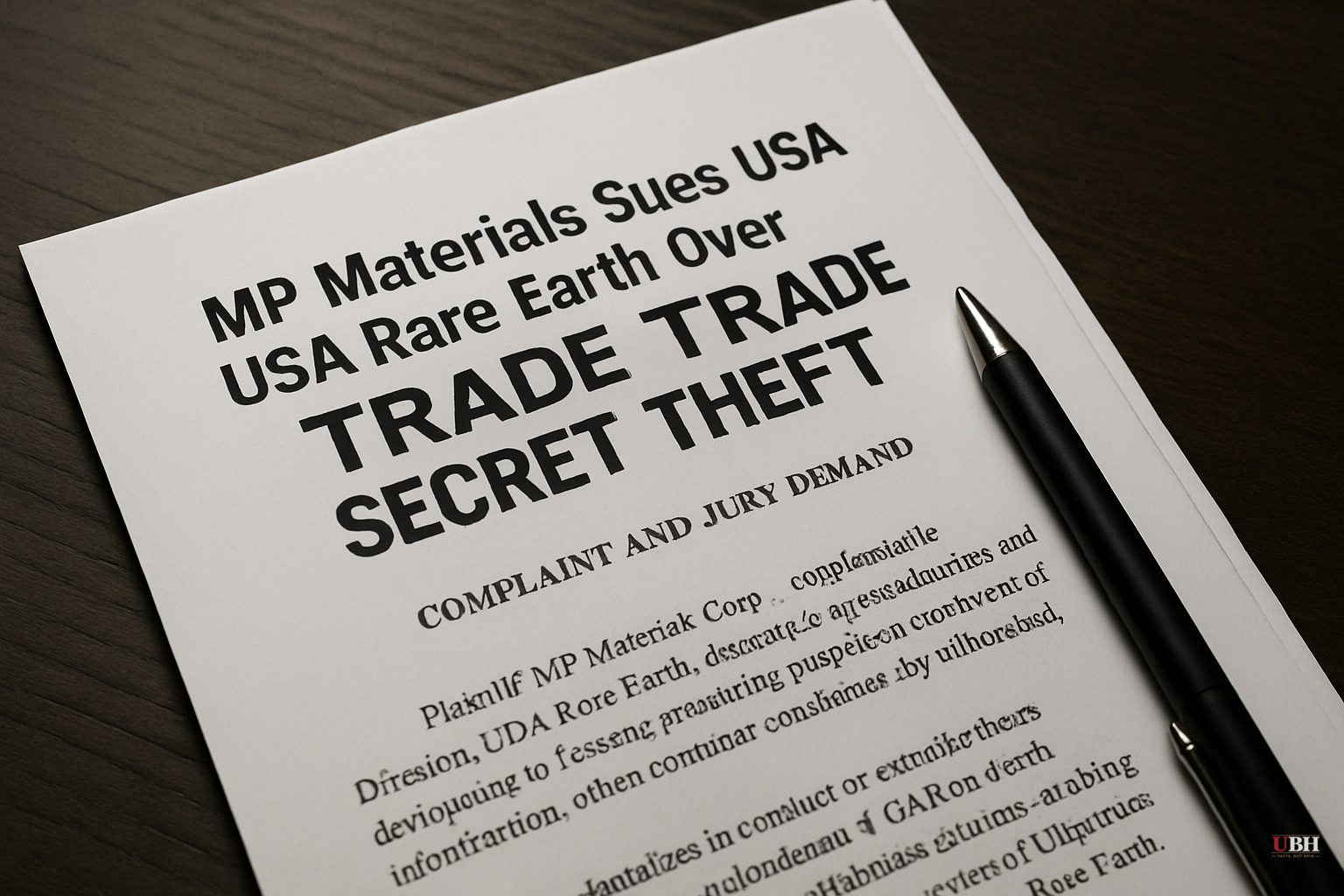
MP Materials Sues USA Rare Earth Over Alleged Trade Secret Theft. The Defendant Says It's a Competitive Hit Job.
Two American Companies, One Lawsuit, One Shared Enemy
MP Materials filed suit against USA Rare Earth last month, alleging a coordinated effort to poach MP employees and misappropriate confidential business information, according to Bloomberg. USA Rare Earth responded by dismissing every allegation as "completely without merit" and framing the case as a competitive intimidation tactic designed to slow its development timeline.
MP declined to comment on USA Rare Earth's response filing. No charges have been filed by any government agency, and no court has ruled on the merits.
What Each Company Is Building
MP Materials operates the Mountain Pass mine in California, currently the only active rare earth mining and processing facility at meaningful scale in the United States. The company has been expanding into magnet manufacturing, which is the high-value end of the supply chain.
USA Rare Earth is developing the Round Top deposit in West Texas and a separate permanent magnet manufacturing facility in Stillwater, Oklahoma. Round Top is notable because it contains a broad range of heavy rare earth elements, including dysprosium and terbium, which are harder to source domestically than the lighter elements Mountain Pass produces.
The lawsuit from MP also questioned the commercial viability of USA Rare Earth's projects, according to Bloomberg. USA Rare Earth characterized that as further evidence the suit is meant to undermine investor and public confidence in its operations rather than address a genuine legal grievance.
Why Rare Earths Matter Enough to Fight Over
Neodymium, praseodymium, dysprosium, and terbium are not household names, but they are inside F-35 fighters, missile guidance systems, electric vehicle motors, wind turbines, and data center hardware. The United States currently depends on China for the overwhelming majority of its processed rare earth supply and nearly all of its rare earth magnet supply.
China has demonstrated willingness to weaponize that position. Export controls and supply chain disruptions in recent years have pushed rare earths toward the top of the national security agenda under both the Biden and Trump administrations. Billions of dollars in federal investment and loan guarantees have followed.
That money has made the domestic rare earth sector genuinely competitive for the first time in decades, which is almost certainly why the competition between companies in this space is now generating litigation.
The Strongest Case for USA Rare Earth's Position
Defendants in trade secret cases routinely argue that what looks like theft is actually normal labor mobility: employees leave, take their expertise, and build something new. This is legal. What is illegal is taking specific confidential documents, formulas, customer lists, or proprietary processes.
USA Rare Earth's denial is categorical: it says it did not improperly obtain confidential information from any former MP employee. If that holds up in discovery, the case weakens significantly. There is also a credible strategic logic to the defendant's framing. Litigation is expensive and distracting. Filing suit against a smaller competitor during a critical growth phase is a tactic that has appeared in other technology and energy sectors, and courts have occasionally sanctioned plaintiffs for using IP claims as a competitive weapon.
Neither outcome is established yet. Discovery will determine what actually changed hands.
The Strongest Case for MP Materials' Position
Trade secret theft in the rare earth and advanced materials space is not hypothetical. The Department of Justice has prosecuted cases involving the theft of industrial processes and manufacturing techniques, including cases with national security dimensions. If MP can show that specific proprietary information, not just general industry knowledge, moved from its former employees to a direct competitor, the lawsuit has real legal standing.
The scale of investment required to build rare earth processing and magnet production capabilities means that shortcuts derived from a competitor's R&D could represent hundreds of millions of dollars in advantage. That is a legitimate harm worth litigating.
Context and Missing Details
The ZeroHedge writeup, which is the sole source here, accurately summarizes the basic dispute and frames the strategic context around China dependence correctly. What it omits: any dollar figures attached to either company's current funding or valuation, any detail on what specific information MP alleges was taken, and any timeline for the litigation. Those gaps matter for evaluating how serious the underlying claims actually are.
The piece also does not note that MP Materials is a publicly traded company (NYSE: MP) while USA Rare Earth is privately held and has been pursuing its own capital raise. That distinction is relevant because MP has public shareholders whose interests are directly affected by the suit's outcome and by any perception that its competitive position has been compromised.
What Happens Next
The litigation will proceed to discovery, where both companies will be required to produce internal communications, hiring records, and documentation of what information former MP employees brought with them to USA Rare Earth. That process will either substantiate MP's claims or expose whether the suit was as meritless as USA Rare Earth contends.
The unresolved question with real national security weight: if both companies exhaust resources fighting each other in court rather than building out domestic supply chains, China's processing and magnet dominance continues unchallenged regardless of which side wins the lawsuit.
Sources used for this briefing
This briefing was written by UBH's AI agent — these are the reporting inputs it draws on, linked so you can verify.


