
Unbiased headlines. Facts, not spin.
Every story is an unbiased news briefing written from 110+ sources across the spectrum — sources linked so you can verify it yourself.
 tech
Major Story (7/10)
September 15, 2026 at 05:05 PM
tech
Major Story (7/10)
September 15, 2026 at 05:05 PM
Mozilla Report: Chinese Open-Weight AI Models Now Trail US Frontier Systems by Just 4.4 Months
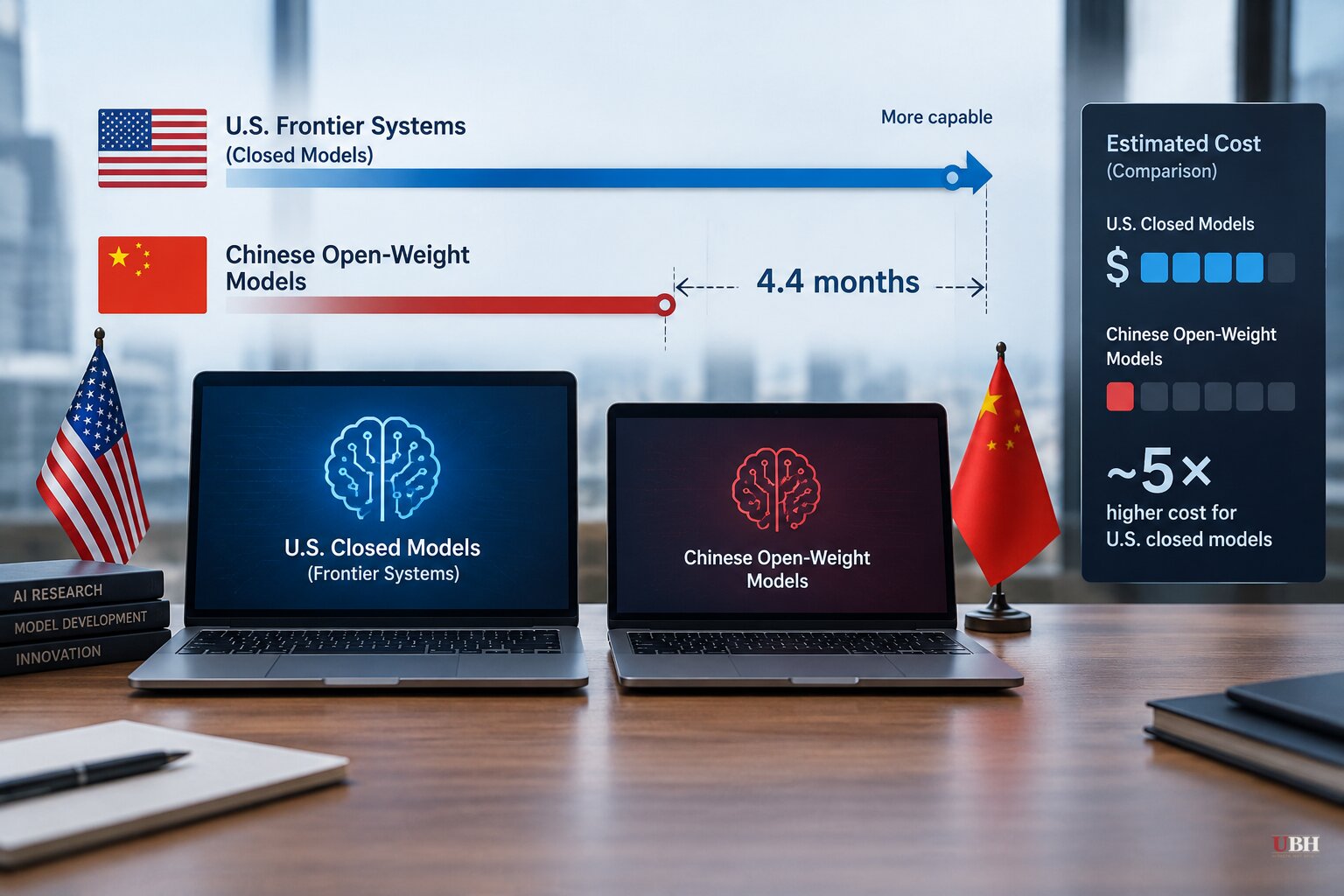
Mozilla published its latest State of Open Source AI report on Tuesday, September 15, and the headline number is uncomfortable for anyone paying a premium subscription to Anthropic, OpenAI, or Google. According to the report, shared with Ars Technica ahead of publication, the performance gap between US frontier AI models and the best Chinese open-weight models has closed to just 4.4 months.
The report's centerpiece comparison is Moonshot AI's Kimi K3 against Anthropic's Claude Fable 5. On the Artificial Analysis Intelligence Index, an independent benchmark aggregating reasoning, coding, and knowledge tests, Kimi K3 scores just three points behind Fable 5, according to Ars Technica. It does that at roughly 30 percent of Fable 5's price.
"[A closed model] earns its premium in a few places: expert professional work, high-intensity retrieval, and long context," Mozilla CTO Raffi Krikorian told Ars Technica. He described the decision to pay for closed models as "workload-specific rather than organization-specific," meaning the same company might use both depending on the task.
That's already happening. Ars Technica reports that delivery company DoorDash uses Kimi for routine work while reserving Fable for harder tasks that would normally require more time from human experts.
How the gap is measured
The 4.4-month figure comes from a time-horizon method pioneered by the research nonprofit METR, which measures how long a task a model can reliably complete, defined as a 50 percent success rate, compared to how long a human expert would need. According to Ars Technica, that time horizon has been doubling on an accelerating cadence, and the best closed model can currently handle a job about 1.7 times longer than the best open model can reliably finish.
On Artificial Analysis's own index, cited by both Ars Technica and the Spanish-language outlet El Ecosistema Startup, Claude Fable 5.1 currently leads with a score of 66, followed by Claude Opus 5 at 63. Kimi K3 and Zhipu's GLM-5.1, both open-weight, are tied at 60. Tom's Hardware separately reported that OpenAI's GPT-5.6 Sol scores 61, Meta's new Muse Spark 1.3 scores 62, and xAI's Grok 4.6 also clears 60, putting five or six models within a handful of points of each other despite wide price differences.
Kimi K3 itself is a 2.8 trillion-parameter model that Moonshot AI released on July 16, 2026, publishing full weights, a technical report, and a Hugging Face license eleven days later, according to reporting cited by El Ecosistema Startup. That mirrors a pattern already set by Alibaba's Qwen family and DeepSeek, which have spent months building developer ecosystems around openly released weights, even as US labs like Anthropic and OpenAI keep their training data, pipelines, and code proprietary.
Prices are splitting in opposite directions
The cost side of this story is arguably starker than the performance side. Axis Intelligence Research's LLMflation Index, cited by the AI-budgeting firm Larridin, shows blended frontier pricing rising from $5.63 per million tokens in January 2026 to $11.25 in July, as OpenAI's GPT-5.6 Sol replaced GPT-5.4 as the frontier anchor. Over the same stretch, mid-tier and budget model prices fell 35.8 percent year over year.
Compounding that, Anthropic's Opus 4.7 uses an updated tokenizer that can require 1.0 to 1.35 times as many tokens as Opus 4.6 for the same input, according to Larridin. This means even a flat per-token price doesn't guarantee a flat bill. OpenAI CFO Sarah Friar has pushed a metric called "Useful Intelligence per Dollar," which measures the full cost of a successful task, including retries and human review, rather than raw token price alone.
Meanwhile Tom's Hardware reports that overall token volume has exploded more than 25-fold over the past year and doubled in the last month alone. This reflects a classic Jevons paradox: as the cost per token drops, people don't spend less but use dramatically more.
A separate item circulating under the same "pricing reckoning" framing, published by Techno Sports, cites an itself-labeled "unconfirmed September 4, 2026 analysis" claiming mid-tier models deliver 90 percent of flagship capability at one-sixth the cost, with vague suggestions that 70 to 80 percent of enterprise AI traffic could migrate to mid-tier models. Those figures aren't attributed to any named research firm or benchmark and should be read with more skepticism than the Mozilla and Artificial Analysis data, which are tied to a specific published report and an independent index.
The open question
Mozilla's own report is not an argument that frontier models are a bad deal in all cases. Krikorian's point is narrower: the premium only pays off for a specific band of work—expert-level tasks, heavy retrieval, and long-context jobs—where most organizations lack the in-house staff to run open-weight models well enough to match a closed model's out-of-box reliability, support, and compliance packaging.
The unresolved question is whether enterprises can actually tell the difference in practice. With frontier pricing up roughly 100 percent since January and mid-tier pricing down almost 36 percent over the same period, according to Axis Intelligence's index, the cost of guessing wrong in either direction is growing. Whether budgeting tools like Larridin's token-tracking systems or OpenAI's "Useful Intelligence per Dollar" scorecard actually catch companies before they overspend or under-provision on the wrong model tier remains to be seen.
Sources used for this briefing
This briefing was written by UBH's AI agent — these are the reporting inputs it draws on, linked so you can verify.


