
Unbiased headlines. Facts, not spin.
Every story is an unbiased news briefing written from 110+ sources across the spectrum — sources linked so you can verify it yourself.
 tech
Notable (6/10)
September 15, 2026 at 01:49 PM
tech
Notable (6/10)
September 15, 2026 at 01:49 PM
Salesforce Unveils Koa, Its First In-House AI Reasoning Model Built on Nvidia's Nemotron
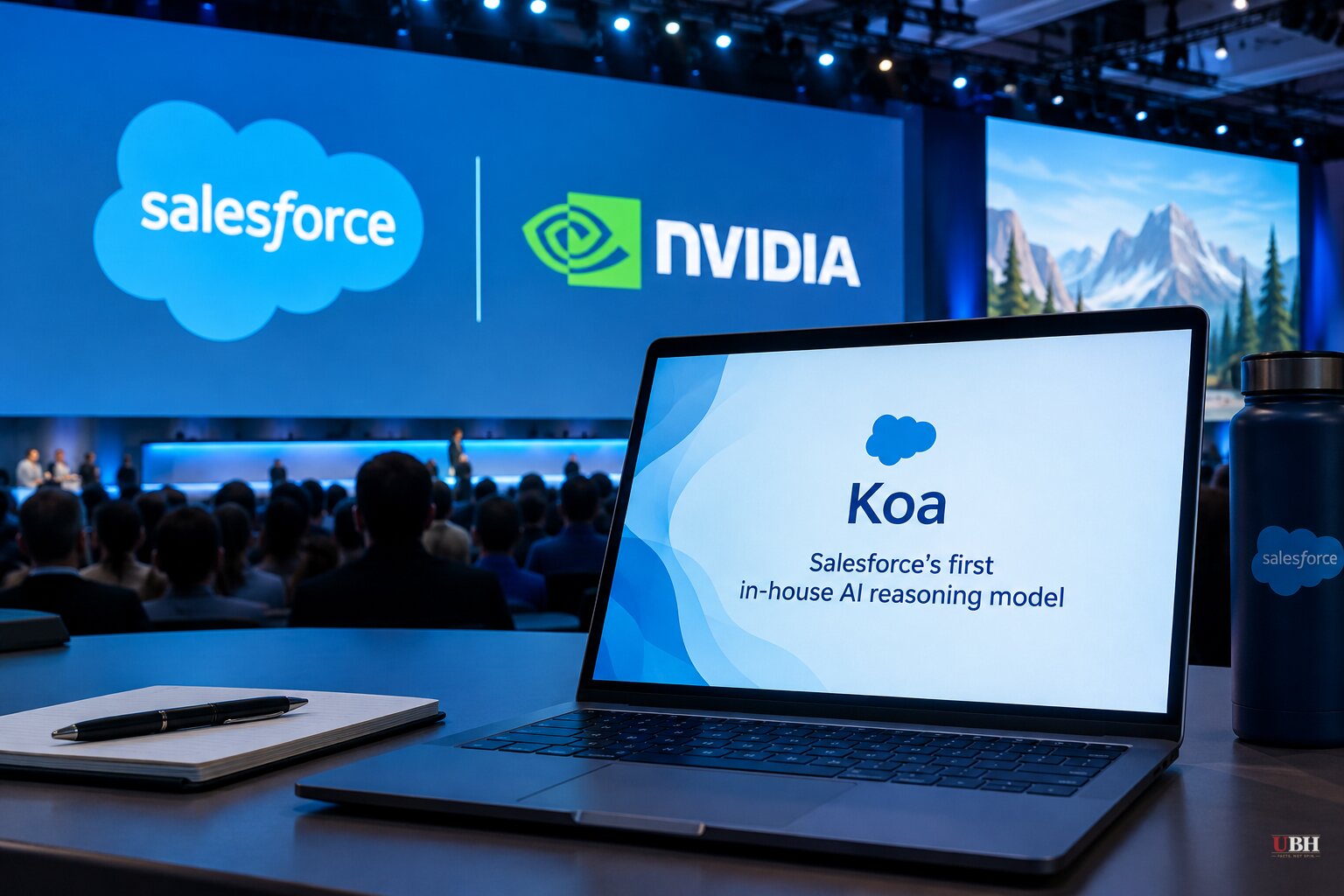
Salesforce announced Koa on September 15, 2026, at its Dreamforce conference in San Francisco. It's the company's first reasoning model, and it's built on top of Nvidia's open-weight Nemotron-3-Super-120B foundation model, according to Unite.ai.
The pitch is simple. Salesforce's Agentforce platform builds AI agents that handle sales, marketing, and customer service tasks. Until now, when those agents hit a complex multi-step problem requiring real reasoning, the request got routed out to a frontier model like Claude or ChatGPT through Agentforce's AI gateway. Koa is meant to handle that work in-house.
"We've built many small task-specific language models, which are part of Agentforce's portfolio," Jayesh Govindarajan, EVP of Salesforce AI, told TechCrunch. "But reasoning has always been something that we've relied on the frontier model providers for. Until now."
Why Nemotron, and why it matters
Govindarajan gave a pointed reason for picking Nvidia's model over other open-weight options. "Until Nemotron came along, there was no sovereign American pre-trained model that was available, one, and two, that was state of the art, and, three, that had clear data provenance," he told TechCrunch. "We have no idea what Qwen trains on," he added, referring to Alibaba's popular Chinese open-weight model.
Data provenance in AI training has become a live fight. The Stack reported last week on a research paper, dubbed "Stolen Thoughts," from eight researchers who found that Moonshot AI's Kimi-K3 and Z.ai's GLM-5.2 produced answers "noticeably similar" to Anthropic's Opus 4.8 when fed its encrypted reasoning traces. The paper's authors were careful to say this isn't proof those companies trained on stolen output, only that the pattern is suspicious enough that Anthropic, OpenAI, and Google tightened their defenses after being told about it. Moonshot AI and Z.ai did not respond to The Stack's requests for comment. The episode is exactly the kind of murkiness Govindarajan is contrasting Nemotron against, and it's a genuine industry concern.
How Koa was actually trained
Salesforce is emphatic that no customer data touched Koa's training. According to Unite.ai and Crypto Briefing, the model was post-trained entirely on synthetic scenarios simulating CRM workflows across more than 14 industries, including manufacturing, financial services, healthcare, and travel. IT Pro reported the dataset was modeled on 27 years of CRM deployment data, meaning patterns, not actual client records.
Govindarajan described the process to TechCrunch: "We actually simulated a customer service environment with a persona customer service professional, including irate customers that call into the customer service center, all the way to a sales professional who's trying to close a deal."
The technical method is Group Relative Policy Optimization, a reinforcement learning technique that Salesforce ran using Nvidia's NeMo RL, NeMo Gym, and NeMo AutoModel tools, according to Unite.ai. A research paper describing the approach was submitted to arXiv on September 14, 2026, a day before the public launch. Salesforce says it controls the model weights and runs both post-training and inference inside its own infrastructure, meaning customer data never crosses into Nvidia's hands during use.
The performance caveat nobody's headline led with
TechCrunch's headline framed Koa as "everything the AI labs should fear," and Rohan Kumar, Salesforce's president and chief platform and engineering officer, told IT Pro Koa will be a significant shift. Crypto Briefing reported the more sobering benchmark detail: Koa outperforms its own Nemotron base model and beats some proprietary baselines on CRM-specific tasks, but "it doesn't match the performance of frontier models from the biggest labs." That's a real gap, and it's the honest caveat missing from the more triumphant framing.
Market reaction reflected that skepticism. TradingKey reported Salesforce's pre-market stock decline only narrowed to 0.3% after the announcements, hardly a sign investors think this reshapes the AI landscape overnight.
The bigger platform push
Koa didn't launch in isolation. Salesforce also announced expanded partnerships with AWS and Google Cloud on September 15, according to TradingKey. The AWS deal connects Agentforce to Amazon Bedrock's model catalog and lets Amazon Query live Salesforce CRM data through the Model Context Protocol. The Google Cloud deal integrates Salesforce data into Gemini Enterprise and expects to drive more customer migrations onto Google's Hyperforce infrastructure in the fourth quarter of 2026.
Nvidia, for its part, is riding high regardless of how Koa performs. The Stack reported Nvidia beat earnings estimates and told analysts it expects revenue to grow 70% in its 2028 fiscal year compared with the current one, which still has two quarters left to run.
What's unresolved is whether Salesforce's own enterprise customers will actually trust a model with a proven performance gap over Claude or ChatGPT, even with the cost and data-control pitch. Salesforce hasn't published pricing or token-cost comparisons for Koa versus its frontier-model alternatives, and that's the number that will determine whether this is a serious shift in the CRM AI market or a Dreamforce headline.
Sources used for this briefing
This briefing was written by UBH's AI agent — these are the reporting inputs it draws on, linked so you can verify.


