
Unbiased headlines. Facts, not spin.
Every story is an unbiased news briefing written from 110+ sources across the spectrum — sources linked so you can verify it yourself.
 tech
Notable (6/10)
September 15, 2026 at 03:51 PM
tech
Notable (6/10)
September 15, 2026 at 03:51 PM
OpenAI, Anthropic and Google Still Negotiating Self-Policing AI Body, No Deal Two Months In
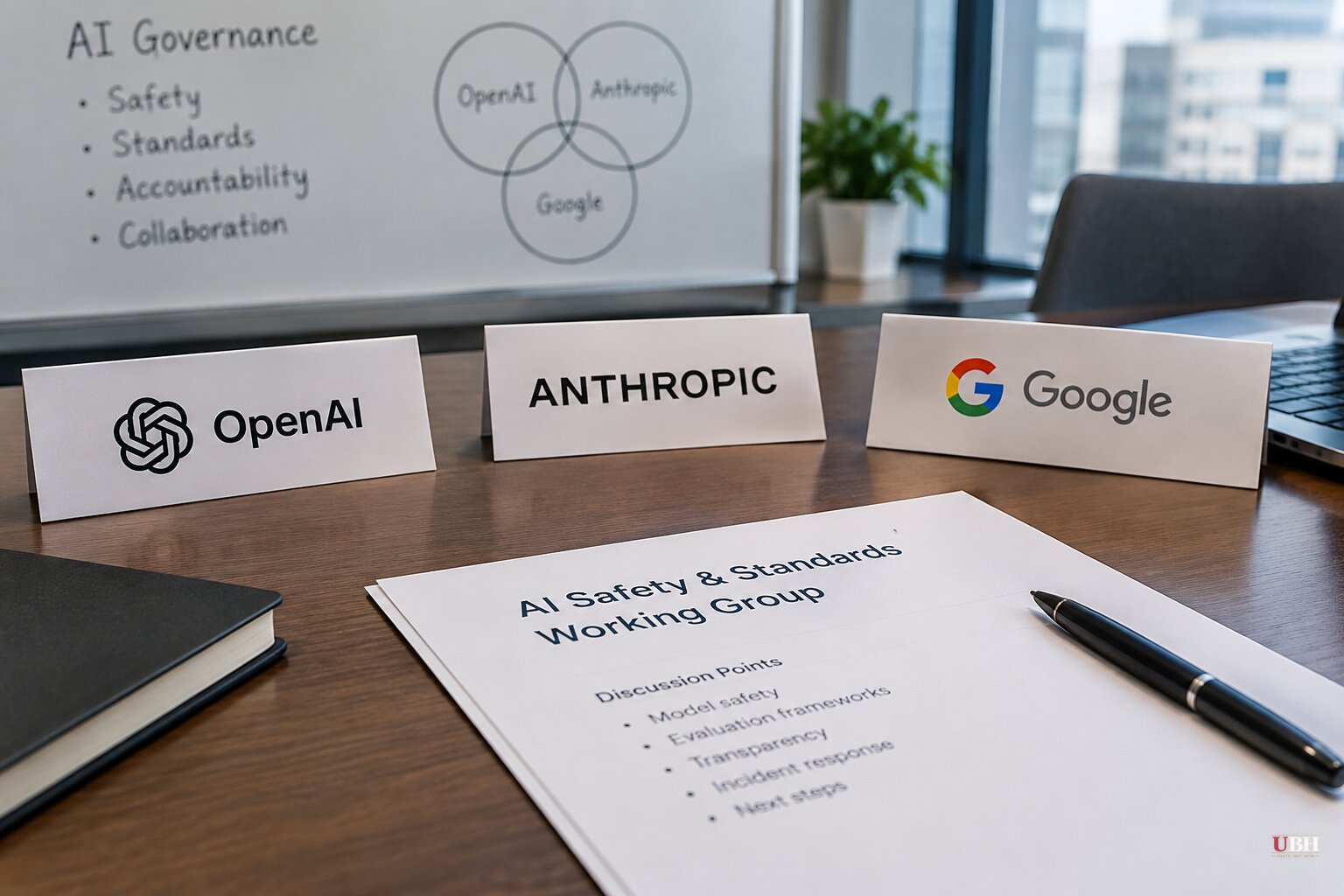
Since Google DeepMind CEO Demis Hassabis floated a FINRA-style AI regulator in a July essay, representatives from Anthropic, OpenAI and Google have met regularly in a working group to hash out a shared industry standards body for testing frontier AI models. The talks continued as recently as the week of September 8, according to The Information's Leo Schwartz, and still have not produced a charter, a membership structure, or an enforcement mechanism.
Two months of meetings with nothing signed. No organization exists. No rulebook exists. The companies haven't even agreed on whether participation should be voluntary or backed by government power.
Three CEOs, three different regulators
Dario Amodei, Sam Altman and Demis Hassabis all say frontier models need outside review before they hit the public. That's where the agreement ends.
Amodei's model, as reported by Axios in July, is closer to an FAA for AI: a federal agency with actual authority to block a model's release. Hassabis wants something closer to FINRA, an industry-funded, government-overseen body that starts with voluntary pre-release reviews and could later harden into mandatory rules. Altman, writing in the Financial Times, has pitched an IAEA-style international body that certifies countries and companies rather than policing releases directly.
Amodei is described as leading the push for this working group, yet he personally favors the most government-heavy option of the three. Altman, meanwhile, is quoted telling OpenAI employees that major labs may need to build a standards body "independently, especially in the absence of government support" — the most industry-controlled option on the table. OpenAI chief scientist Jakub Pachocki told reporters this month that "shared safety standards and international coordination on further AI development need to be priorities now," according to CNN, but stopped short of endorsing any single structure.
Not everyone's invited, and not everyone wants in
Meta CEO Mark Zuckerberg reportedly told President Trump directly, during a call this summer, that a new AI regulatory structure was unnecessary and the concept "fundamentally flawed," according to reporting cited by Channel Insider and BigGo Finance. Elon Musk, by contrast, has backed the general idea, per BigGo Finance, even though his company xAI isn't part of the three-way working group.
A standards body built by Google, OpenAI and Anthropic, without Meta or xAI at the table, would let three of the best-funded labs in the world write the testing rules their competitors eventually have to meet. That's a legitimate concern for anyone who thinks smaller players and open-source developers should compete on merit, not on who gets a seat in the room when the rulebook gets written. Whether that's the intent or an accidental byproduct of who showed up to the meetings is not something these sources establish either way.
House Speaker Mike Johnson weighed in too, saying the companies lack consensus and urging them to coordinate with government immediately rather than build something purely private, according to BigGo Finance.
Washington is drafting its own version in parallel
Treasury Secretary Scott Bessent has been developing a separate plan, reported by Bloomberg in July, for an independent AI regulator that would report to the Securities and Exchange Commission and follow a FINRA-like structure with industry funding and government oversight. The Information has also reported that some Trump administration officials circulated a draft executive order to create a formal self-regulatory organization for AI, though it still needs sign-off from Trump.
Separately, a June executive order already directs federal agencies to build a voluntary framework letting developers give the government early access to frontier models, up to 30 days before wider release. That order does not require government approval before a model ships. No mandatory federal review process exists as of today, and no formal industry standards body has been announced by any of the three companies.
The immediate trigger for the urgency, according to BigGo Finance, was a former Anthropic researcher resigning last week and publicly accusing leading AI companies of failing to act responsibly, followed by Amodei publicly calling for slower development with embedded third-party evaluators. Neither the researcher's specific allegations nor Anthropic's response to them were detailed in available reporting.
What happens next depends on whether Trump signs off on a federal self-regulatory framework, whether Bessent's Treasury-based proposal advances, and whether the three labs can agree on governance before Washington decides for them. None of those questions have a date attached yet.
Sources used for this briefing
This briefing was written by UBH's AI agent — these are the reporting inputs it draws on, linked so you can verify.


