
Unbiased headlines. Facts, not spin.
Every story is an unbiased news briefing written from 110+ sources across the spectrum — sources linked so you can verify it yourself.
 tech
Notable (6/10)
Event date: September 11, 2026
tech
Notable (6/10)
Event date: September 11, 2026
CERN Detects Entangled Qutrits in Higgs Decay as New Benchmark Shows Quantum Computers Fall 100,000x Short
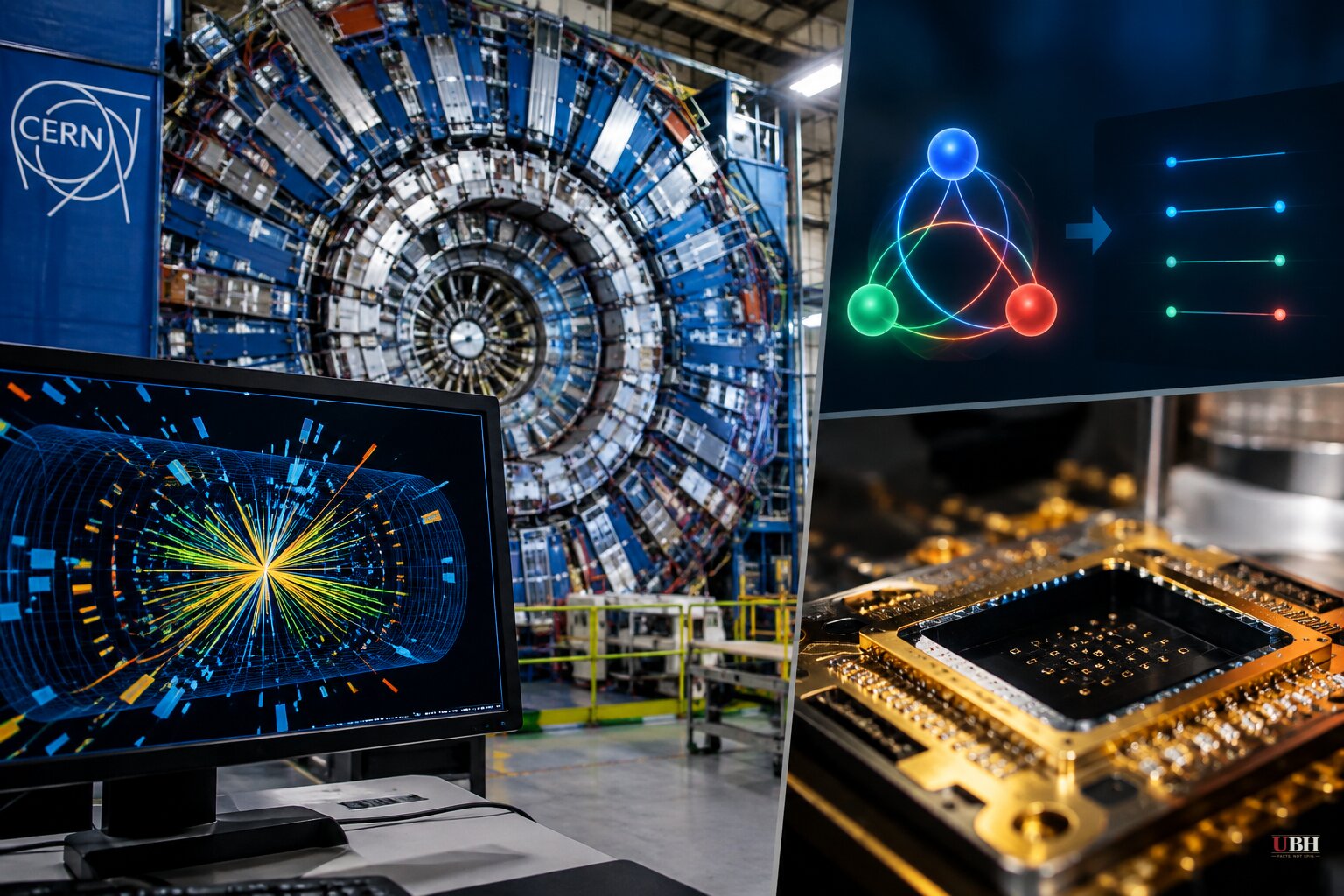
A Rare Decay, A New Kind of Entanglement
Physicists with the ATLAS Collaboration at CERN's Large Hadron Collider have published direct evidence of quantum entanglement between qutrits, three-state quantum systems, according to a paper in Physical Review Letters dated September 11, 2026. This is a new category of measurement. Every prior entanglement result in particle physics, including a 2024 finding involving top quarks, dealt with qubits, particles with only two possible spin states.
The ATLAS team examined a rare Higgs boson decay: Higgs into two Z bosons, then tracked the four leptons those Z bosons produce. A Z boson is a spin-1 particle with three possible spin orientations, which makes it a qutrit rather than a qubit. According to Tech Times, the measurement was built on roughly 400 of these Higgs-to-ZZ-to-four-lepton events, a golden but statistically thin channel because the decay itself is rare at LHC collision rates.
"The spins of the two Z bosons are extremely entangled, considerably more so than in the top-antitop case that was measured previously," said Juan Antonio Aguilar-Saavedra of Spain's Institute of Theoretical Physics, who developed the theoretical framework behind the measurement, according to Tech Times.
Tech Times also frames the result as raising questions about whether "virtual" particles deserve their usual philosophical dismissal in physics. The paper itself is a measurement of spin correlations, not a resolution of that decades-old debate about virtual particles.
The Benchmark Nobody Wanted to Hear
A separate and unrelated development landed the same week: a new benchmark called QUOPS, the Quantum Universal Operations Performance System, developed by Sandia National Laboratories with Quantinuum and NVIDIA, and detailed in a preprint posted to arXiv on September 10, 2026 (arXiv:2609.12146). The paper has not yet been peer reviewed.
QUOPS was built to solve a specific problem. Qubit counts and gate fidelities, the numbers quantum companies love to publicize, don't tell you how big a real computation a machine can actually run successfully. QUOPS instead measures the largest random circuit a processor can execute above a 61% accuracy threshold (a score called Q), and how fast it can do it (a rate called Ω).
The researchers ran QUOPS on Quantinuum's Helios-1, Google's Willow, and IBM's ibm_boston, according to Quantum Computing Report. Helios-1 scored Q = 1,504 (1,824 with leakage postselection). Willow scored Q = 216 at 2.0 x 10^7 operations per second. Ibm_boston scored Q = 204 at 3.1 x 10^5 operations per second. The team also tested a small fault-tolerant processor using 8 error-corrected logical qubits on Helios-1, which scored Q = 40 at a much slower rate of 4.9 operations per second.
Solving genuinely useful scientific problems, like factoring RSA-2048 encryption (estimated Q of roughly 2.5 x 10^8) or calculating the energy states of the FeMoco molecule relevant to nitrogen-fixing chemistry (estimated Q of roughly 3.4 x 10^8), requires scores about 100,000 times higher than what any machine hit in this test, according to the arXiv preprint and Quantum Computing Report.
The Fair Counter-Argument
Quantinuum's own blog post about the study, cited by The Quantum Insider, frames the trade-offs positively. Helios's trapped-ion architecture handled larger circuits even though Google's and IBM's superconducting chips ran faster. The fault-tolerant logical-qubit demonstration on Helios-1, while small, proves error-corrected computing works end to end today, not just in theory. A reasonable industry advocate would argue that hitting any nonzero Q score on a fault-tolerant logical architecture, using real magic-state injection and syndrome extraction, is the actual milestone, and that QUOPS itself was designed to track exponential improvement across future hardware generations, not to declare the field a dead end.
That argument has some grounding. The paper's authors explicitly say QUOPS is meant to project growth across successive fault-tolerant generations, not just take a single snapshot. But a 100,000-fold gap is still a 100,000-fold gap, whichever way you frame the trend line.
What Happens Next
QUOPS was built partly to align with the Department of Energy's Quantum Computer for Application Development and Discovery Science initiative, according to Quantum Computing Report, meaning it's positioned to become a real metric in federal quantum procurement decisions, not just an academic exercise. That's taxpayer money getting a harder yardstick before it gets spent.
The QUOPS preprint has not cleared peer review yet. Whether the benchmark becomes the industry standard, or whether Quantinuum, Google and IBM push back on its methodology as their next-generation chips come online, is an open question with no resolution date attached.
Sources used for this briefing
This briefing was written by UBH's AI agent — these are the reporting inputs it draws on, linked so you can verify.


