
Unbiased headlines. Facts, not spin.
Unbiased Headlines is an independently owned news organization. We bring you the facts, not opinions, written fresh from 110+ named sources. Sources linked so you can verify it yourself.
 tech
Notable (6/10)
tech
Notable (6/10)
Morgan Stanley Sees Nvidia Collecting About $690 Billion of 2027 AI Capex as Huang Rejects the Two-Lab Risk
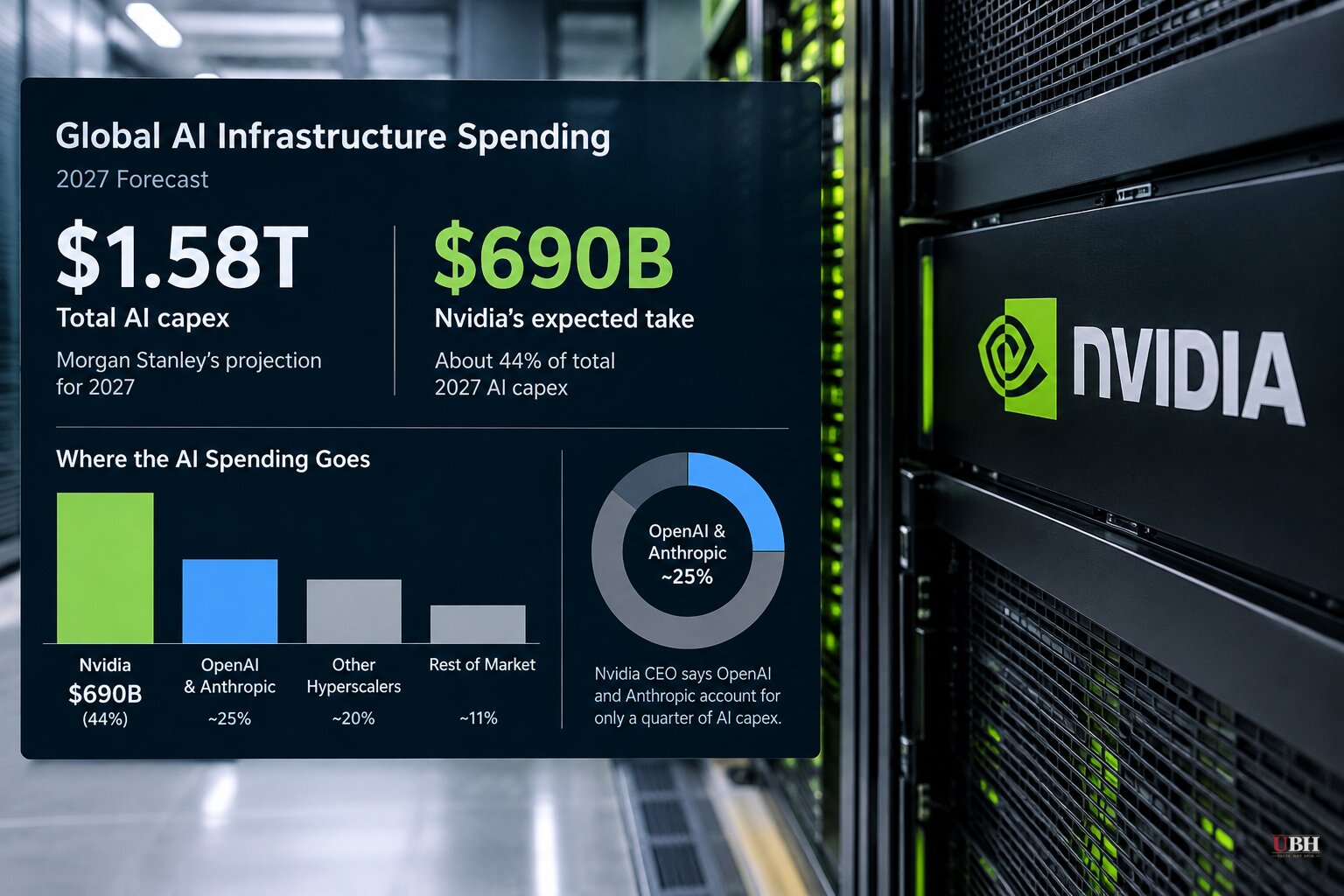
Since Morgan Stanley published its $1.58 trillion forecast for 2027 AI spending, the focus has moved from the size of the pot to who gets the biggest piece. The bank's math points to one company: Nvidia.
Morgan Stanley's forecast works like a funnel. About 65% of total AI capex, roughly $1.03 trillion, is expected to flow to companies in the S&P 500. Nvidia is then expected to capture about two-thirds of that share, or approximately $690 billion. That would make one chipmaker the biggest beneficiary of one of the largest corporate building cycles on record.
How the forecast breaks down
By category, semiconductors and servers are projected at about 42% of 2027 AI capex, or approximately $672 billion.
Morgan Stanley raised its 2027 total by about 14% after it began counting lease obligations that were previously left out. A company that rents data center capacity instead of building it still commits real money. It just lands on a different line of the financial statements.
The bank expects AI-related capex to equal about 5% of S&P 500 revenue in 2027 and to drive about 25% of the index's sales growth.
Nvidia's own guidance points the same way. On the company's fiscal Q2 2027 earnings call, CFO Colette Kress indicated she expects hyperscaler capex to approach $800 billion in 2026 and reach around $1.3 trillion in 2027. She also cited a cloud industry backlog above $2 trillion.
The near-term pace is not settled. Estimates for 2026 hyperscaler capex have ranged from about $650 billion to more than $800 billion, and forecasters have been adjusting through the year. The spenders are Microsoft, Alphabet, Amazon, Meta and Oracle, with Nvidia's GPUs at the center of most of the buildout.
Huang's answer to the two-lab worry
The concern Huang is answering is that the buildout depends on two companies, OpenAI and Anthropic, that lose billions of dollars a year while committing to hundreds of billions more in compute.
In a conversation on BG2Pod, Huang said those two labs represent only a quarter to a third of Nvidia's compute demand. He said the rest comes from enterprises replacing classical computing and from thousands of startups, sovereigns and "neoclouds" renting Nvidia capacity.
Huang projected annual AI infrastructure spending of $3 trillion to $4 trillion by late this decade. He called it "unnecessary" to extrapolate the frontier labs into trillion-dollar revenue lines to justify the capex.
He also made a pricing claim. "The offering that we offer into one gigawatt went from about 18 billion or so per gigawatt to 20 somewhat billion per gigawatt to now 40 plus per gigawatt," Huang said. "If you had to hand somebody a hundred billion dollar check to place a purchase order right now for a next generation... sight unseen... we're literally the only one."
Huang runs the company that stands to collect the money, so his split of the demand is the seller's account.
The stock has not followed the forecasts
The market has not rewarded the numbers. Consensus revenue forecasts for Nvidia rose 100% to 200% over the past year. The stock is up only about 20% and trades at roughly 13 to 14 times forward earnings.
That gap is the skepticism Huang is arguing against. His case is that power scarcity widens Nvidia's moat. He said the 2027 bottleneck will be land and electricity rather than chips.
He also named new growth lines: software licensing, revenue-sharing with neoclouds, and orbital data centers with SpaceX. No revenue figures for any of those were given.
What the numbers leave open
Morgan Stanley's $690 billion is a projection of where spending could land, not revenue Nvidia has booked. The leases added to the bank's count also show how much the headline depends on definitions. The 14% increase came from what is counted, not from new orders.
The gap between Morgan Stanley's $1.58 trillion for 2027 and Huang's $3 trillion to $4 trillion late-decade run rate is a claim about the future, not a reported result. The things to track from here are whether hyperscaler capex guidance keeps moving higher, how quickly Nvidia's Blackwell and related platforms ship, and whether Morgan Stanley and other forecasters revise their 2027 totals again.
Sources used for this briefing
2 links from 2 independent newsrooms (syndicated copies of the same report count once)
These are the sources it draws on, linked so you can verify.


