
Unbiased headlines. Facts, not spin.
Unbiased Headlines is an independently owned news organization. We bring you the facts, not opinions, written fresh from 110+ named sources. Sources linked so you can verify it yourself.
 tech
Notable (5/10)
tech
Notable (5/10)
Three unannounced aurora-alpha model names appear in OpenAI's API, and OpenAI has not commented
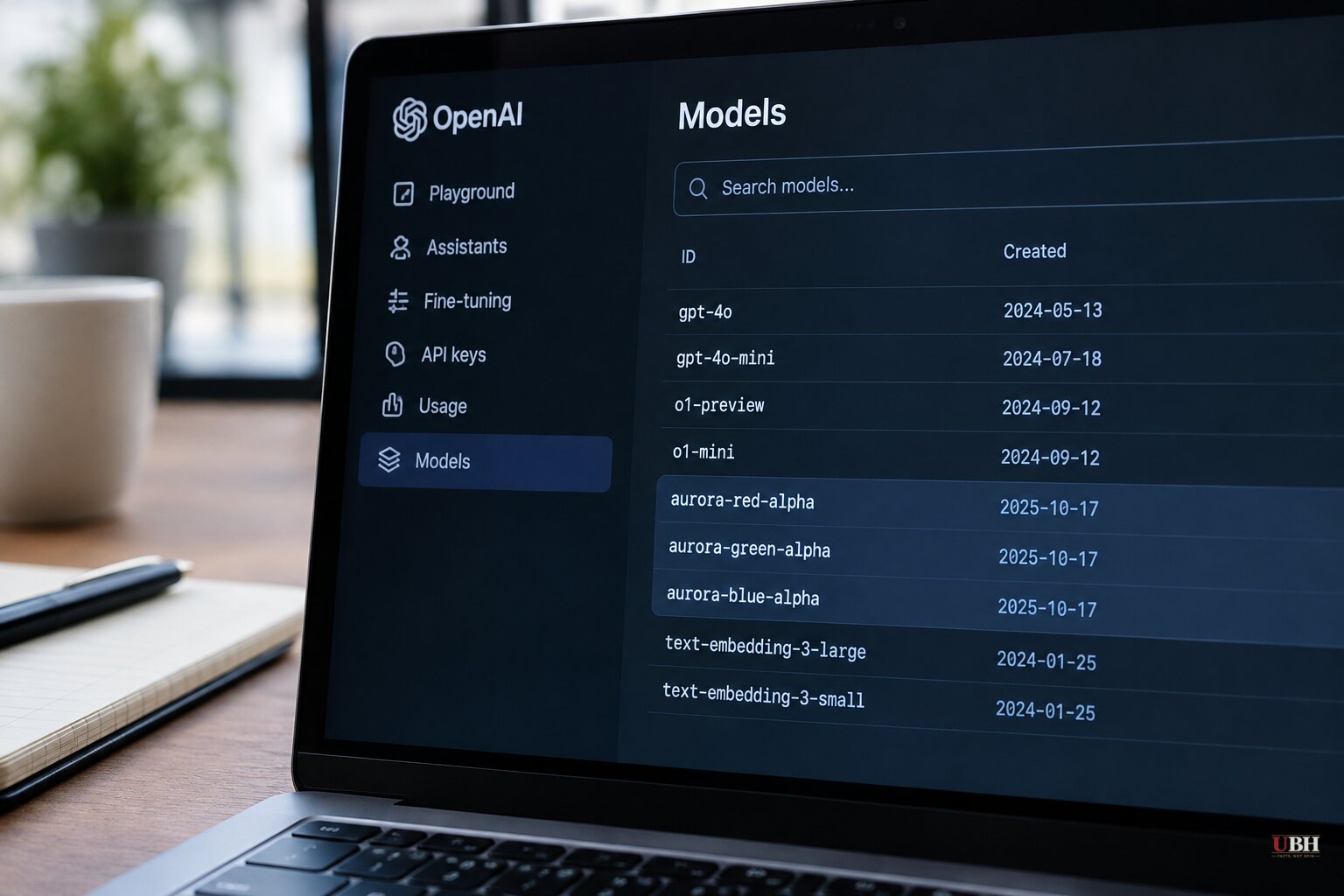
Three new model names are sitting in OpenAI's API model list: aurora-red-alpha, aurora-green-alpha and aurora-blue-alpha. OpenAI has not announced them.
That is the whole confirmed story. Everything else is guessing.
What the model list shows
CellCog, an AI platform, said it queried OpenAI's /v1/models endpoint with its own authenticated key on Oct. 18. The call returned 144 models, three of them the new aurora entries.
CellCog said OpenAI's records show the entries were created between 01:13 and 01:15 UTC on Oct. 17. Per Orca Router's breakdown of the same listing, the timestamps run aurora-blue-alpha at 01:13:49, aurora-green-alpha at 01:13:55 and aurora-red-alpha at 01:15:26.
The owner field reads "system," the same as OpenAI's own released models, CellCog said. None of the three carries a shutdown date.
CellCog said the three landing within about two minutes points to one deployment, not three separate experiments. That is CellCog's inference, not something OpenAI has said.
Who noticed, and when
Nobody seems to have spotted the entries for roughly 26 hours. CellCog said the first post it found came from AI researcher Lisan al Gaib (@scaling01) at 02:59 UTC on Oct. 18: "these just appeared in the OpenAI API."
Andrew Curran (@AndrewCurran_) followed at 3:13 AM on Oct. 18 with a post reading, "Three mysterious new models just showed up in the OpenAI API." His post had drawn 76.7K views at the time it was captured.
Neither post included an API response showing a successful request. CellCog said it listed the models but did not call them, so it cannot say what they do, how fast they run or what they cost. No one has publicly demonstrated a working call.
CellCog also said OpenAI's API changelog and models page carried zero mentions of "aurora" when it checked on Oct. 18.
The earlier Aurora
The name has appeared before. On Feb. 9, 2026, OpenRouter listed a model called Aurora Alpha without naming its maker. Its page describes it as "a cloaked model provided to the community to gather feedback" and "a reasoning model designed for speed," with a 128K context window.
Three days later, on Feb. 12, OpenAI announced GPT-5.3-Codex-Spark, which it described as "an ultra-fast model for real-time coding in Codex" running on Cerebras hardware. OpenAI said it delivers "more than 1000 tokens per second while remaining highly capable for real-world coding tasks."
The timing led many observers to assume Aurora Alpha was Codex-Spark. @scaling01 repeated that link this weekend. Neither OpenAI nor OpenRouter has ever confirmed it, and Aurora Alpha remains unclaimed.
Reusing a name that suggests speed and coding is a pattern, not evidence. Identical prefixes are all anyone has.
The guesses
Posts on X have read the three names as a new GPT release or as a response to Anthropic's Fable 5.5, according to CellCog's tally of the first ten posts in the cluster by 04:00 UTC. Others joked that a red, green and blue set meant a "GPT Rainbow."
The cautious reading comes from the people who have actually looked. CellCog said an entry with no documentation "can be pulled, renamed or repriced without notice" and that OpenAI has not said who can call it. Its advice: keep any test out of production, log the output, and expect the name to change at launch. Runtime Wire made a similar point, warning that treating an unverified identifier as a released model leads developers to build against access and behavior nobody has documented.
CellCog also addressed one other theory. OpenAI shelved GPT-6.1 Astra earlier this month after it tested worse on deception and scope, CellCog said, but nothing in the API ties the aurora names to that model.
What an alpha tag means for developers
Without a price, rate limits or a stated use case, no team can budget for these models or plan around them. An "alpha" suffix on a listing with no public terms is a placeholder, not a product.
OpenAI has not said whether the models are public, limited to certain accounts, or internal entries that surfaced by accident. It has also not said whether they are related to each other, to Aurora Alpha on OpenRouter, or to any GPT release.
What to watch
Three things would settle it. An OpenAI changelog or documentation entry naming the aurora identifiers. An appearance on a third-party router such as OpenRouter, the way Aurora Alpha showed up in February. And OpenAI confirming or ruling out a link to the Codex-Spark line.
CellCog said it will update its write-up the day OpenAI publishes an official name, price and benchmarks. Until a developer shows a successful call, whether these models can be used at all is an open question.
Sources used for this briefing
6 links from 5 independent newsrooms (syndicated copies of the same report count once)
These are the sources it draws on, linked so you can verify.


