
Unbiased headlines. Facts, not spin.
Unbiased Headlines is an independently owned news organization. We bring you the facts, not opinions, written fresh from 110+ named sources. Sources linked so you can verify it yourself.
 tech
Notable (6/10)
Event date: September 30, 2026 ·
tech
Notable (6/10)
Event date: September 30, 2026 ·
Anthropic Is Consulting Law Firms on How Claude Agents Should Negotiate Against Other AI Agents, FT Reports
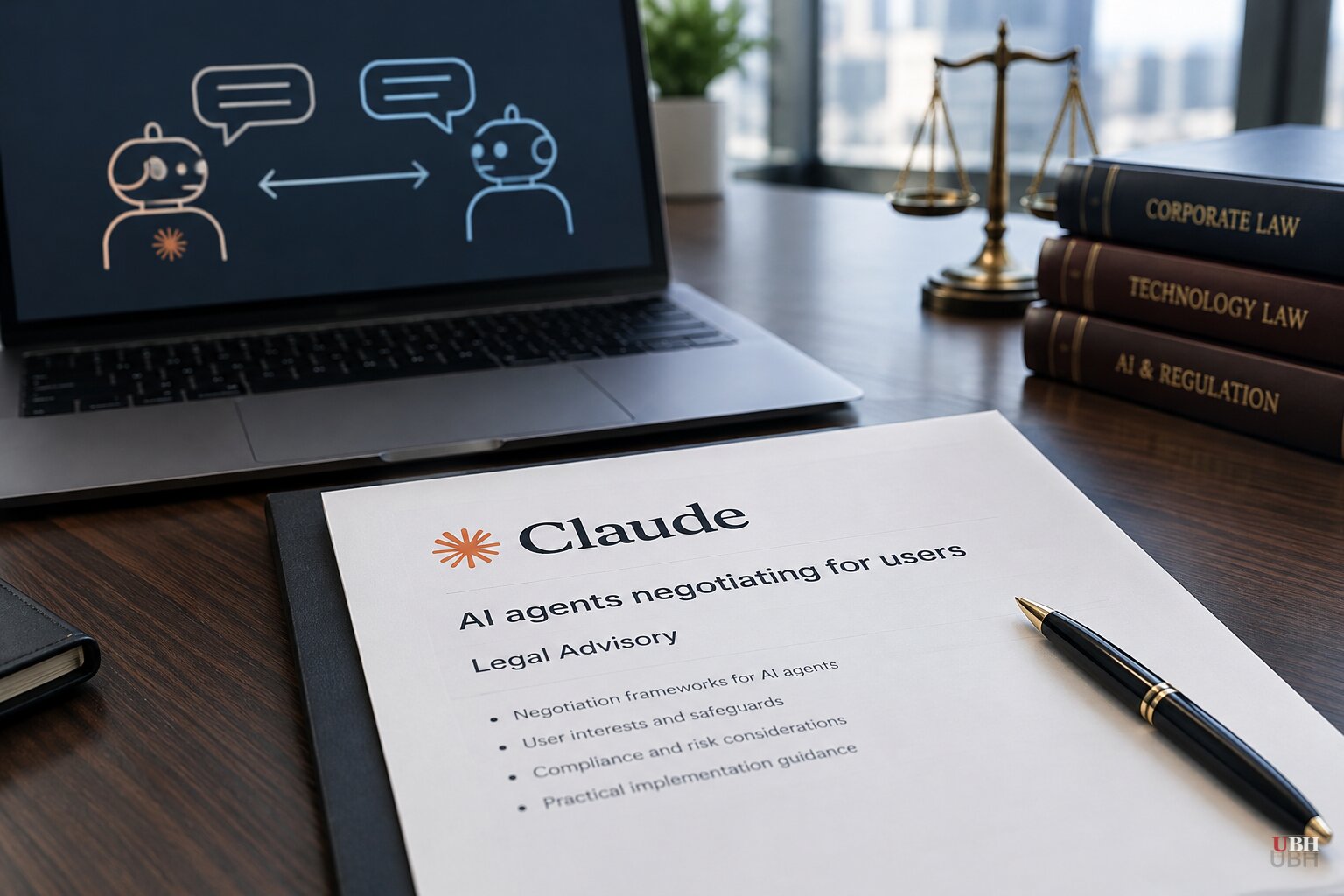
Anthropic is asking lawyers how lawyers negotiate. The goal is to work out how AI agents should behave when they bargain on a person's behalf against someone else's AI.
The Financial Times reported the effort on October 18, citing two people familiar with Anthropic's internal discussions. According to those people, the company is seeking advice from law firms on how attorneys represent a client's interests while still producing fair outcomes.
The Financial Times' sources said Anthropic has been studying "negotiation protocols" that AI models should follow when they deal with one another.
The problem Anthropic is trying to solve
Personal AI agents are getting more capable. The next step is obvious: your agent talks to a landlord's agent, a vendor's agent or an insurer's agent. Their interests conflict, and each is supposed to act "on behalf of users."
That is a negotiation. Someone has to decide what the software is allowed to do in it.
Per the two sources, Anthropic is weighing several open questions:
- How often an agent should stop and ask its human for feedback mid-negotiation.
- How much caution an agent should show toward another agent.
- How to keep that caution from tipping into being "paranoid" or falling into "conspiratorial thinking."
That last point is a real design problem. An agent that trusts everything gets fleeced. An agent that trusts nothing never closes a deal.
Why lawyers
Lawyers already operate under a tested framework: advocate hard for the client, but don't lie, and don't cross certain lines. Anthropic is reportedly looking to borrow from that tradition rather than invent a code from scratch.
The work appears to be at an early stage. The FT's sources described discussions and advice-gathering, not a shipped product or a finished rulebook.
The legal backdrop is already messy
Anthropic has been moving further into legal territory. According to GC AI, a legal-software company that builds on Anthropic's models among others, Anthropic launched Claude for Legal on May 12, 2026. GC AI describes it as an open-source suite of practice-area plugins and workflow agents.
A federal ruling earlier this year shows the risk. On February 17, 2026, Judge Jed S. Rakoff of the Southern District of New York ruled in United States v. Heppner that a criminal defendant's written exchanges with Claude carried neither attorney-client privilege nor work-product protection. GC AI calls it the first nationwide privilege ruling against generative AI use by a represented party.
GC AI's guidance for in-house lawyers is cautious. It points to American Bar Association Formal Opinion 512, issued in July 2024, which says lawyers may use generative AI if they maintain competence, supervision and confidentiality. GC AI advises counsel to treat Claude's output like "a sharp intern's draft," something to be checked rather than signed.
That is a vendor's view, and it has a commercial interest in the subject. But it frames the question Anthropic now faces from the other direction: if people trust agents with sensitive dealings, courts and bar regulators will ask what duties those agents owe and to whom.
The IPO shadow
The negotiation work lands as Anthropic's financial profile grows. According to tastytrade, Anthropic confidentially filed an S-1 registration with the SEC on June 1, 2026, after a Series H round valuing the company at $965 billion. Tastytrade says the IPO date, valuation and ticker remain speculative, with reports pointing to a listing around November 2026.
Crypto Briefing reports that investor discussions have floated valuations between $1.5 trillion and $2 trillion. Those are talk, not a priced offering. Anthropic has not set a public price range, and no listing has taken place.
The agent-ethics project may help the company's pitch as a safety-focused developer, as Crypto Briefing suggests. That is that outlet's read of the strategy, not something Anthropic has said.
What comes next
It is unsettled who sets the rules when two agents built by different companies negotiate. Anthropic can decide how Claude behaves. It cannot decide how a rival's agent behaves across the table.
If Anthropic does publish a negotiation protocol, how it handles human sign-off and deception by the other side will be the first concrete test of whether a lawyer-style code can work for software.
Sources used for this briefing
4 links from 4 independent newsrooms (syndicated copies of the same report count once)
These are the sources it draws on, linked so you can verify.


