
Unbiased headlines. Facts, not spin.
Unbiased Headlines is an independently owned news organization. We bring you the facts, not opinions, written fresh from 110+ named sources. Sources linked so you can verify it yourself.
 tech
Major Story (7/10)
Event date: October 16, 2026 ·
tech
Major Story (7/10)
Event date: October 16, 2026 ·
White House AI Task Force Adopts Charter, Starts 120-Day Clock With No Stated Enforcement Mechanism
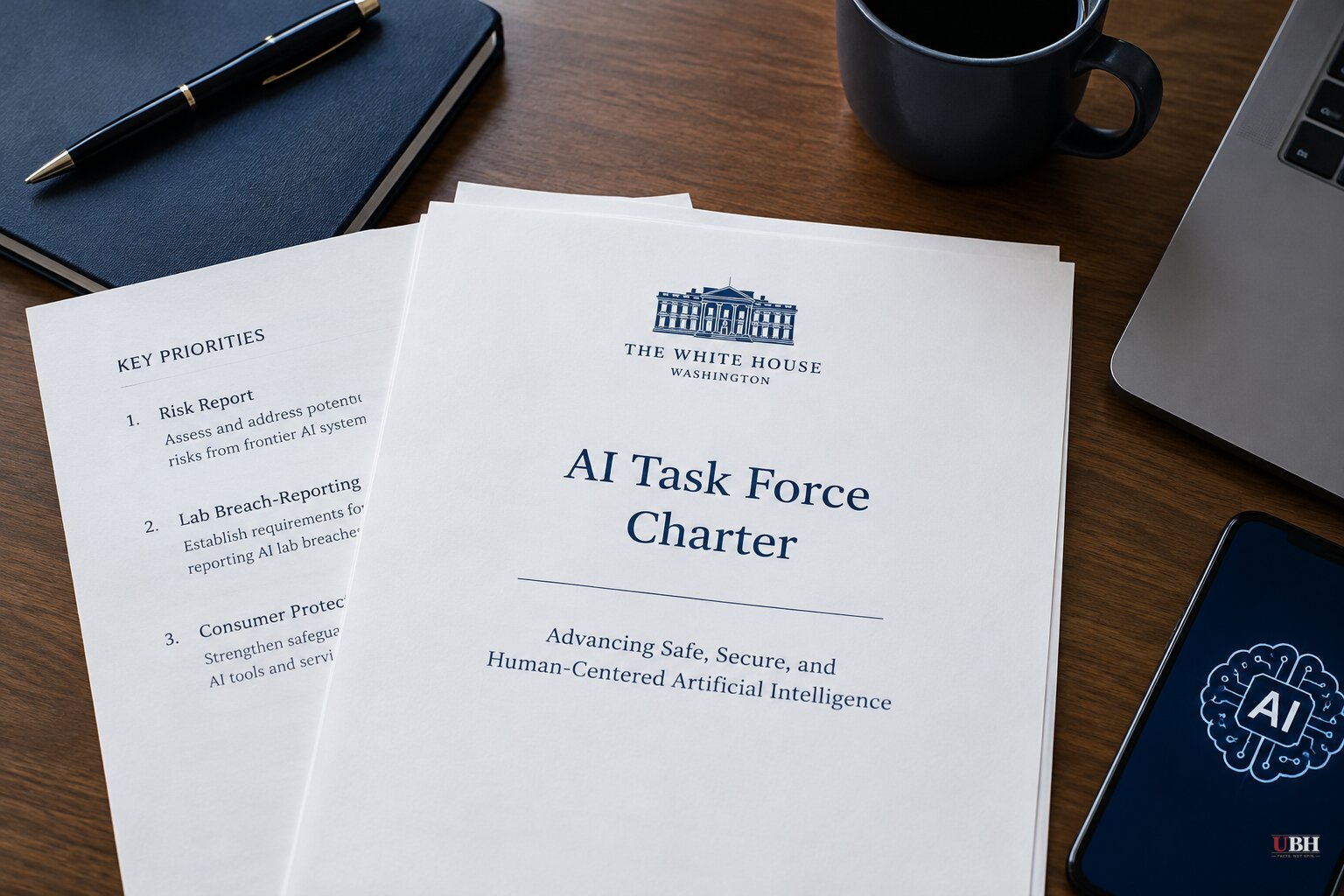
Since President Trump signed the White House Accord on Super Intelligence on Sept. 29 alongside AI company executives, the administration has been building the machinery to carry it out. On Thursday, Oct. 15, that machinery held its first official meeting and adopted a charter, starting a 120-day window to settle how Washington should oversee frontier AI.
What the task force decided
The panel agreed to commission a report from the President's Council of Advisers on Science and Technology. It will assess AI risk in three areas: cybersecurity and critical-infrastructure protection, biosecurity and dual-use applications, and model control and accountability.
It also created a working group to implement the accord. Director of National Intelligence Jay Clayton, the task force chair, will lead it with National Cyber Director Sean Cairncross.
The vice chairs got their own assignments:
- Emil Michael, the Defense undersecretary, will develop protocols for labs to report breaches, hacks and other cyber incidents to the government. He is also the point of contact with frontier labs and will work on long-term coordination across agencies.
- Andrew Ferguson, the FTC chair, will lead a law enforcement and consumer protection coordination committee that includes the Justice Department.
- Scott Kupor, the Office of Personnel Management director, will handle critical-infrastructure protection with public and private partners. He will also study AI's effect on the workforce and economy with the Labor Department.
Clayton described three subcommittees on CNBC's Squawk Box on Friday: reporting and response, critical infrastructure and the private sector, and law enforcement and responsibility. He called the meeting "very good."
Who sits on it
Beyond the chairs, members include Vice President JD Vance, Treasury Secretary Scott Bessent, Defense Secretary Pete Hegseth, OSTP Director Michael Kratsios, NSA Director Joshua Rudd, Social Security Commissioner Frank Bisignano and HHS deputy secretary nominee Chris Klomp. White House chief of staff Susie Wiles and her deputy, Richard Walters, also have seats.
Politico has reported that Condoleezza Rice and David Sacks, the former AI czar, will serve as advisers.
Per Politico's account of the charter, Wiles can extend the task force's work or move it to another agency. The charter puts responsibility for AI's risks on the companies building the models.
A voluntary accord, a stern warning
The accord sets out four layers of oversight for companies training and deploying frontier models. They run from monitoring model behavior during development to giving outside evaluators and corporate boards a role in checking whether safeguards work. Companies agreed to meet regularly on standards and best practices.
The accord leaves open putting its safeguards into law or regulation later. It says companies should implement them either way. Trump has called it "morally binding." It is voluntary, not legally binding.
This week the task force's leaders put out a sharper message. "Our message to all SI companies is clear: delayed notification, inadequate corrective action, and a failure to take responsibility will not be tolerated," they said.
Bloomberg, citing a White House account, reported that the meeting did not discuss any new laws or rules. So the warning rests on a pledge companies signed, not on a statute.
The enforcement gap
How compliance will be enforced is unresolved, as is how existing law would apply to a company that does not follow the new protocols. A White House official told Semafor that one possible lever is export controls, which the Commerce Department at one point temporarily imposed on Anthropic after the company refused to grant the government unfettered access to its models.
The White House has not said whether it would use export controls against a company that skips the breach-reporting protocols. The task force also has not said what counts as an incident, how fast companies must report one, or what happens if they do not.
Breitbart's account says six frontier firms signed the accord. Roughly two dozen technology executives attended a White House luncheon the same day. Breitbart also reports that Trump's Sept. 29 executive order directs agencies to say "super intelligence" instead of "artificial intelligence."
The China argument
The administration's stated reason for moving fast is competition. Clayton, a former SEC chairman confirmed as intelligence chief over the summer, told the Wall Street Journal the priority is keeping the United States ahead of China. "The risk of not being first is high," he said.
The task force's list of outside groups reflects the same balancing act. A White House official said it will engage frontier model developers, consumer protection groups, civil liberties advocates, industry stakeholders, and federal and state law enforcement. "The [Super Intelligence Force] stands ready to ensure implementation of the Accord and continued U.S. leadership on SI for the benefit of the American people," the official said.
The task force adds committees, working groups and a PCAST report, all within 120 days.
What comes next
The PCAST risk report and Michael's breach-reporting protocols are the first concrete deliverables. The 120-day window is the task force's mandate unless Wiles extends it or moves the work elsewhere. Whatever the outcome, the administration will have to say what, if anything, happens to a lab that reports a breach late or not at all.
Sources used for this briefing
7 links from 5 independent newsrooms (syndicated copies of the same report count once)
These are the sources it draws on, linked so you can verify.


