
Unbiased headlines. Facts, not spin.
Unbiased Headlines is an independently owned news organization. We bring you the facts, not opinions, written fresh from 110+ named sources. Sources linked so you can verify it yourself.
 finance
Notable (6/10)
finance
Notable (6/10)
Moody's: Private Credit Default Rate Is 5.8%, Not 4%, When PIK Deals and Maturity Extensions Count
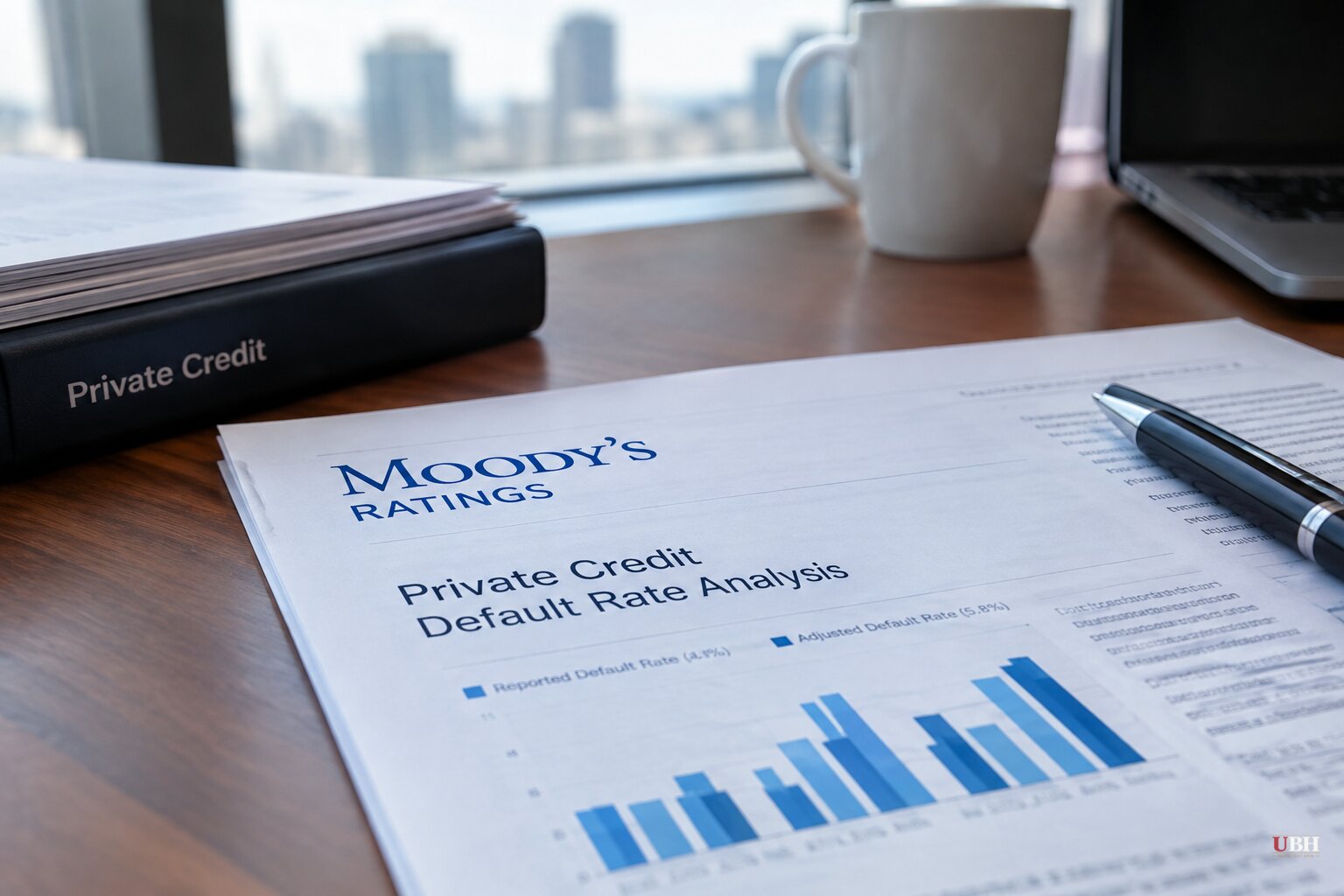
Moody's Ratings says the official default numbers in US private credit understate the problem.
Among 607 private credit borrowers it assessed, the default rate was 4% in the 12 months to June. Add payment-in-kind (PIK) amendments and maturity extensions at distressed issuers, and the figure rises to 5.8%. Moody's treats those moves as distressed exchanges, which it counts as defaults.
The difference between the two figures comes from borrowers delaying payments instead of missing them.
How PIK works
PIK lets a borrower pay interest by adding it to the loan balance instead of sending cash. Take a $100 million loan at 10%. A conventional structure means $10 million in cash interest a year. Under full PIK, the balance grows to $110 million, and future interest accrues on the larger amount.
The borrower keeps cash. The lender can book the accrued interest as income even though no cash has arrived. The debt grows, and so does the refinancing problem down the road.
PIK is not automatically a warning sign. Some loans are structured with it from day one for companies with uneven cash flow or long-payoff investments. Moody's itself says the rise in PIK "is not evidence of distress itself," though it "may signal growing pressure on borrower cash flow."
What the numbers show
Moody's looked at business development companies (BDCs), the public vehicles that disclose portfolio data, and found a widening gap versus public corporate debt:
- As of June 2026, the asset-weighted average one-year probability of default for public BDCs was about 0.49%, versus about 0.25% for Baa-rated corporates. That gap more than tripled over the prior year.
- Among roughly 100 private BDCs, the weighted average probability of default rose from about 0.77% in autumn 2025 to about 0.92% by spring 2026.
- PIK now makes up roughly 8% of gross investment income at public BDCs, up from about 5.5% in 2021.
- By spring 2026, withdrawal requests at some non-traded vehicles reached about 10.5%, more than double a typical 5% quarterly gate.
Those are modeled probabilities, not realized losses. Moody's says the figures "do not point to imminent systemic distress."
The other side of Moody's own message
Moody's does not call this a crisis. Its report says headline measures "do not indicate broad-based distress" and that the tools in question "can serve valid purposes." Its concern is that the combined use of PIK, NAV lending and fund-level leverage makes a borrower's or fund's effective leverage harder to read.
The agency also points to closer ties among private funds, banks and insurers. Stress, it says, could travel through channels that are less transparent than those in public credit markets.
The default count also rests on a methodological choice. Counting every distressed PIK amendment or extension as a default is Moody's definition. Not every lender or borrower would agree that an amendment negotiated to keep a company running is the same as a missed payment.
Scale and a product to match
Moody's expects global private credit assets under management to exceed $2 trillion in 2026 and approach $4 trillion by 2030. It also notes that competition has narrowed the pricing premium historically earned in direct lending.
Moody's Analytics and software firm Allvue Systems have launched a product aimed at exactly this problem: the EDF-X Private Credit Model. It estimates the likelihood of "hard" events such as missed payments and "soft" events such as covenant waivers and PIK arrangements that can precede them.
The model is calibrated on de-identified performance data from Allvue's software, used directly or through fund administrators by more than 1,000 private capital firms. It is available to customers of both companies through the Moody's Analytics EDF-X API.
"In private credit, the signals that matter often emerge before a missed payment or default," said Christina Kosmowski, CEO of Moody's Analytics. Allvue CEO Marc Scheipe said private credit's growth has outpaced the infrastructure used to monitor it.
Moody's is both the agency warning about opacity and a seller of the monitoring tool. That does not make the numbers wrong. It does mean the company has a commercial stake in the problem it describes.
What private investors face
Private credit does not offer the broad published ratings, regular public disclosures or transparent pricing of listed debt markets. Investors often rely on internal assessments that are hard to compare across managers.
The redemption data shows how that plays out. Withdrawal requests at 10.5% against a 5% gate mean some investors who wanted out could not get all of it back at once.
Moody's says the public-private gap in modeled risk "may indicate deterioration before it appears in realized defaults." Whether realized defaults follow, or whether the 5.8% figure is the high-water mark, is the open question the next rounds of borrower data and redemption requests will start to answer.
Sources used for this briefing
5 links from 5 independent newsrooms (syndicated copies of the same report count once)
These are the sources it draws on, linked so you can verify.


