
Unbiased headlines. Facts, not spin.
Unbiased Headlines is an independently owned news organization. We bring you the facts, not opinions, written fresh from 110+ named sources. Sources linked so you can verify it yourself.
 finance
Major Story (7/10)
finance
Major Story (7/10)
CoreWeave Shares Fall as Much as 16% as Yields on Its 2031 and 2032 Bonds Reach About 14.8% to 14.9%
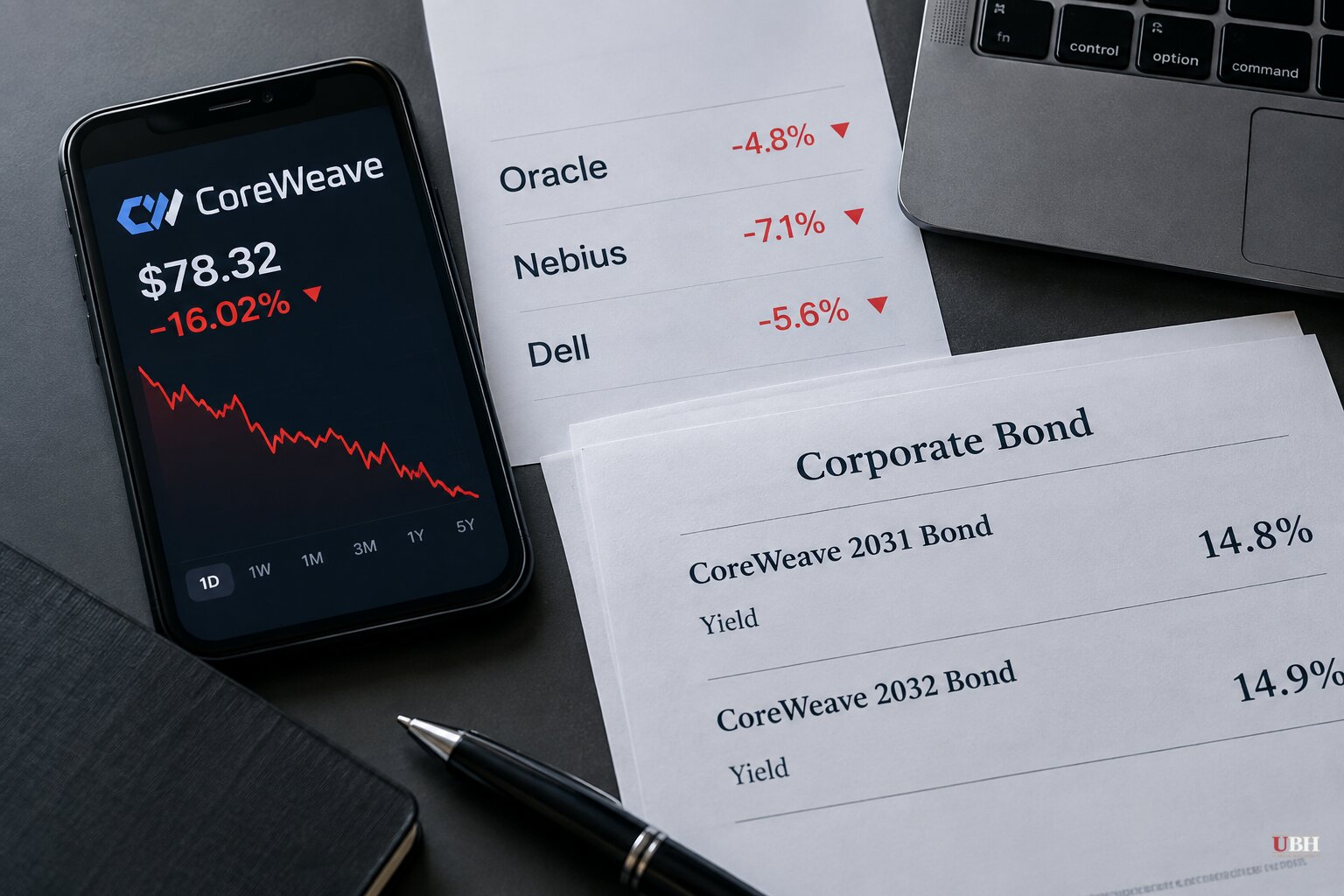
CoreWeave carries about $52 billion in debt and lease obligations as of the end of June, and the bond market is now pricing that load at close to 15%. Shares in the AI cloud provider fell as much as 16% in trading today, Oct. 14, after the yield on its 9.625% notes due 2032 reached 14.8% and the yield on its 9.75% notes due 2031 reached about 14.9%.
Bond yields move opposite to prices. A yield that far above the coupon means buyers are paying less for the same fixed payments.
The bond move came first
Investor Chamath Palihapitiya, CEO of Social Capital and of AI company 8090, posted a chart late Tuesday showing the 2032 bond's yield touching 15% on Oct. 13 before closing that session at 14.5%. The chart tracked $1.25 billion of those notes. Elon Musk replied with one word: "yikes."
Bloomberg reported, citing Trace pricing data, that CoreWeave's unsecured 2032 debt traded below 80 cents on the dollar today. Bloomberg described that level as one typically associated with financial strain. It is a market convention, not a default signal.
The stock closed Tuesday at $77.81, down 3.05%, according to Benzinga. Today's intraday low was somewhere near $65 to $68, per Crypto Briefing. Earlier in the session the stock was down about 10% at $70.37, per 24/7 Wall St. The drop deepened as the session went on.
Options traders piled in
CNBC reported that CoreWeave options volume ran more than seven times its 30-day average. Traders bought just under 200,000 puts against 106,000 calls.
The largest single position appeared around 10 a.m. ET: 26,000 puts at a $37.50 strike expiring Dec. 18. SpotGamma data showed the contracts trading near the asking price, which suggests they were bought. The position cost about $1.9 million, and CNBC calculated the stock would have to fall another 42% by expiration for it to pay off.
Scott Bauer, CEO of Prosper Trading Academy, said the trade could be a hedge against holdings in related stocks or the Nasdaq rather than a bet on collapse. The buyer has not disclosed a rationale.
The damage spread
Oracle shares fell nearly 7%, and its 6.25% bond due November 2032 yielded 7.24%. Nebius dropped about 9% to 10%, Dell fell 10%, and the Nasdaq Composite lost 1.4% in CNBC's snapshot.
Luis Alvarado, co-head of global fixed income strategy at Wells Fargo Investment Institute, said investor sentiment on AI has shifted. "The era of easy money, which we experienced in the first nine months of the year, is starting to disappear and dissipate," he said. In his view, each additional dollar of borrowing now gets examined for the concessions the issuer offers.
The International Monetary Fund warned Tuesday that an AI-related market correction is one of three risks that could sharply tighten financial conditions. The IMF said hyperscalers now account for 10% of global investment-grade bond issuance, up from under 1% in 2024.
Palihapitiya's own analysis points at pricing. Private loans to AI companies carry an average spread of 6.2 percentage points over the base rate, he found, against 6.1 points for other private credit loans. His argument is that lenders charge almost nothing extra for AI-specific risk. JPMorgan estimates cited by CNBC put hyperscaler spending at $800 billion this year and above $1 trillion annually by 2027.
The numbers behind the worry
CoreWeave rents Nvidia-based computing capacity to AI companies and has financed much of that hardware with debt. In the second quarter, revenue more than doubled to $2.58 billion. The company lost $626 million. Net interest expense hit $640 million, up from $267 million a year earlier.
Total debt stood at about $52 billion at the end of June, against roughly $15 billion a year earlier. During that quarter CoreWeave raised more than $10 billion in unsecured debt and convertible bonds plus a $3.1 billion term loan. Its contracted backlog is about $104 billion.
The case that the selloff is overdone
Paul Meeks, head of technology research at Freedom Capital Markets, agrees CoreWeave's balance sheet is "relatively bad" next to other neocloud providers, because it has borrowed more and is building more data centers. He does not share the market's worry, though.
"The yields have blown out because there's just more and more concern, that I don't share, about the wherewithal of these guys being able to over time pay back their interest expense," Meeks said. "It's definitely not a deteriorating situation. Maybe it's not improving."
Meeks expects flat margins for June to September and a significant improvement in guidance for September to December, once more data centers come online.
CoreWeave co-founder Brannin McBee has said the company's plan is to win investment-grade ratings on more of its chip-backed debt so it can borrow from insurers, whose capital he described as effectively unlimited. That would lower the cost of funding future chip purchases. The bond market is currently charging the opposite.
CoreWeave's next quarterly results are expected in November.
What the market will watch there is whether margins move the way Meeks expects. Whether the 2032 notes recover from sub-80 pricing is the other open question.
Sources used for this briefing
8 links from 7 independent newsrooms (syndicated copies of the same report count once)
These are the sources it draws on, linked so you can verify.


