
Unbiased headlines. Facts, not spin.
Unbiased Headlines is an independently owned news organization. We bring you the facts, not opinions, written fresh from 110+ named sources. Sources linked so you can verify it yourself.
 finance
Notable (6/10)
finance
Notable (6/10)
CoreWeave's Debt and Leases Reach About $52 Billion as a Thin Prediction Market Prices 27% Odds of Bankruptcy by 2029
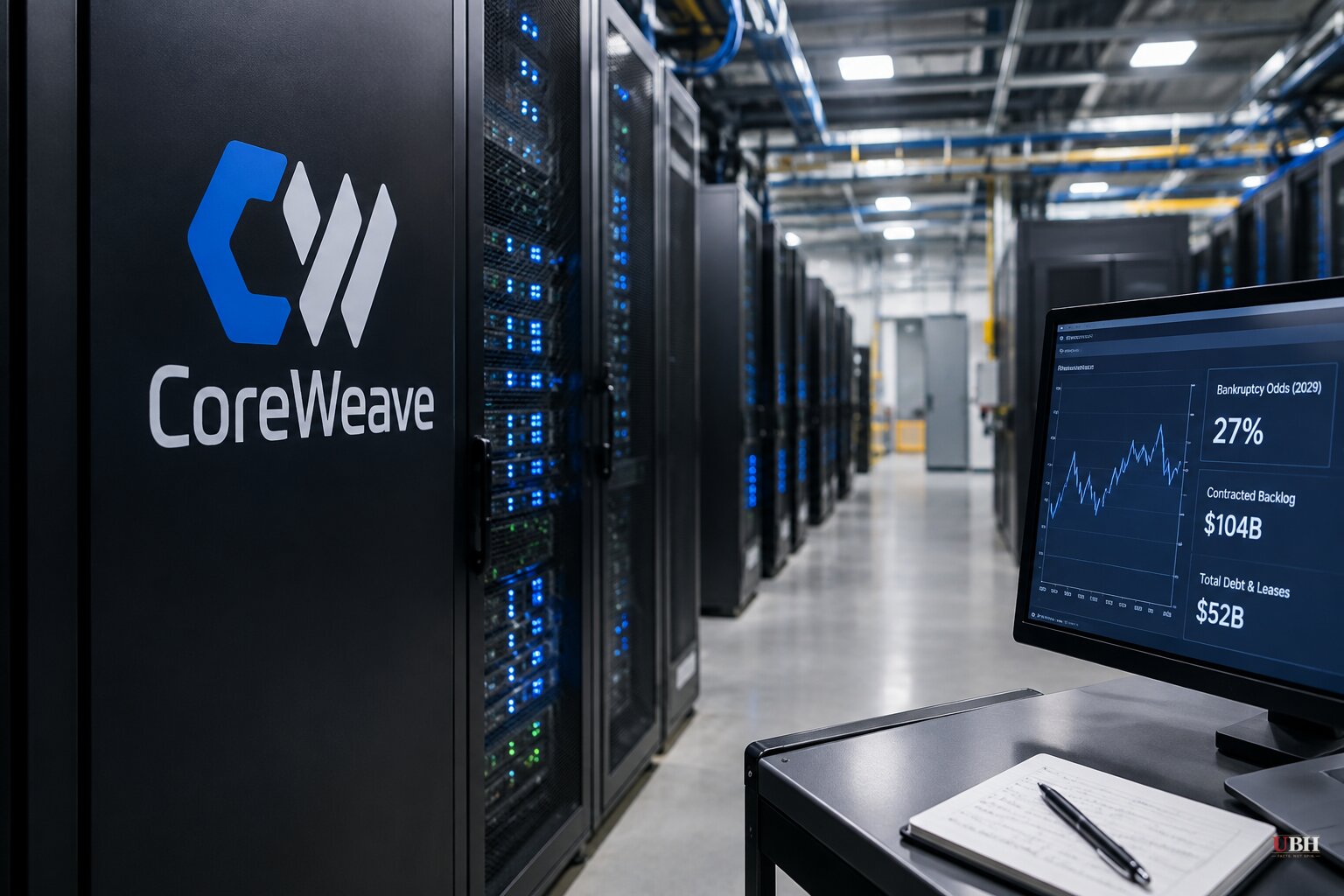
CoreWeave is building the AI economy's data centers with borrowed money, and the borrowing is enormous.
The company's debt and lease obligations totaled about $52 billion at the end of June. It has raised more than $35 billion this year through chip-backed loans, high-yield bonds, convertible bonds and share sales. One comparison circulating among investors sets roughly $5.5 billion in cash against $51.6 billion in debt.
The backlog
The other side of the ledger is large too. CoreWeave's contracted revenue backlog has reached about $104 billion, with more than $25 billion in new commitments reportedly signed early in the third quarter. In September the company announced new compute contracts at higher prices than those signed before June 30.
Co-founder Brannin McBee told the Financial Times that nearly all of CoreWeave's 2027 capacity has been sold. He said contracts now extend into 2028 and beyond.
Revenue is already scaling. CoreWeave reported $5.1 billion for 2025, up 168% from the year before. The company listed on Nasdaq in March 2025.
The financing model
McBee is now pitching insurers as the next source of capital. "It's unlimited. Like, that's all the money in the world that sits in the insurance tranche," he told the Financial Times.
There is precedent. An $8.5 billion loan backed by computing infrastructure and a contract with Meta Platforms received an investment-grade rating. CoreWeave wants to extend that structure to debt backed by contracts with lower-rated AI labs, and eventually to win an investment-grade rating for the company itself.
The model works only if the collateral holds up. That means the GPUs and the customer contracts attached to them.
The March 2027 test
Seeking Alpha contributor Rick Orford, who rates the stock a Strong Buy, flags a figure in CoreWeave's bond paperwork that faces a test by March 2027. Crypto Briefing describes the same test as a check on whether the company's financial structures, including customer contracts and GPU collateral, can withstand pressure. Failure, it says, could expose unsecured bondholders to refinancing risk. Passing would let CoreWeave keep funding growth with debt.
Orford's bullish case is that backlog is growing faster than the company can build capacity. He also points to a recent $4.2 billion convertible bond deal that should lower interest costs, though it carries dilution risk.
He names a weak spot himself. CoreWeave has $64.6 billion in future rent obligations on its leases. Those run longer than its customer contracts, so renewal pricing after 2026 becomes critical.
What the market says
CoreWeave stock closed at $80.26 on Monday, Oct. 12. It opened Tuesday at $76.32 and was last quoted at $77.45 during the session. Headlines this week cite declines of roughly 20% to 25% over six months.
Analysts are split. Cantor Fitzgerald reaffirmed an overweight rating with a $176 target on Sept. 28. Northland Securities set a $200 target on Oct. 7. Raymond James downgraded the stock to hold on July 22. Bears point to widening losses, high leverage and the rising capital spending needed to keep building.
The prediction market on Lines is a sideshow, but it gives a rough read. It puts the chance of a CoreWeave bankruptcy announcement at 13% by the end of 2027, 21% by the end of 2028 and about 27% by the end of 2029. Total volume is only about $183,000, so it reflects a small pool of bettors.
It also resolves narrowly. A debt restructuring that stops short of a formal bankruptcy filing does not count as a YES. Lines' own analysis argues that a filing would require an inability to service debt, not just high leverage.
What is still open
No bankruptcy filing, covenant breach or restructuring has been announced. CoreWeave has not disclosed any refinancing trouble in the material now public.
The unresolved question is whether the debt can be serviced if customer contracts end before the lease payments do. The next marker is March 2027, when the bond-paperwork test comes due. Refinancing terms, any change in customer contract terms, and whether insurers actually take up McBee's pitch will show how much of CoreWeave's $104 billion backlog turns into cash.
Sources used for this briefing
7 links from 7 independent newsrooms (syndicated copies of the same report count once)
These are the sources it draws on, linked so you can verify.


