
Unbiased headlines. Facts, not spin.
Unbiased Headlines is an independently owned news organization. We bring you the facts, not opinions, written fresh from 110+ named sources. Sources linked so you can verify it yourself.
 finance
Major Story (7/10)
Event date: September 25, 2026 ·
finance
Major Story (7/10)
Event date: September 25, 2026 ·
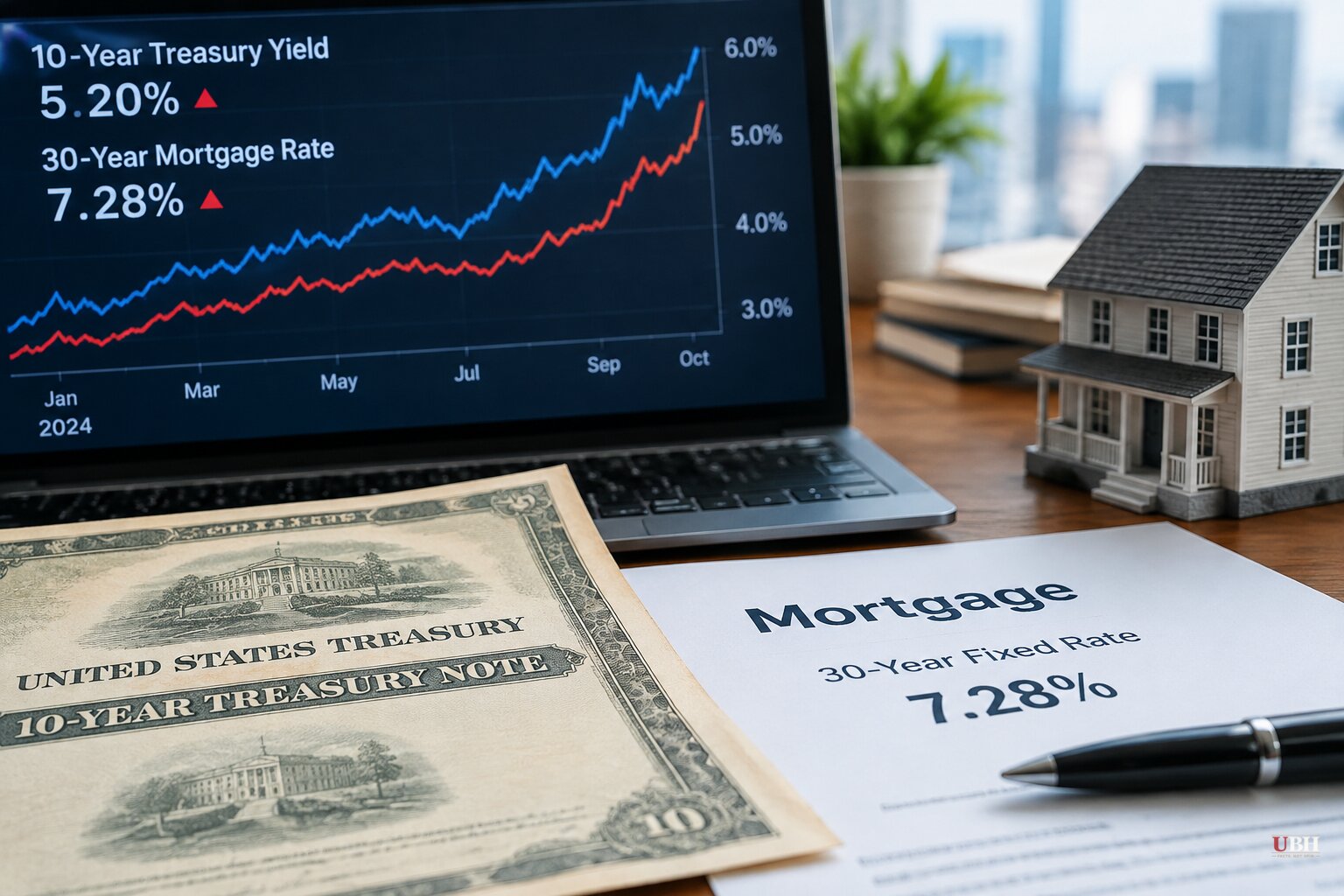
10-Year Treasury Yield Hits 5.2%, Highest Since 2007, and 30-Year Mortgage Rate Reaches 7.28%
The bond market has been the story for three weeks, and the numbers are ugly.
On Thursday, Sept. 24, the 10-year Treasury yield rose as high as 5.22%, its highest since 2007. The 30-year hit 5.5%, the highest since 2004. The 10-year gained more than 20 basis points in a single week.
By Oct. 1, the 10-year had briefly topped 5.3% before settling back near 5.2%. The 30-year reached its highest level since 2002.
Where the pressure came from
CNN reported that Wednesday's sell-off followed S&P Global data showing strong U.S. business activity in September alongside hot inflation from higher energy costs. Traders responded by betting on more Fed tightening. According to the CME FedWatch tool, the odds of an October rate hike stood at 71% on Sept. 24, up from 11% a month earlier.
The backdrop is the war with Iran. The closure of the Strait of Hormuz has driven oil higher. Brent crude settled at $106.60 a barrel on Sept. 24, up 3.41% on the day.
The Fed and the European Central Bank both raised rates in September. The two-year Treasury yield, which tracks Fed expectations, has climbed from 3.48% at the start of the year to 4.93%. At the start of the year, some Wall Street analysts expected rate cuts.
The move was not limited to the U.S. Ten-year yields in France and Germany reached their highest levels in roughly 15 years. Japan's 10-year touched 3.122%, a 30-year high. Australia's 10-year approached a 15-year peak.
"Every major bond market's feeling the heat at once," deVere Group CEO Nigel Green said in a note.
Gennadiy Goldberg, head of U.S. rates strategy at TD Securities, told CNN that investors are "trading headlines more so than anything else, just because of the lack of certainty." Brent briefly dipped to roughly $104 on Sept. 24 after Reuters reported that U.S. and Iranian negotiators had discussed a path to reopening the Strait. Then it climbed back.
A market briefing from the research firm iCrypex said the Treasury's buyback program was also under strain. The briefing said Treasury Secretary Scott Bessent added buybacks a month earlier to defend the 5.30% level on the long end, and that the latest operation completed only $4 billion of a planned $6 billion.
Mortgages and housing
The sell-off hit household borrowing fast. Freddie Mac put the average 30-year fixed mortgage at 7.28% on Oct. 1, up from 7.03% a week earlier. It was the largest weekly jump in four years and the highest since November 2023. A year ago the rate was 6.34%.
The 15-year fixed rose to 6.60% from 6.42%.
Realtor.com estimates a half-point swing in rates changes purchasing power by about $30,000 for a buyer with a $2,000 monthly principal-and-interest budget.
The housing market was already softening. Realtor.com's Sept. 30 report found:
- Homes under contract fell 4.1% in September from a year earlier.
- Active listings rose 5.4% to about 1.16 million.
- 20.8% of listings had price cuts, the highest share for a September since 2018.
The Mortgage Bankers Association said its overall application index fell 6% in the week ended Sept. 25.
Morgan Stanley economist Heather Berger wrote that credit card and auto loan rates had stopped falling even before the latest move. She said mortgage rates were re-accelerating and forecast a 40 basis point slowdown in real consumption growth next year, mainly through weaker goods spending.
Japan's money is moving, slowly
Higher yields at home are starting to pull Japanese capital back. Finance Ministry data show Japanese investors were net sellers of foreign bonds for a second straight month in September, unloading 969 billion yen (about $6.13 billion). August net sales were 1.16 trillion yen.
Net foreign bond sales for the year total about 5.08 trillion yen, the most since 2022. Japanese banks led September's selling of long-term foreign bonds at a net 2.49 trillion yen. Life insurers sold 288.6 billion yen and investment trusts 200.1 billion yen.
Trust accounts went the other way, buying a net 1.2 trillion yen of foreign long-term bonds. Bank of Japan data show Japanese investors sold a net 4.74 trillion yen of U.S. bonds in the first eight months of the year.
The larger repatriation that some expect has not arrived. Reuters reported on Sept. 26 that major investors are reluctant to commit heavily to Japanese bonds while yields are still rising and policymakers give few clues about how high rates must go. The Bank of Japan raised rates the week before, with two dovish dissents. It also reportedly conducted a rate check in the currency market, a step meant to deter bets against the yen.
Investors keep asking where Japanese yields will peak, and whether the Fed, facing a 71% market-implied hike probability as of Sept. 24, will move before Hormuz reopens. Neither answer is in yet.
Sources used for this briefing
6 links from 5 independent newsrooms (syndicated copies of the same report count once)
These are the sources it draws on, linked so you can verify.


