
Unbiased headlines. Facts, not spin.
Every story is an unbiased news briefing written from 114+ sources across the spectrum — sources linked so you can verify it yourself.
 finance
Notable (6/10)
October 14, 2026 at 02:38 AM
finance
Notable (6/10)
October 14, 2026 at 02:38 AM
Hong Kong SFC Freezes HK$4.6 Billion and Halts Baicha Shares Over Suspected IPO Rigging
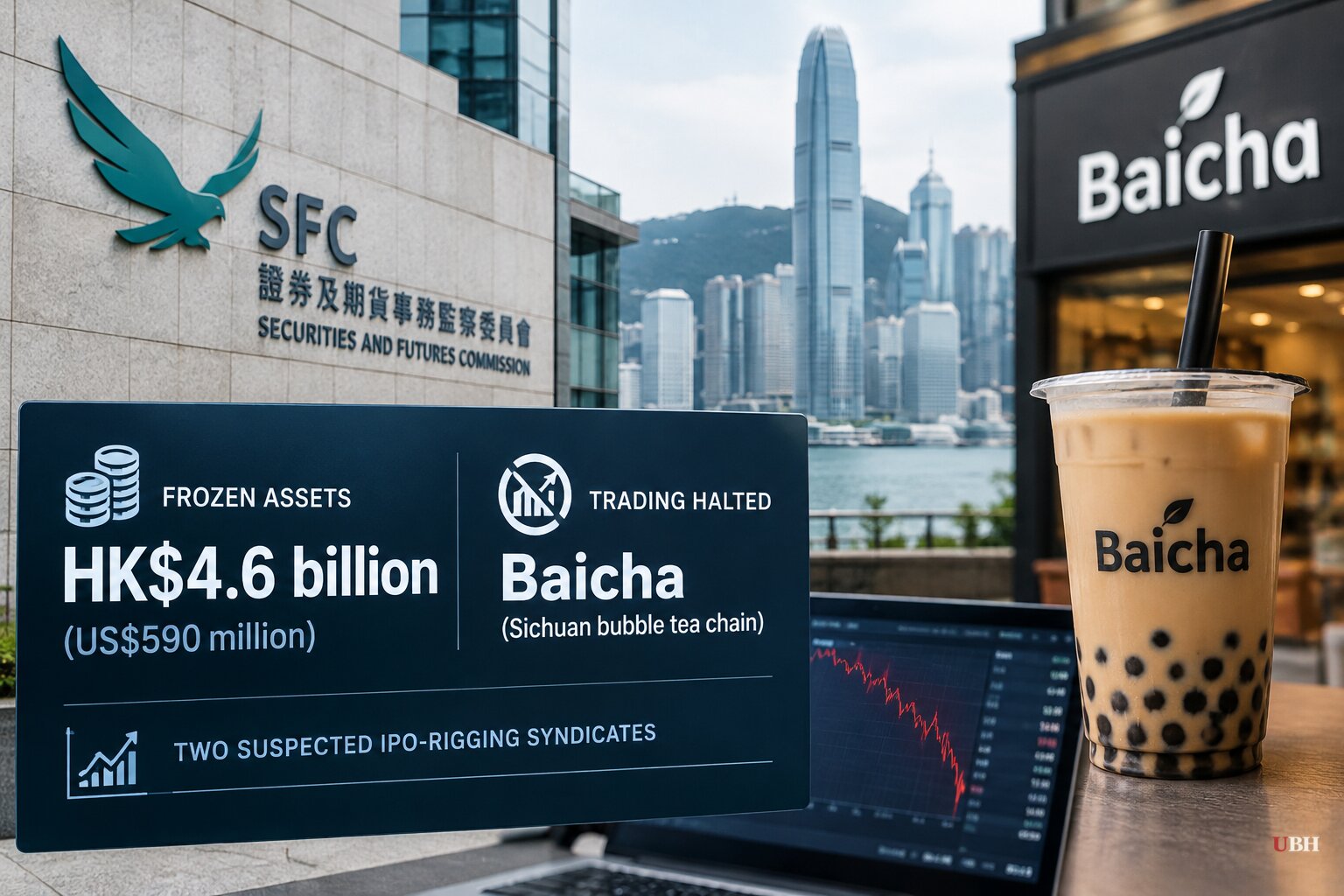
Hong Kong's securities regulator has frozen a record amount of client assets and pulled a listed bubble tea chain from trading, saying it suspects someone faked investor demand during initial public offerings.
The Securities and Futures Commission (SFC) announced the actions on Tuesday, Oct. 13. It directed the Stock Exchange of Hong Kong to suspend dealings in Sichuan Baicha Baidao Industrial Co. (stock code 2555) from 9:00 a.m. that day. The SFC said it has "serious concerns that Baicha's IPO may have been rigged to create an artificial impression of demand."
The regulator said the suspension is necessary or expedient to maintain an orderly and fair market in the shares and to protect investors while its investigation continues.
The two suspected syndicates
The SFC described two groups.
Against the first, it issued restriction notices to six brokers. They bar the brokers from dealing with or processing up to HK$4,379,463,215 in client-account assets held in the names of Sun Ran and eight related companies: Avant Team, Citadel Wealth, Fortuna Capital Management, Gemstone Capital Management, Generations Capital Management, Panda Capital Management, Prudent Wealth Global and Timeless Capital Management. The SFC said this is the largest amount of its kind in its history.
The first syndicate is suspected of fraudulent schemes tied to the IPOs of Cloudbreak Pharma (2592) and Baicha. The SFC halted Cloudbreak's shares last month for the same reason.
Against the second, it issued restriction notices to 29 brokers covering up to HK$285,030,265 in accounts held by Liu Haoran, The Reynold Lemkins Group (Asia) Limited and Kaufmann & Company Pan-Asia Limited. That group is suspected of a scheme involving the IPO of Tianju Dihe (Suzhou) Technology (2479). Tianju Dihe's stock has been suspended since April 2025 after the company failed to publish financial results.
Between the two, 35 brokers are now under restriction notices. The combined freeze comes to roughly HK$4.6 billion across three alleged schemes.
How the alleged scheme worked
According to the SFC, the syndicates allegedly struck undisclosed agreements with companies preparing to list. Under those deals, portions of IPO proceeds were moved out of the companies for what were described as investments in financial products.
The SFC alleges the money was then quietly routed back to major IPO placees or their connected parties. That would have let those buyers appear to place big orders, manufacturing what amounts to phantom demand during the offering.
If that is what happened, the companies' own IPO money may have helped pay for the appearance of enthusiasm. Ordinary buyers coming in after the listing would have been reading a demand signal that was not real.
The SFC said it maintains a "zero-tolerance policy" toward IPO rigging. It has made no finding yet. Restriction notices freeze assets while an investigation proceeds. They are not convictions, and no charges have been announced against any person or company named.
What Baicha's debut looked like
Baicha raised roughly US$330 million in its April 2024 listing, which at the time was the city's largest first-time share sale of the year. The debut was weak. Shares fell 27% on the first day and have not traded above the offer price since.
Demand was soft on the numbers. The retail portion was subscribed 0.5 times, while institutional orders equaled 1.1 times the initial allocation. The company carries a market value of about HK$5.9 billion (US$752 million). China International Capital Corp. was the sole sponsor. The SFC's statement does not accuse the sponsor of anything.
A wider squeeze on listing quality
The same day, the SFC said it had suspended 65 listing applications in the first nine months of this year because of the poor quality of the sponsors' work. That is a sizable number in a year when Hong Kong's IPO market has been busy, helped by a wave of Chinese companies tied to the artificial intelligence supply chain, with a few hundred prospective listings in the queue.
Analysts cited by the South China Morning Post saw the moves as an effort to strengthen the quality of the city's market. The SFC has also warned investment banks and other intermediaries against arrangements that may artificially inflate IPO demand.
The case raises a basic question for any exchange: whether the orders in an IPO book are real. Hong Kong wants to keep drawing mainland listings and global money, and its regulator is now telling the market that fabricated demand will be met with frozen accounts and halted shares.
The SFC has not said when Baicha's shares might resume trading, and its investigation into all three listings remains open.
Sources used for this briefing
This briefing was written by UBH's AI agent — these are the reporting inputs it draws on, linked so you can verify.


