
Unbiased headlines. Facts, not spin.
Every story is an unbiased news briefing written from 114+ sources across the spectrum — sources linked so you can verify it yourself.
 finance
Major Story (7/10)
Event date: October 8, 2026
finance
Major Story (7/10)
Event date: October 8, 2026
Visa, Mastercard, Stripe and Coinbase Launch Open USD Stablecoin With $1 Billion in Committed Liquidity
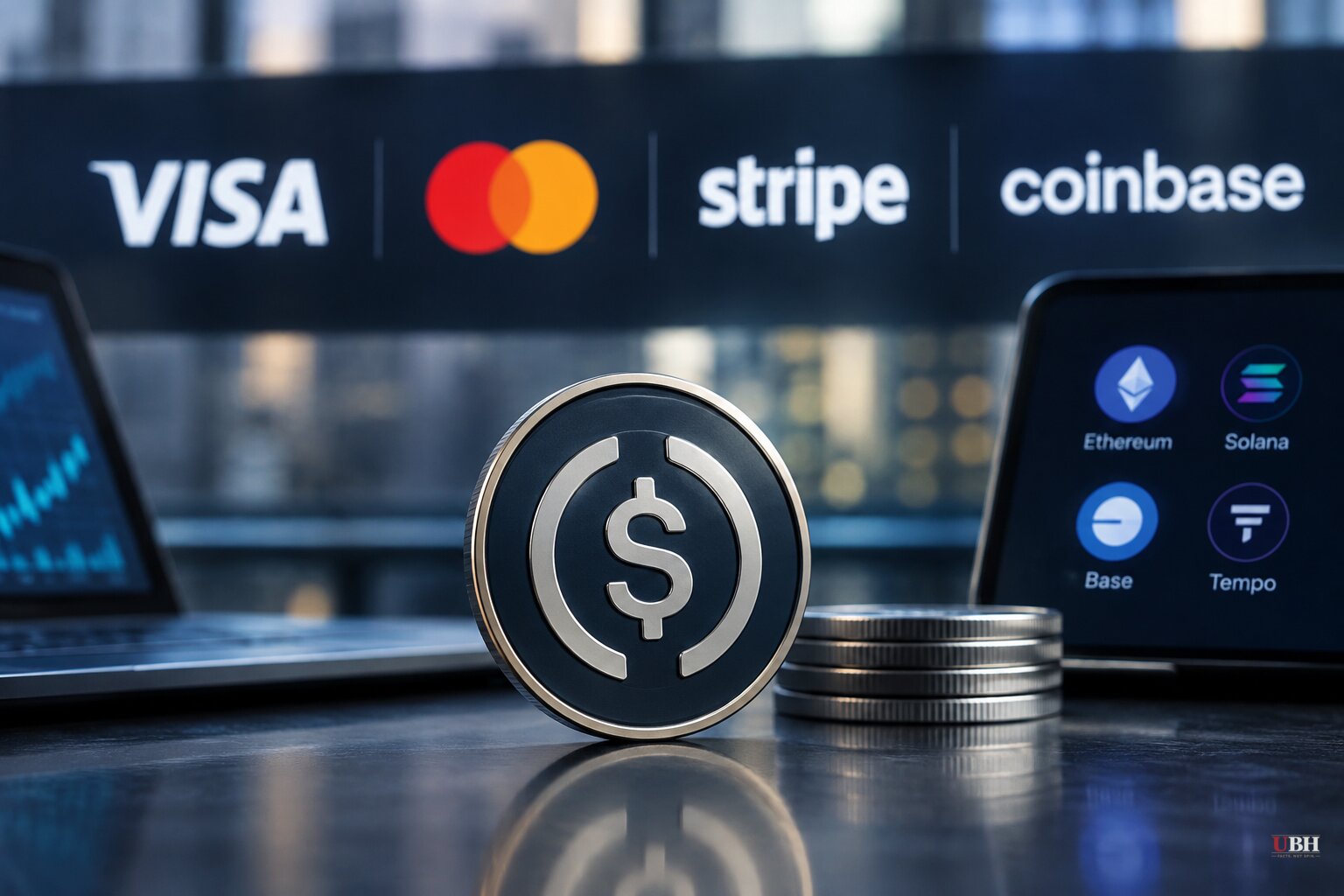
Open USD, a dollar-pegged stablecoin backed by Visa, Mastercard, Stripe, Coinbase and Shopify, has been live since Wednesday, Sept. 30. It runs on Ethereum, Solana, Base and Tempo.
The five founders committed more than $1 billion to seed liquidity over the coming months. Open Standard, the company behind the project, announced the token in June with 140-plus partners. That network has since grown past 200 companies, including UBS, SBI Holdings, Jeeves, BNY, Standard Chartered, DBS and SoFi.
How the token works
Bridge, a Stripe subsidiary, issues OUSD. Reserves are held at BlackRock, BNY and Lead Bank, with monthly attestations.
Businesses can mint and redeem OUSD one-for-one with the dollar at no fee. Access runs through Coinbase, Stripe, Visa and Mastercard. Coinbase support went live Oct. 1.
Stripe offers the deepest integration, covering Treasury, Issuing, Global Payouts and Crypto Onramp.
The ownership model
The pitch is about who gets paid. Coinbase, Mastercard, Shopify, Stripe and Visa each took an equal founding equity stake in Open Standard.
CEO Zach Abrams says the "overwhelming majority" of the equity will go to founders and network partners over the next four to five years. The split will track how much OUSD supply and transaction activity each partner generates. Founders get no special revenue share, Abrams said. They earn rewards under the same framework as everyone else.
Partners that clear a minimum threshold can earn equity. Most of the reserve interest is shared with partners rather than kept by the issuer.
"Every other stablecoin is building a fund. We're building money," Abrams said.
That is a break from the incumbents. Tether keeps the yield on USDT reserves. Circle keeps most of the yield on USDC and pays Coinbase and other distributors a share. Open Standard instead pays partners in rewards and equity and takes a small transaction fee for itself.
The author of the fintechbrainfood newsletter, reporting from the SIBOS banking conference, described the structure as a member-owned utility. The author noted that Visa and Mastercard began as bank-owned associations before their 2008 and 2006 IPOs. The author also quoted one large global bank saying, "we cannot work with a private issuer," and tied that to the fact that yield-chasing stablecoins compete for bank deposits.
The incumbents are far ahead
The stablecoin market is worth more than $300 billion. Circle's USDC has about $74 billion in circulation. Tether's USDT figure varies by source: roughly $143 billion in one tally, about $184 billion according to DefiLlama. By either number, OUSD is starting from zero against a giant.
The fintechbrainfood author acknowledged the gap: Circle remains the "behemoth onshore" and Tether offshore, with deep liquidity, chain access and integrations. The same writer said Tether faces increasing scrutiny over anti-money-laundering controls, and that Circle is looking for business models beyond the stablecoin itself, citing its Arc chain.
OUSD also has a geographic limit. As of Oct. 1 it had no registration under the EU's MiCA rules, which restricts where it can be offered.
Mastercard's play
Mastercard is routing OUSD through BVNK, the stablecoin infrastructure company it acquired earlier this year. Banks and businesses using BVNK can hold, move and settle OUSD alongside fiat currencies and other stablecoins.
"The challenge isn't creating more forms of money. It's helping businesses use them," said Jorn Lambert, Mastercard's chief product officer.
CEO Michael Miebach told Bloomberg TV that the clearest use case for stablecoins today is cross-border payments. "If you make a cross-border payment, it takes days; the fees are unclear," he said. "From a working capital perspective for a company, if you could move the money instantly, it would be so much better." He said Mastercard wanted a stablecoin built for moving money, not for investment.
Abrams has also said the project is already seeing demand for stablecoins in currencies other than the dollar.
What to watch
The founders' $1 billion is committed over the coming months, not deposited on day one. Open Standard has not published an OUSD circulation figure, so the early test is how fast real supply builds.
The equity payouts depend on that supply and on transaction activity. Partners will be watching those numbers over the four-to-five-year distribution window. The next measurable checkpoint is whether OUSD gets a MiCA registration and opens the European market.
Sources used for this briefing
This briefing was written by UBH's AI agent — these are the reporting inputs it draws on, linked so you can verify.


