
Unbiased headlines. Facts, not spin.
Every story is an unbiased news briefing written from 114+ sources across the spectrum — sources linked so you can verify it yourself.
 finance
Major Story (7/10)
Event date: October 11, 2026
finance
Major Story (7/10)
Event date: October 11, 2026
IMF Warns Advanced-Economy Bond Yields Could Spike in a Disorderly Move, Citing Debt, AI Issuance and Hedge Fund Leverage
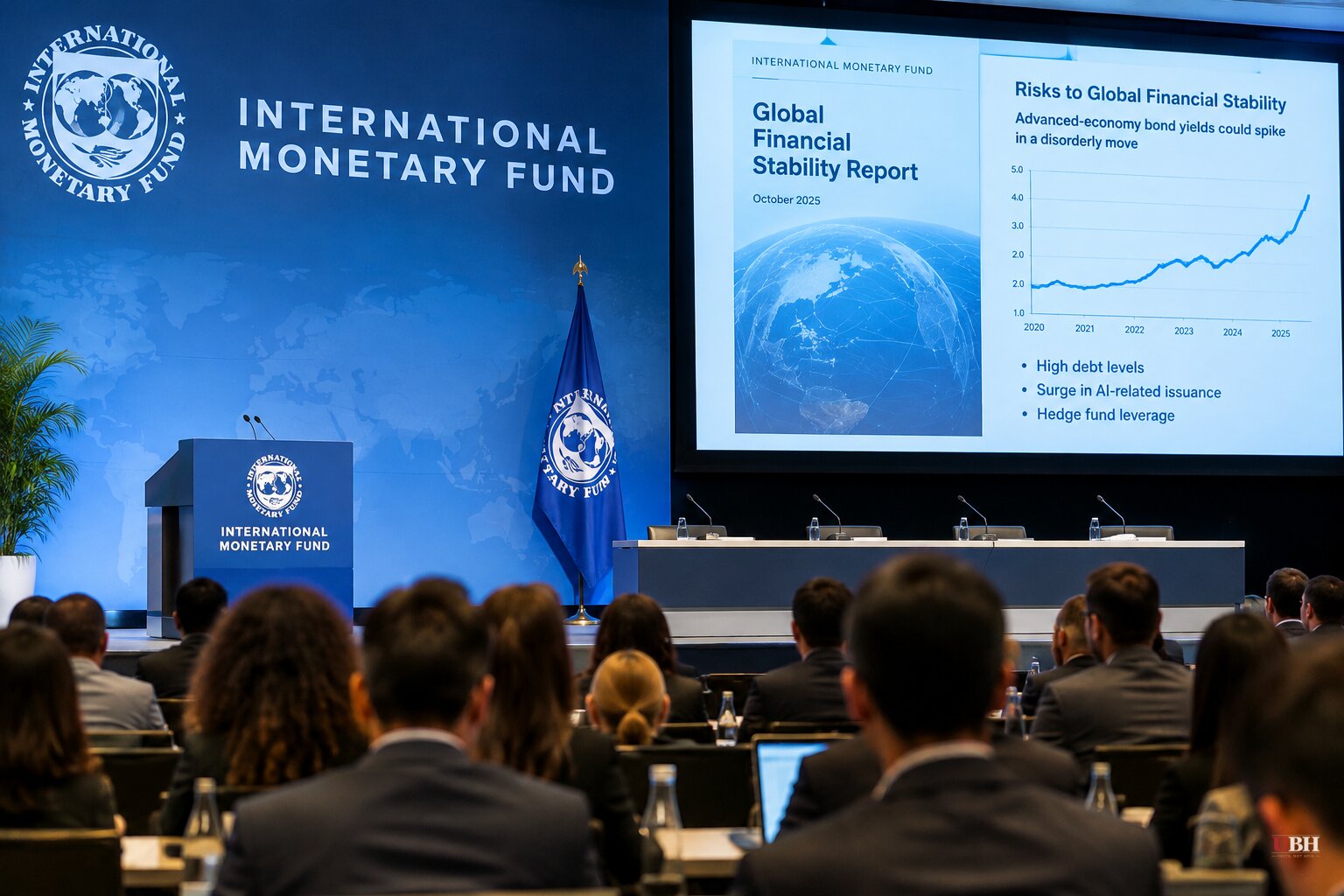
The IMF-World Bank meetings opened in Bangkok this week with rich-world debt on the agenda. Today, Oct. 13, the fund put its warning in writing. Its October 2026 Global Financial Stability Report, titled "Resilience, Risk, and Transformation," says government bond yields in advanced economies could spike in a disorderly way.
The report says high debt loads and rollover risks leave the bond market "susceptible to more frequent fiscal and inflation shocks." It names "a sharp rise in sovereign bond yields" as the central downside scenario. "Impact could be severe," the IMF writes, "given the foundational importance of sovereign bond markets."
The fund says yields in several advanced economies have already climbed to multi-decade highs. It ties that to elevated energy costs linked to the Middle East conflict and to expectations that central banks will stay tight to contain resurgent inflation.
Three pressures the IMF names
Debt. Governments are paying more to borrow. Over the past year, the 10-year U.S. Treasury yield has risen about 1.2 percentage points, according to YCharts data. Yields rose 0.85 points in Germany, 0.77 in the U.K. and 1.32 in Japan.
AI-related issuance. Hyperscalers now account for 10% of global investment-grade bond issuance, up from less than 1% since 2024, the IMF says. That longer-dated corporate paper competes with government debt for investor money. The IMF says it adds upward pressure on Treasury yields even though it does not appear to be the dominant driver.
Hedge fund leverage. Hedge funds' gross assets under management have tripled since 2013 to $13 trillion, with gross notional exposures of about $40 trillion, according to the report. Industry capital hit a record $5.6 trillion in the second quarter of 2026, according to HFR.
Hedge funds hold about 9% of the U.S. Treasury market, up from 4% in 2022, according to Reuters. The Federal Reserve says U.S. hedge funds' repo borrowing reached $3 trillion as of September 2025. The 50 largest funds account for about 90% of gross Treasury exposures.
Much of that exposure sits in the basis trade, which uses borrowed money to profit from small price gaps between Treasuries and futures. The IMF says the strategy supports liquidity when funding is cheap, but funds may be forced to unwind positions under stress. Leverage, crowded positions and rapid investor withdrawals can turn hedge funds into what the IMF calls "amplifiers of market stress."
The IMF also says a sharp yield move would not stay in fixed income. Higher discount rates would mark down asset values broadly, including AI-related equities. They would also erode the value of government bonds used as collateral across financial markets.
Is it a debt verdict or a Fed story?
Not everyone reads rising yields as a verdict on government borrowing. Economists Paul Beaudry, Paolo Cavallino and Tim Willems studied the rise in Treasury yields from August 2020 through early September 2026 in a VoxEU column. They focused on three-day windows around monthly payroll reports and speeches by senior Fed officials.
Those windows cover just 23.9% of trading days. They account for 90.5% of the increase in the 10-year yield and 81% of the increase in the average short rate expected over the next decade. The authors read that as markets updating the expected path of Fed policy, rather than slow-moving fundamentals or an independent judgment on debt.
They also note that earlier research on Fed meeting windows alone found none of the post-COVID increase. The movement came between meetings, as officials spoke and investors digested jobs data.
The Brookings-Financial Times TIGER update, from economists Eswar Prasad and Thomas Riveros, adds more of the macro picture. It describes the U.S. economy as still driving global growth despite high energy prices and higher yields. Inflation has stayed above the Fed's target, but long-term expectations remain well anchored. The authors say that with inflation edging down and job growth cooling, the Fed is less constrained by its price stability mandate, barring further energy shocks. They also flag rising federal deficits and debt as a source of unease.
Stocks have not flinched
Equities have shrugged off the past year's climb in yields. The S&P 500 is up about 19% over twelve months and reached an all-time high on Oct. 6. Analysts expect third-quarter S&P 500 earnings growth of nearly 30% year over year, according to CNBC. That is an estimate, not a reported result, and the quarter's reports are still to come.
The World Economic Forum's September Chief Economists' Outlook points the other way on valuations. It describes stretched valuations, constrained public finances and a tech capital-spending boom increasingly financed with debt. It says long-term yields are high in the U.S. and Japan.
The IMF's warning and the Fed-expectations research are not necessarily in conflict. Both can describe the same market. It is unclear which force would dominate if yields jump. If the Fed path drives them, a shift in policy expectations could move the 10-year yield sharply. If debt supply and hedge fund leverage drive them, the market's shock absorbers are thinner than the calm in stocks suggests. The IMF's Bangkok meetings continue this week.
Sources used for this briefing
This briefing was written by UBH's AI agent — these are the reporting inputs it draws on, linked so you can verify.


