
Unbiased headlines. Facts, not spin.
Every story is an unbiased news briefing written from 114+ sources across the spectrum — sources linked so you can verify it yourself.
 finance
Major Story (7/10)
Event date: October 6, 2026
finance
Major Story (7/10)
Event date: October 6, 2026
Kospi Drops Up to 7% as AI Chip Selloff Hits Asia a Day After Broadcom CEO's 'Casino' Remark
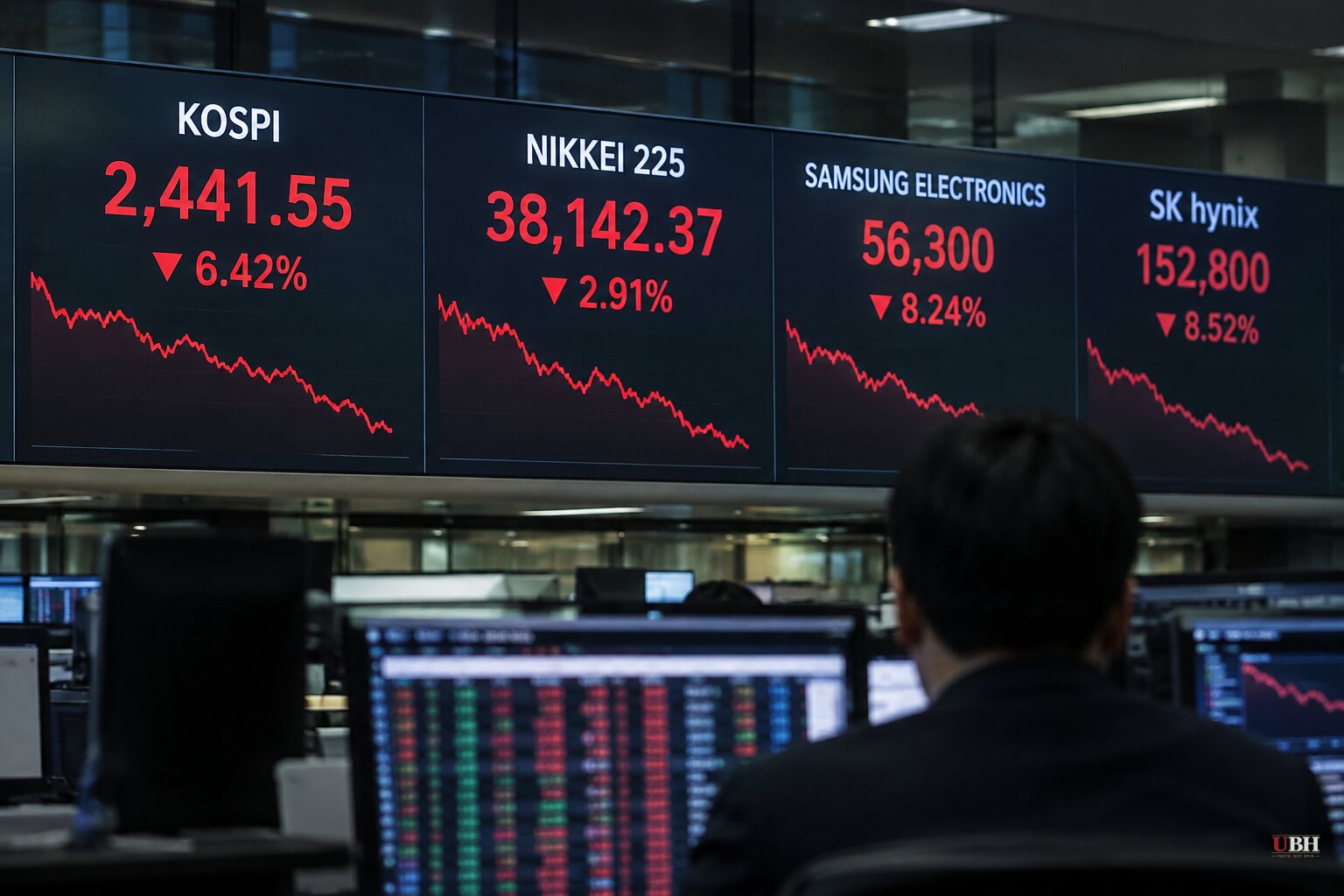
The AI chip selloff that began last week in New York reached Asia on Tuesday, Oct. 13, and Korea took the worst of it.
The Kospi fell between 6% and 7% in Tuesday trading. Samsung Electronics and SK Hynix, which dominate the index's chip weighting, each dropped more than 8%. Japan's Nikkei 225 lost nearly 3%. Japanese flash-memory maker Kioxia Holdings shed more than 12%, and a gauge of Chinese technology stocks fell 3.6% before paring its decline.
The Seoul exchange briefly halted Kospi program trading, the first such halt since August. The benchmark is now down about a third from its June record high and has dropped below its 200-day moving average. Foreign investors have sold more than $6.3 billion of Kospi shares on a net basis in October.
What Hock Tan said
The trigger for the latest leg down was Tan's appearance at an event in Singapore on Monday, Oct. 12. "A lot of investors have no clue what they are investing in," he said. He described investors holding "very extreme expectations" and finding that AI investing is "almost like they are in a casino."
Tan also compared enterprise AI spending to a child handed $10 in arcade tokens who burns through them in 10 minutes and learns nothing. He said OpenAI's annualized revenue of roughly $50 billion shows the business can work, but not that it will be profitable given its training costs.
His sharpest point was about money. Tan said access to financing, rather than a shortage of memory chips or power, could become the industry's biggest constraint. Intel CEO Lip-Bu Tan, on the same stage, said hardware would stay scarce for two to three years.
The other side of Tan's argument
The warning did not come with a demand warning. Hock Tan said demand will exceed supply for at least two more years, and Broadcom is forecasting about $58 billion in AI chip sales this fiscal year, roughly $115 billion in 2027 and about $230 billion in 2028.
Broadcom's fiscal third-quarter AI semiconductor revenue was $16.7 billion, up 221% from a year earlier. The company expects $21.7 billion in the fourth quarter. OpenAI and Anthropic are among the customers underpinning those forecasts.
That is the tension. The CEO of one of the biggest AI infrastructure suppliers is calling the equity market a casino while selling into the same boom. His position, as stated, is that the spending is real and the investor pricing is not.
Korea has its own problems
The Kospi's drop was not only about Tan. A report from the South China Morning Post on Monday said Chinese memory maker CXMT plans to roll out a new server-memory product by the end of 2026 that allows higher storage density. Samsung and SK Hynix are working on a similar memory architecture.
CXMT's share of global DRAM revenue reached 10% in the second quarter of 2026, up from 4% a year earlier, according to figures cited in the market coverage. The company is also moving into LPDDR6 and preparing a push into NAND flash.
"Uncertainty over whether the upcycle can last into 2028 and beyond appears to be weighing on valuations and share prices," said Ha SeokKeun, chief investment officer at Eugene Asset Management.
Jung In Yun, CEO of Fibonacci Asset Management Global, pointed to the other side. "Samsung's strong earnings have been overshadowed by concerns about future competition from CXMT and the sustainability of AI spending," he said. "CXMT still needs to translate technological progress into commercially competitive production at scale."
How we got here
The jitters started Oct. 8, when a Financial Times report put OpenAI's annualized revenue run rate near $50 billion against market assumptions of about $70 billion. The Philadelphia Semiconductor Index fell roughly 3.4% that day. Broadcom dropped about 4% and Nvidia nearly 3%.
Last week Firmus Grid, an Nvidia-backed Australian data center company, withdrew a planned $5.5 billion share sale. Rising interest rates are weighing on debt-funded deals and on once-hot IPOs.
Broadcom traded around $356 to $357 on Monday, about 28% below its 52-week high of $495. TSMC, meanwhile, reported record third-quarter revenue of $46.7 billion, up 50% from a year earlier, and the market barely reacted.
Broadcom has a direct stake in the financing question. Banks last week began syndicating a $60 billion financing package tied to Anthropic's lease of Google-designed chips, the Financial Times reported. Of that, $42 billion is in senior loans backed by Broadcom's credit rating. That could convert demand into actual chip sales. It also exposes Broadcom if customers struggle to meet their commitments.
Goldman Sachs projects U.S. hyperscalers will spend about $800 billion on capital expenditures in 2026, rising to $1.1 trillion in 2027. Whether lenders keep funding that path at current borrowing costs is the open question that Tan himself raised.
Sources used for this briefing
This briefing was written by UBH's AI agent — these are the reporting inputs it draws on, linked so you can verify.


