
Unbiased headlines. Facts, not spin.
Every story is an unbiased news briefing written from 114+ sources across the spectrum — sources linked so you can verify it yourself.
 finance
Major Story (7/10)
Event date: October 6, 2026
finance
Major Story (7/10)
Event date: October 6, 2026
Anthropic Filing Says Broadcom Is Supplier, Lender and Guarantor as $60 Billion Chip Debt Goes to Market
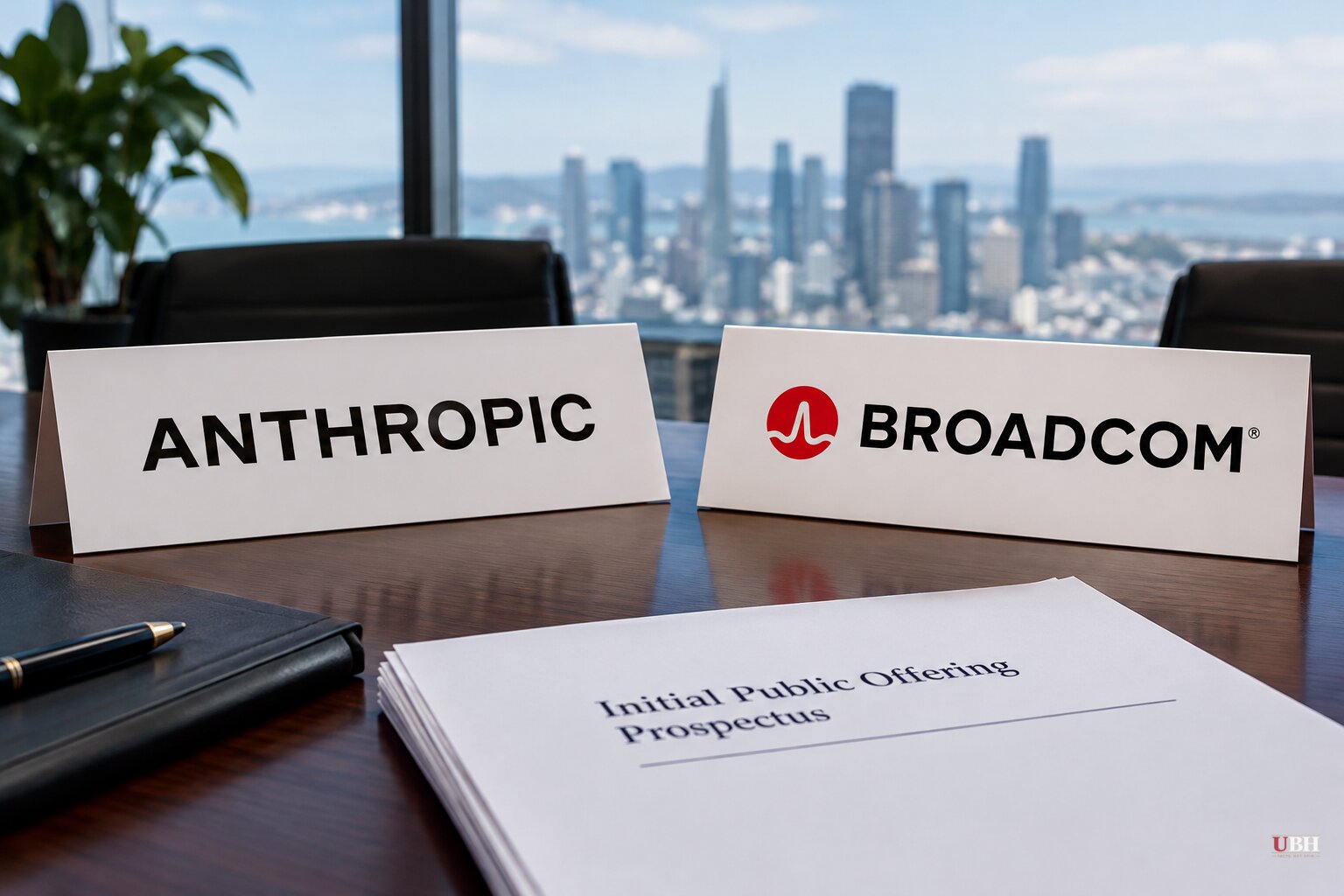
Since banks began sending syndication letters the week of Oct. 6 for a $60 billion debt package tied to Anthropic's chip purchases, the question of who is financing whom in AI has gotten harder to ignore. As of today, Oct. 12, Bloomberg reports that overseas investors are pouring billions into the sector's financing loop. The comparison being drawn is the run-up to 2008.
The Anthropic deal is the clearest example of the pattern.
One company, four roles
Anthropic's IPO prospectus, as described by Tech Times, says Broadcom has agreed to supply Anthropic's AI processors, lease it the equipment, lend it up to $42 billion through convertible notes that can convert into Anthropic equity, and guarantee the $60 billion in debt now going to lenders. The filing calls this concentration of roles a "potential conflict of interest."
Bank of America, Citigroup and Morgan Stanley sent out letters for a $42 billion Class A senior-secured tranche. Tech Times called it the largest chip-financing transaction ever structured. Blackstone is leading an $18 billion Class B junior tranche, committing $9 billion of its own money and syndicating the rest.
The $42 billion senior tranche is a different instrument from the up-to-$42 billion Broadcom convertible notes. Same number, separate pieces of paper. The senior debt buys Google Tensor Processing Units through a special-purpose vehicle.
The package supports Anthropic's 2027 chip orders, with lease payments starting when the chips are delivered. Anthropic has signed a five-year, $125.2 billion TPU lease. The $60 billion covers roughly half of it.
Who carries the risk
The two tranches are not the same bet. The senior debt carries a partial residual value guarantee from Broadcom, which holds an A-minus investment-grade rating. Senior lenders are therefore betting on Broadcom's creditworthiness as much as Anthropic's.
Junior lenders are, in one analyst's words, "directly assuming Anthropic's credit risk." They are expected to hold off committing their full allocation until after Anthropic's planned IPO, when its financials become public. That IPO could value the company at $2 trillion, according to Tech Times.
There is a plain argument that this structure is sturdier than the circularity headlines suggest. The senior tranche is secured, it has a guarantor with an investment-grade rating, and the buyer has disclosed the conflict in its own prospectus. Nobody is hiding the arrangement.
The wider loop
Bloomberg's reporting puts the Broadcom-Anthropic arrangement inside a bigger pattern. Chipmakers, cloud providers and AI labs invest in one another and then spend heavily on one another's chips, compute and infrastructure.
Over half of the investment value flowing into AI firms from 2021 to 2025 came from other AI firms. Microsoft and Nvidia hold a combined $15 billion stake in Anthropic. Nvidia has a separate $100 billion commitment linked to OpenAI.
Morgan Stanley anticipates total AI-related debt could reach $1.5 trillion by 2028. Estimates for private credit owed by AI-related firms run from $300 billion to $600 billion by 2030. Another projection has private credit to tech and AI rising by $800 billion, to about $1.25 trillion.
Private credit comes from non-bank lenders such as investment funds, which face lighter disclosure requirements than banks. Forecasts that differ by hundreds of billions of dollars suggest nobody has a precise map of the exposure.
The Bloomberg-based reporting says foreign investors hold about 20% of U.S. equities and that this feeds current-account imbalances last seen in 2008. The concern raised is not that AI is fake. It is leverage, opacity and how tightly the players are tied together.
The rate backdrop and the China argument
Debt this size gets more expensive in a tightening cycle. The minutes of the Federal Reserve's last meeting showed most officials expect another rate hike by year-end. Equities have not flinched: the S&P 500 set a record close of 7,818.93 last week, according to Breitbart's weekly business digest.
The case for spending at this pace is usually competitive. Leah Siskind, an AI research fellow at the Foundation for Defense of Democracies, told Fox News Digital that China is flooding the world with free open-source models while American systems are "very, very expensive." She said many Fortune 500 companies are choosing Chinese models on cost.
Gordon Chang told Fox News Digital that Beijing is repeating its solar-panel playbook and expects to "drive out the American models on cost and availability." Both spoke ahead of a visit by Xi Jinping to the U.S. expected this week. Neither addressed how American AI is being financed.
What comes next
The Class A syndication is under way. The more telling number comes later: how much of the $18 billion Class B tranche lenders commit to after Anthropic's financials become public. The sources do not give an IPO date.
Until then, the people carrying Anthropic's direct credit risk are waiting to see the books, while the supplier on the other side of the table has guaranteed much of the debt.
Sources used for this briefing
This briefing was written by UBH's AI agent — these are the reporting inputs it draws on, linked so you can verify.


