
Unbiased headlines. Facts, not spin.
Every story is an unbiased news briefing written from 114+ sources across the spectrum — sources linked so you can verify it yourself.
 finance
Low Interest (3/10)
Event date: October 6, 2026
finance
Low Interest (3/10)
Event date: October 6, 2026
Delhi High Court Rejects NatWest Appeal Over Cut in Interest on ₹5.89 Crore Court-Ordered Deposit From 7.75% to 3.5%
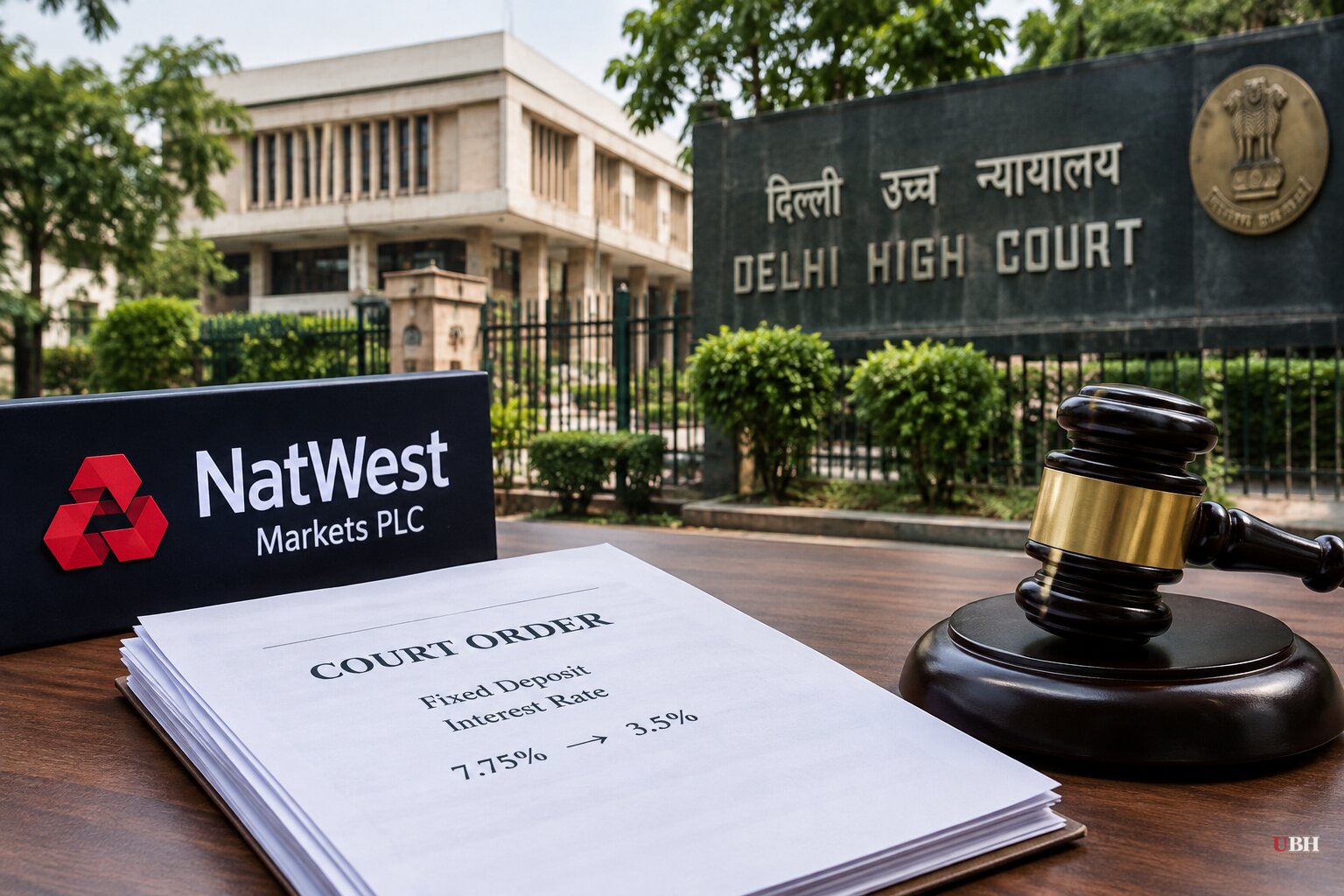
The Delhi High Court has ruled that NatWest Markets PLC cannot cut the interest on a court-ordered fixed deposit without a demonstrated basis and without telling anyone. A Division Bench of Justices Avneesh Jhingan and Shail Jain dismissed the bank's appeal on Sept. 23, 2026.
The case involves a ₹5.89 crore deposit that has been held under court order since 2008.
How a 2008 freeze became a bank dispute
The deposit traces to a commercial fight between Hero Exports and Tiffins Barrytes, Asbestos and Paints Limited. Before arbitration began, Hero Exports went to the High Court under Section 9 of the Arbitration and Conciliation Act, 1996, seeking interim protection.
On July 18, 2008, the court ordered that ₹8.5 crore in Tiffins Barrytes' bank accounts be secured. Of that, ₹5.89 crore sat with ABN Amro Bank, which later became part of Royal Bank of Scotland and is now NatWest Markets PLC.
The court directed the bank to hold the money in a fixed deposit earning the maximum rate of interest.
For nearly a decade, the bank paid 7.75%, then 8.25%, then 7.75% again. From Jan. 30, 2018, the rate dropped to 3.5%.
What surfaced in 2017 and 2018
In 2017, NatWest was winding down its operations and asked the arbitrator for permission to move the money to another bank. That application did not mention any reduction in the interest rate, the bench noted.
The Resolution Professional of Tiffins Barrytes later sought release of the funds. The bank disclosed that ₹11.22 crore was in the frozen account.
Hero Exports challenged the rate cut. In May 2019, a single judge ordered NatWest to deposit the entire amount with the High Court's Registrar General. The judge also ordered interest from Jan. 30, 2018 to be calculated at the average of the preceding three years' rates, which works out to roughly 7.9%.
The bank's argument
NatWest appealed. Its position rested on an RBI circular dated July 1, 2015. The bank said Clause 3.3 lets banks set their own interest rates on domestic term deposits. It said Clause 3.4 provides that a deposit not renewed after maturity earns only the savings bank rate.
On that reading, once the fixed deposit matured without renewal, 3.5% was permissible.
Why the bench rejected it
The bench read the same circular differently. Clause 3.3 does give banks discretion, but subject to a condition: banks may not discriminate in the interest paid on deposits accepted on the same date, whether at the same or different offices.
The court said NatWest produced no evidence that the rate on all similarly placed deposits was cut to 3.5%. In the bench's words, "no evidence was adduced to establish that the ROI on the FDR for all similarly placed customers was reduced to 3.5%."
The judges also noted that the money went into the deposit under a specific High Court direction to earn the maximum rate. They found no proof that NatWest told Hero Exports, Tiffins Barrytes or the court about the reduction. They found no proof either that the bank notified the parties the deposit had matured and needed renewal.
The court found no legal or factual error in the single judge's order and upheld it.
What the ruling does and does not settle
The judgment does not strip banks of their power to set deposit rates. The bench confirmed that discretion exists. What it requires is that the discretion be non-discriminatory and that the bank be able to prove it was applied evenly.
It also turns on the facts of a deposit sitting under judicial custody. Multiple reports describe the ruling as a general limit on rate cuts for court-ordered deposits, but the bench's reasoning centered on the missing evidence of equal treatment and the missing notice in this case.
The gap is large: the deposit earned 3.5% from January 2018, against roughly 7.9% under the single judge's formula, on a sum that the bank itself put at ₹11.22 crore when it came to light.
The exact interest owed from January 2018 will be calculated under the single judge's formula, and the money remains with the court while the arbitration dispute between Hero Exports and Tiffins Barrytes plays out.
Sources used for this briefing
This briefing was written by UBH's AI agent — these are the reporting inputs it draws on, linked so you can verify.


