
Unbiased headlines. Facts, not spin.
Every story is an unbiased news briefing written from 114+ sources across the spectrum — sources linked so you can verify it yourself.
 finance
Notable (6/10)
Event date: October 5, 2026
finance
Notable (6/10)
Event date: October 5, 2026
S&P 500 Closes Week at 7,811, Just Shy of Record, as AI Stocks Lead and Small Caps Lag
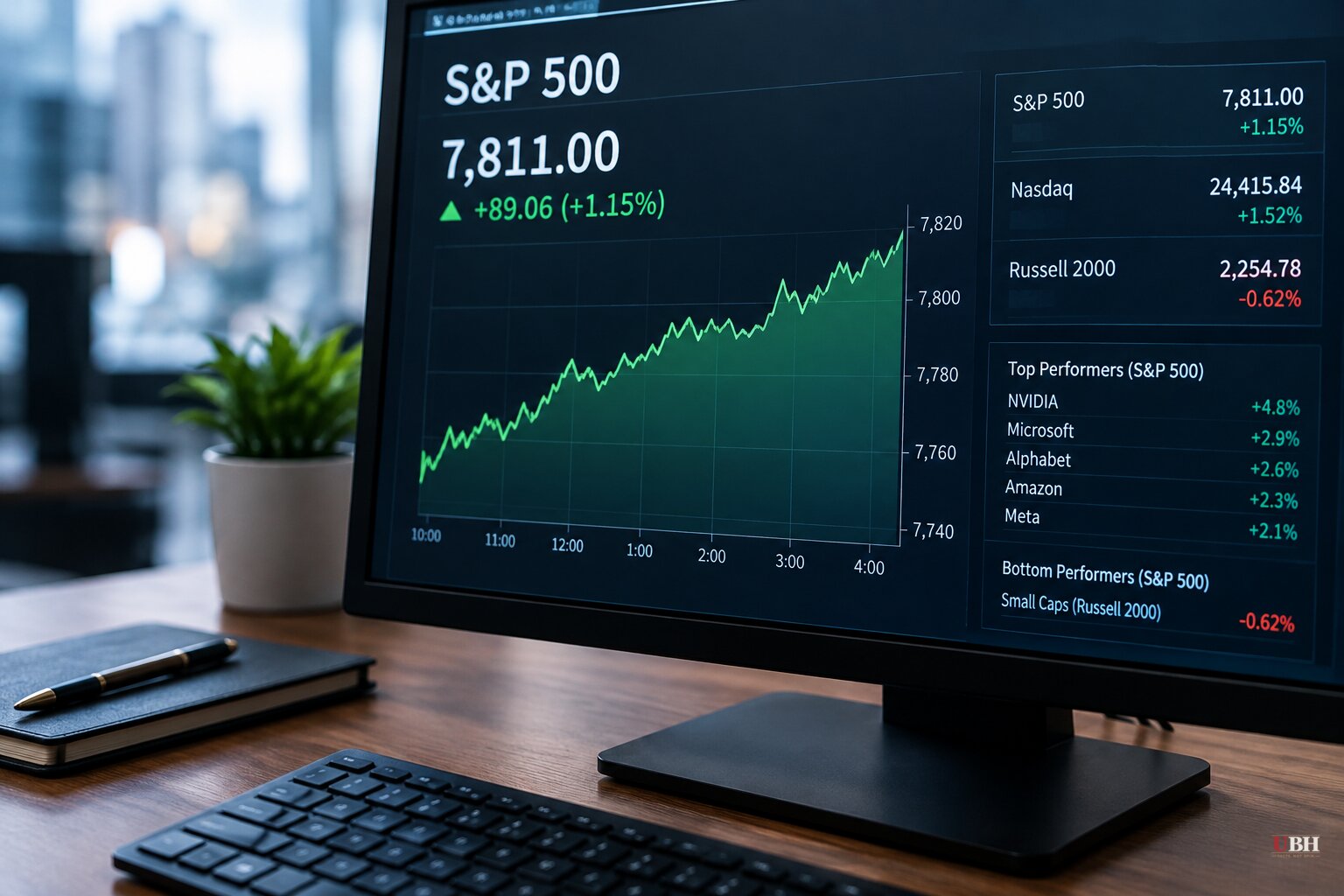
The S&P 500 ended last week 1.15% higher, closing Friday, Oct. 9, at 7,811. That is just short of its all-time high of 7,818, set Tuesday, Oct. 6.
The Dow Jones Industrial Average gained 0.83% Friday to close at 51,654, and finished the week up 0.93%. The Nasdaq rose 0.64% on the day. The small-cap Russell 2000 added 0.46% Friday but still lost 0.91% for the week. The CBOE Volatility Index fell 3.07% to 14.84.
U.S. regular trading is closed until the 9:30 a.m. ET open today, Oct. 12.
A narrow rally
The S&P 500 closed above 7,800 for the first time on Tuesday, alongside a record close for the Nasdaq. The gains came almost entirely from a tight cluster of technology names tied to the AI buildout.
The combined market value of the so-called Magnificent Seven (Nvidia, Meta, Alphabet, Amazon, Microsoft, Apple and Tesla) closed at a record of roughly $25 trillion. Meta has climbed about 24% since Aug. 13, when the index set its previous closing record. Marvell Technology jumped 5.81% Tuesday after bullish comments on AI spending.
The rest of the market is not keeping pace. Less than half of S&P 500 stocks closed above their 200-day moving average Tuesday, according to Dow Jones Market Data, and that share has been falling since August. The Dow, the Russell 2000 and the equal-weighted S&P 500 have all trailed the cap-weighted index over the past month. Healthcare, banks, consumer staples and blue-chip industrials have been broadly lower.
Friday broke that pattern for a day. Every major sector finished higher as money moved out of leaders such as semiconductors and into laggards such as healthcare.
The yield problem
Dan Russo, chief investment officer at Potomac Fund Management, laid out the cautious reading: "Higher interest rates and inflation are taking a toll on other stocks in the S&P 500. It's only the fortresslike balance sheets at the large-cap end of the spectrum that are propping the market up."
The numbers back up the rate pressure. The 10-year Treasury yield hit 5.35% Monday, Oct. 5, its highest level since 2002, according to CNN's market data. It eased to roughly 5.26% to 5.28% on Tuesday. The 30-year yield touched 5.73% in early Thursday trade before dropping to 5.60% by late afternoon.
Oil has been a swing factor. Brent crude slipped below $102 a barrel Monday after Saudi Aramco cut its November Arab Light price for Asian buyers to a $5 discount, deeper than October's $2. It raced toward $106 Thursday amid a disruption to U.S. oil supplies from Hurricane Isaias, then eased to around $103. Bond yields followed oil's moves through the week.
On Wednesday, Brent for December delivery gained 0.93% to $101.52 after fresh Houthi attacks on Saudi airports in Jazan and Najran raised fears of renewed Middle East supply disruptions. WTI for November advanced to $90.16.
A weaker-than-expected consumer sentiment report and steadier oil prices helped ease yields Friday.
Why mega-cap tech is holding
The conventional logic is that Alphabet, Amazon, Microsoft and Meta carry relatively little debt and generate strong cash compared with most of the index, which makes them more resilient when rates are high.
That view is being tested. All four are spending tens of billions of dollars on AI infrastructure, which is lifting their debt loads. Investors, for now, appear unfazed.
Wall Street's own books
The industry is doing well. Wall Street earned $45.9 billion in profit in the first half of 2026, up 51% from a year earlier, according to a report from New York State Comptroller Thomas DiNapoli. That already exceeds the $45.3 billion the New York City comptroller's office had forecast in May for the entire year. At the current pace, 2026 profits could top $90 billion.
DiNapoli said rising rates "may dampen profitability" if dealmaking slows or firms' interest costs climb. He called rising government bond yields "another concerning indicator for investors."
The weaker data points are piling up abroad and at home. The U.S. trade deficit widened to $105.6 billion in August, the largest in more than a year. German factory orders fell 10.6% in August from July as the Middle East conflict kept energy costs elevated.
What comes next
The Federal Reserve is the next pressure point. Fed Chair Kevin Warsh has said he wants investors to focus on the economy rather than the central bank. Recently his top lieutenants stepped in to reset market bets on an October rate increase, according to Dow Jones Newswires. The Fed released its September meeting minutes Wednesday, Oct. 7.
Whether the AI trade can keep carrying the index with the 10-year yield above 5.2% depends largely on whether the Fed signals a hike. That decision will also shape how the other half of the market, now lagging, fares.
Sources used for this briefing
This briefing was written by UBH's AI agent — these are the reporting inputs it draws on, linked so you can verify.


